Procedure
SMILE, Small Incision Lenticule Extraction
SMILE is the most recent of the three laser refractive surgery techniques. It is performed entirely with the femtosecond laser, with no excimer laser and no corneal flap. The laser outlines a thin disc of tissue inside the cornea, the lenticule, which I then remove through a micro-incision of 2 to 3 millimeters.
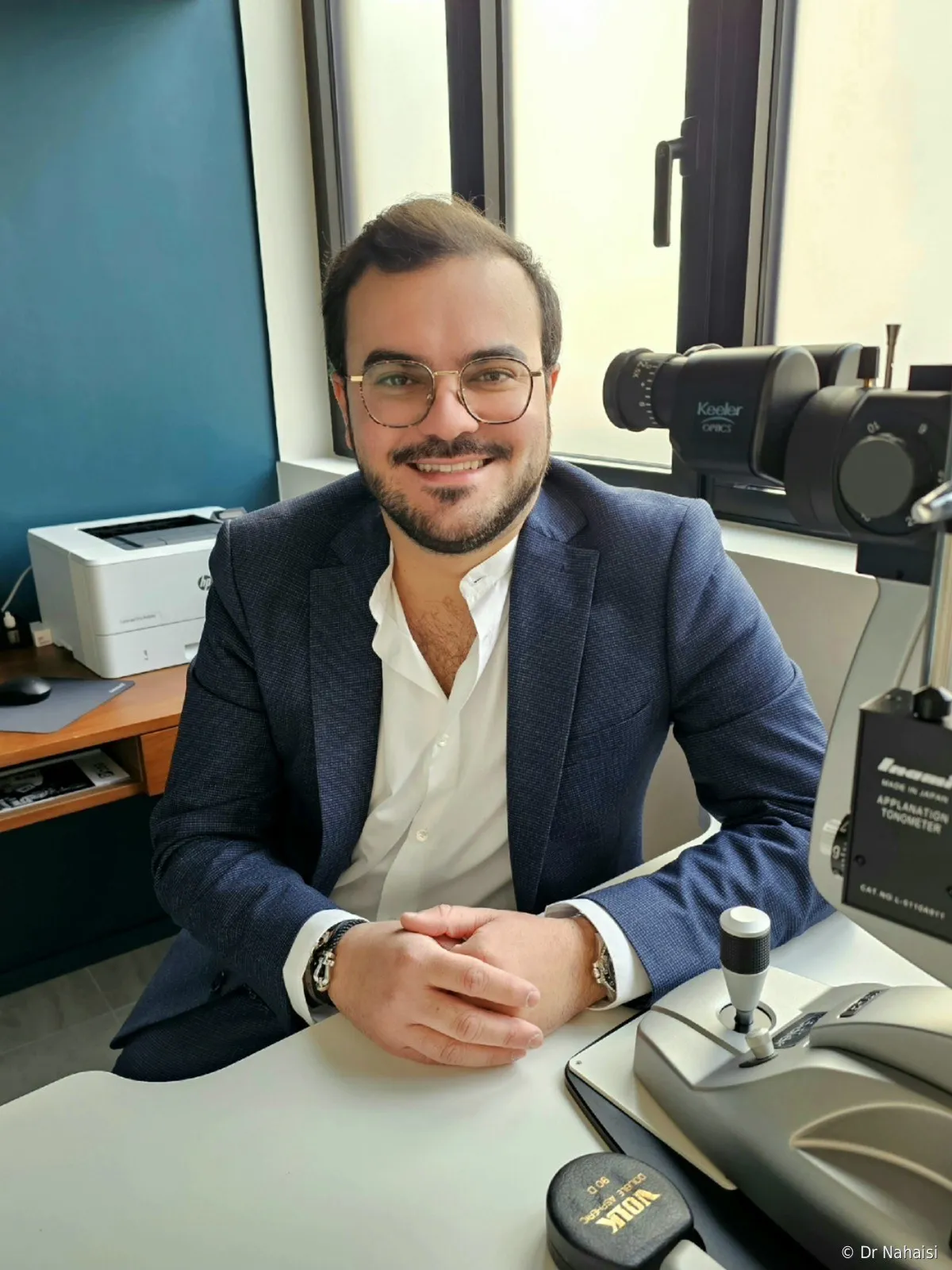
Dr Steven Nahaisi
Updated on 15 October 2026 · 30 min read
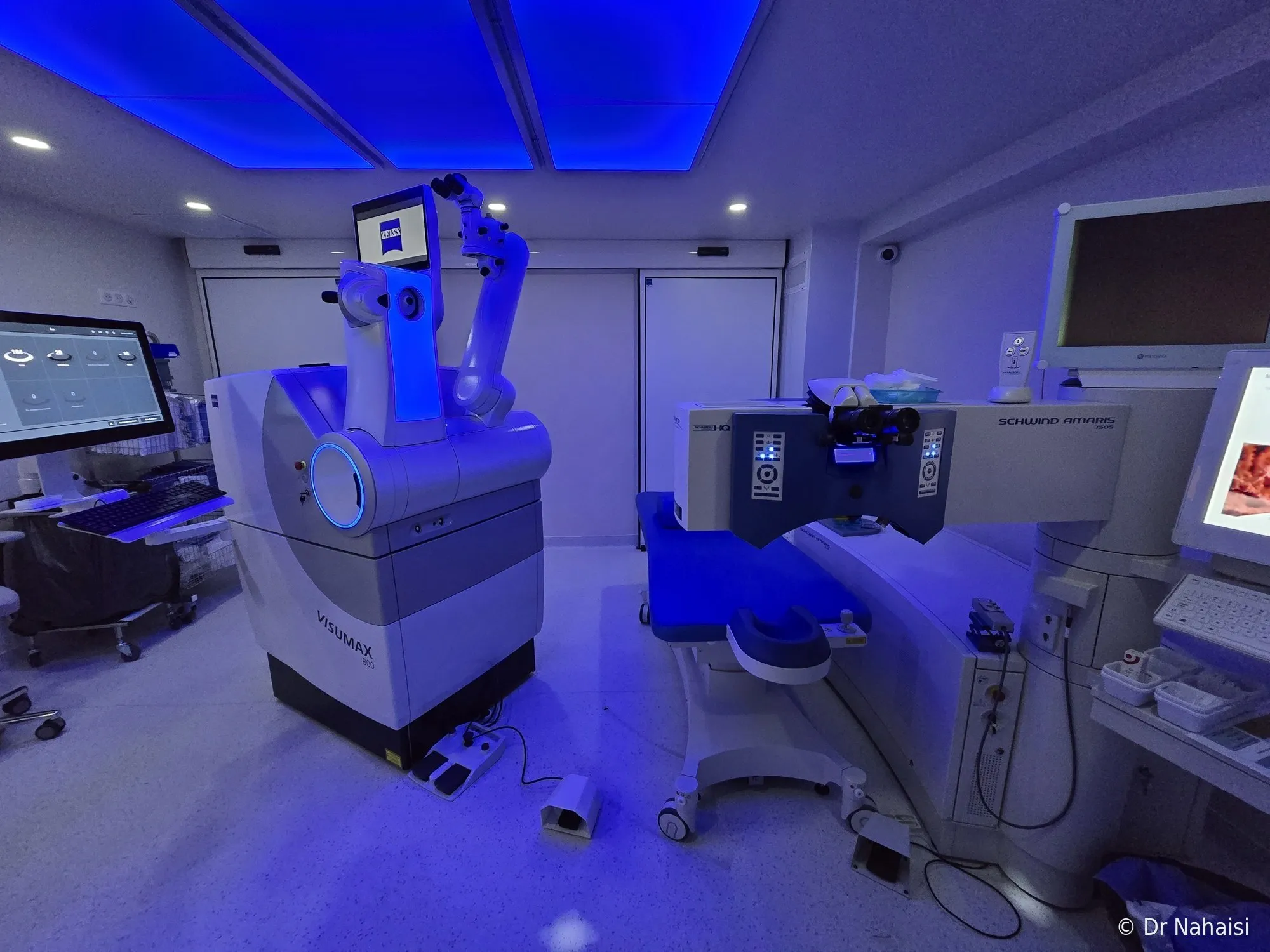
SMILE is performed at the Institut Laser Ophtalmologique Voltaire (Voltaire Laser Eye Institute), in Paris 11th (11e arrondissement), on the Zeiss Visumax 800 laser, the latest generation of femtosecond laser. It is the same machine that cuts the flap for my LASIK procedures.
On this page, I explain what SMILE is, how the procedure goes, who it is really for, what it cannot do, the recovery and the risks. I also answer the questions my patients ask me every week in consultation.
On this page13 sections
WHAT IS SMILE?
SMILE: definition and how the procedure works
SMILE is the acronym for Small Incision Lenticule Extraction, literally "extraction of a lenticule through a small incision." The name describes exactly what is done.
All laser refractive surgery has the same goal: to change the curvature of the cornea, the transparent tissue at the front of the eye that provides most of its optical power. What sets the techniques apart is how they reach the deep layer of the cornea, the stroma, and how they remove tissue from it.
LASIK lifts a flap to expose the stroma, then the excimer laser vaporizes tissue at its surface. TransPRK goes through the epithelium with the laser and sculpts the stroma at the surface, with no flap and no contact. SMILE works differently: nothing is vaporized, nothing is lifted. The femtosecond lasercuts, within the very thickness of the cornea, the two faces of a lens of tissue. This small disc is then removed in a single piece. The volume removed changes the curvature of the cornea, and vision is corrected.
The SMILE sequence, in four steps
1. The lasercuts the back face of the lenticule, deep in the stroma, according to the correction to be treated. The shape and thickness of this disc are calculated from your refraction.
2. The lasercuts the front face of the lenticule, which is more superficial, then a small peripheral incision of 2 to 3 millimeters that will serve as the entry point.
3. The lenticule is detached and removed through this micro-incision, using a fine instrument. This step requires precision, because the lenticule must come out whole.
4. The cornea closes on its own. There are no stitches, no bandage contact lens and no flap to reposition. The epithelium heals along the micro-incision within a few days.
A recent technique, with less long-term data than LASIK
SMILE came into routine practice in themid-2010s, on Zeiss femtosecond lasers. LASIK, on the other hand, has been performed on a large scale since the mid-1990s. To me, this twenty-year gap matters. When you offer someone elective surgery on a healthy eye, the depth of clinical experience is part of the argument.
THE STEPS OF SMILE
SMILE step by step
Everything is done under a single machine, with no change of laser or of position of the operating bed between steps. It is a simple, short sequence.
Step 1: positioning and anesthesia
You lie comfortably under the laser. Anesthesia is given by drops only, with no general anesthesia and no injection. An eyelid holder keeps your eye open without any effort on your part. Your eye cannot close during surgery; this is a common worry in consultation, and it is unfounded.
Step 2: docking the eye to the laser
The Visumax 800 works in contact with a curved interface placed on the eye, held by gentle suction. You look at a green light. You see this light come closer, then your vision becomes hazy for a few seconds. The pressure you feel is much lighter than with previous generations of femtosecond lasers, and it is never painful.
This docking phase matters a great deal in SMILE. Because the lenticule is cut in a single pass, the position of the eye at the moment of cutting determines the centering of the treatment. I take the time needed for the alignment to be correct before starting the laser.
Step 3: cutting the lenticule
The laser successively traces the two faces of the lenticule, then the peripheral micro-incision. The cut takes about 14 seconds per eye. You feel nothing, apart from the haze already described. No instrument comes into contact with the inside of the cornea during this step: the laser works at a distance, through the superficial layers, which remain intact.
Unlike LASIK and TransPRK, there is no burning smell during SMILE. This smell is specific to the excimer laser, which is not used here.
Step 4: removing the lenticule
I then separate the lenticule from the surrounding layers, and remove it through the micro-incision, in a single piece. You may feel slight tugging and see shadows crossing your field of vision. It is brief and painless.
This is the part of the operation that requires the most technique. The lenticule is very thin, and it must come out complete. An incomplete extraction would require finding the remaining fragment, which makes the procedure longer.
Step 5: the end of the procedure
I rinse the surface, check the interface, and that eye is done. No flap to put back, no bandage contact lens to place. We then move on to the second eye.
Your time in the operating room remains very short, about ten minutes for both eyes. I explain each step as we go, and there is always some music playing to ease the atmosphere. I sometimes hum during the procedure, as my patients will tell you.
Summary of the steps and their duration
| Step | Tool | Approximate duration |
|---|---|---|
| Docking the eye | Curved interface, gentle suction | ≈ 20 seconds |
| Cutting the lenticule and the micro-incision | Visumax 800 (femtosecond) | ≈ 14 seconds per eye |
| Separating and removing the lenticule | Manual step | ≈ 30 to 60 seconds |
| Rinsing and checking | Manual step | ≈ 15 seconds |
THE LASER USED
Zeiss Visumax 800: a single laser, from start to finish
SMILE uses only one machine, the Zeiss Visumax 800 femtosecond laser. No excimer laser is involved. The Institut Voltaire is one of the few centers in Paris to have this platform, which went into service in March 2024.
The operating room at the Institut Laser Ophtalmologique Voltaire. On the left, the Zeiss Visumax 800 femtosecond laser, which performs the entire SMILE procedure on its own: it cuts the lenticule inside the cornea, then the micro-incision through which I remove it. On the right, the Schwind Amaris 750S excimer laser, which is not used during SMILE, unlike LASIK and TransPRK.
How a femtosecond laser works
The Visumax 800 works by photodisruption. It emits pulses lasting on the order of a millionth of a billionth of a second, which create microscopic gas bubbles inside the stroma. These bubbles line up with one another and form a cleavage plane in the tissue, with no heat transfer and no mechanical incision.
This is the same technology that cuts the flap in LASIK. The difference lies in the geometry: in LASIK, the laser creates a single plane and a hinge; in SMILE, it creates a closed volume, the lenticule.
What the Visumax 800 brings to SMILE
- A fast cut, about 14 seconds per eye.
- Lower suction pressure compared with earlier generations of femtosecond lasers. The sensation during docking is noticeably more comfortable.
- An even distribution of gas bubbles, which makes separating the lenticule cleaner and removing it simpler. Older femtosecond lasers could leave poorly separated areas, which made the step more difficult.
- No heat transfer to the surrounding corneal tissue.
What SMILE does not use.
The Schwind Amaris 750S excimer laser, which I use for LASIK and TransPRK, offers functions that have no direct equivalent in SMILE. This is a technical point that few websites explain, and it weighs in mypreference for LASIK:
The excimer treats the cornea point by point, based on the complete aberrometry map of your eye measured just before the procedure. Each point of the surface receives the exact ablation that corresponds to it. SMILE, by contrast, sculpts a lenticule whose geometry is calculated from your prescription. The approach is more global, less fine-tuned.
The excimer also benefits from iris recognition and from eye-tracking that follows the eye throughout the treatment, including during involuntary micro-saccades of the gaze. In SMILE, the eye is held still by the interface during the cut, which addresses the issue differently, but centering is determined at the moment of docking.
These differences do not prevent very good results with SMILE on pure myopia. They explain why I consider LASIK more precise as soon as there is astigmatism or a particular aberrometric profile.
Understanding aberrometry and customized treatment
Summary: which laser for which technique
| Technique | Femtosecond (Visumax 800) | Excimer (Schwind Amaris 750S) |
|---|---|---|
| LASIK | Cutting the corneal flap | Sculpting the stroma |
| TransPRK | Not used | Removal of the epithelium, then sculpting of the stroma |
| SMILE | Performs the entire treatment | Not used |
| PresbyLASIK | Cutting the corneal flap | Multifocal sculpting of the stroma |
WHO IS SMILE FOR?
SMILE: indications and candidacy criteria
SMILE is a technique for myopia. That is its territory, and that is where it gives its best results. The thresholds I apply at the Institut Voltaire:
| Refractive error | Treatment with SMILE |
|---|---|
| Myopia | Up to ≈ -10 diopters |
| Astigmatism | Up to ≈ -3 diopters, with lower precision than LASIK |
| Hyperopia | Cannot be treated with SMILE |
| Presbyopia | Cannot be treated with SMILE, see the PresbyLASIK page |
These limits are indicative. The final decision depends on the characteristics of your cornea and your profile, assessed during the pre-operative assessment.
Situations where I offer SMILE
High-level combat sports with a quick return. This is my main indication, and by far the most common. When a patient practices boxing, MMA or martial arts at a level where blows are regular and sometimes bare-handed, having no flap removes a variable for life. TransPRK meets the same need, but it involves 7 to 10 days of reduced visual autonomy. A high-level athlete, or a patient who cannot stop for a week, finds in SMILE a consistent answer: no flap, and a fast recovery.
Patients who want to avoid a flap without a longer recovery. Some people are genuinely bothered by the idea of a corneal flap, by the fact that it stays there for life, or by the risk of traumatic displacement. I explain that this risk is very low after the first 48 hours, and that is enough to reassure most people. For those who remain concerned, SMILE is an option, provided the correction is suitable. We don't just operate on eyes, we operate on patients, and a worry that persists after explanation deserves to be taken seriously.
Corneal criteria in the pre-operative assessment
Candidacy for SMILE follows the same corneal safety rules as LASIK. It never comes down to corneal thickness alone, contrary to a still very widespread belief. Several parameters are analyzed during the assessment:
- Total corneal thickness, measured by pachymetry. The usual safety threshold is about 500 microns.
- Mean and maximum anterior corneal curvature, keratometry.
- Posterior corneal curvature, which makes it possible to detect early keratoconus.
- Epithelial thickness and its distribution on the map.
- The residual posterior stromal bed calculated after removal of the lenticule.
- The percentage of tissue removed relative to the total corneal volume.
- Your eye habits: repeated rubbing, pressure on the eyeballs during sleep. These are risk factors I take into account.
The residual posterior stromal bed
The residual posterior stromal bed is the thickness of healthy stroma that remains under the treated area. Its value determines the long-term biomechanical stability of the cornea and the risk of post-operative ectasia.
The standard safety threshold is 250 to 280 microns. I set myself a more cautious limit, at 300 microns, for all my laser techniques. When the calculation falls below this value, I don't look for a compromise: I turn to TransPRK, which creates neither a flap nor a lenticule and preserves more stroma.
Confirmed keratoconus, or even a cornea showing its first signs, is a contraindication to SMILE just as it is to LASIK. The fact that SMILE does not create a flap does not make it acceptable on a fragile cornea.
MY POSITION ON SMILE
Why I perform few SMILE procedures, and why I'm telling you
We have SMILE at the Institut Voltaire andI perform it. It is not my preferred technique, and I would rather write that here than let you discover it in consultation.
Three reasons.
The quality of correction. LASIK gives me finer results, especially as soon as astigmatism is involved. Point-by-point excimer treatment, guided bythe aberrometry of your eye, works at a scale that cutting a lenticule does not reach. On pure, moderate myopia, the gap narrows considerably. On somewhat unusual profiles, it widens.
Enhancement options. After LASIK, if a small residual correction remains, I lift the existing flap again and readjust with the excimer laser. The step is simple and well mastered. After SMILE, there is no such flap: the retreatment is done either by surface TransPRK, with the recovery that comes with it, or by creating a flap afterward for LASIK. The choice between the two is made case by case. This weighs in my choice, because a possible enhancement is part of what I must anticipate on the day I decide on the technique.
Clinical experience. LASIK has been performed on a large scale for more than twenty-five years. Its long-term behavior, limits and complications are well known. SMILE is younger. That does not mean it is risky; it means we know less about it.
About the extra cost
SMILE costs €600 more than LASIK. This difference is explained by the cost of using the Visumax 800 per treatment, which is higher than that of a treatment combining the two lasers. I charge it at what it costs me, with no additional margin.
But I owe you my opinion: in most situations, this extra cost does not seem to me justified by the benefit it brings. When the indication is there, combat sports, marked apprehension about the flap, I offer SMILE without hesitation and the extra cost is fully justified. When it isn't, I will tell you that LASIK will serve you better, and that it will cost you less.
About what other surgeons say
Some colleagues see things differently from me and operate mostly with SMILE. They are competent surgeons, and their patients are satisfied. I simply think that, in the way this technique is presented to the public, there is a share of marketing that goes beyond what the data allow us to claim. The word "minimally invasive" has a lot to do with it.
If you consult several surgeons and hear two different views, that is normal. Take the time to meet the surgeons, listen to their arguments, and choose based on how you feel. The machine and the fee matter. Your relationship with your surgeon will matter more.
WHEN SMILE IS NOT THE BEST OPTION
Situations where I prefer another technique
Hyperopia. SMILE does not correct it. The technique removes tissue from the center of the cornea, which flattens it. Correcting hyperopia requires the opposite, steepening the center byremoving tissue at the periphery. For a farsighted patient, the choice is between LASIK and TransPRK.
Significant astigmatism. SMILE corrects astigmatism, but with lower precision than LASIK. The cylindrical treatment depends heavily on the alignment of the lenticule, and compensation for cyclotorsion, the slight rotation of the eye between the sitting and lying positions, is less direct than with the iris recognition of the excimer. As soon as astigmatism becomes a significant component of your correction, I will steer you toward LASIK.
Presbyopia. SMILE does not offer a multifocal profile. Laser correction of presbyopia is done with PresbyLASIK, monovision or a hybrid strategy.
Laser correction of presbyopia in Paris
A thin cornea or an at-risk corneal profile. SMILE remains an intrastromal surgery: it uses up corneal thickness. When the calculated residual stromal bed falls below my limit of 300 microns, or when the cornea shows subtle signs of fragility, I turn to TransPRK. With no flap and no lenticule, it preserves more stroma and offers the best biomechanical safety of the three techniques.
A high correction with a likely enhancement. For some high myopias, the probability of having to fine-tune the result is higher. In these cases, I prefer a technique where the enhancement is simple. This is reasoning I do before the procedure, not after.
Beyond the limits of the laser. For very high myopia, or when the cornea is incompatible with corneal laser surgery, such as keratoconus or early ectasia, other options exist. The phakic implant, the ICL, is a lens placed inside the eye, behind the iris, which corrects high refractive errors without touching the cornea. When this option is best suited to your case, I refer you to a specialized colleague.
HOW THE PROCEDURE GOES
What a SMILE procedure at the Institut Voltaire is like
Here I describe the procedure itself. A separate page covers all the practical details: the appointment notice, the prescription, the anti-anxiety tablet, removing contact lenses, arriving at the clinic, changing into the gown, going home, the first check-up.
Surgery day: preparation and practical details
Before the procedure
You take an anti-anxiety tablet about an hour before. There is no need to fast. When you arrive, after the administrative formalities and the last eye images, you change into a sterile gown and are taken to the pre-op room.
In the operating room, you lie under the Visumax 800. I put in the anesthetic drops. The entire surgery is done under local anesthesia with drops: no general anesthesia, no injection. An eyelid holder keeps the eye open without any effort on your part.
Under the laser
For each eye, the sequence is the same: docking to the interface, cutting the lenticule and the micro-incision, separating then removing the lenticule, rinsing. We then move on to the second eye.
The laser itself works for only about fifteen seconds per eye. The rest of the time is taken up by positioning, the explanations I give you as we go, and the extraction step. Your time in the operating room is very short, about ten minutes for both eyes.
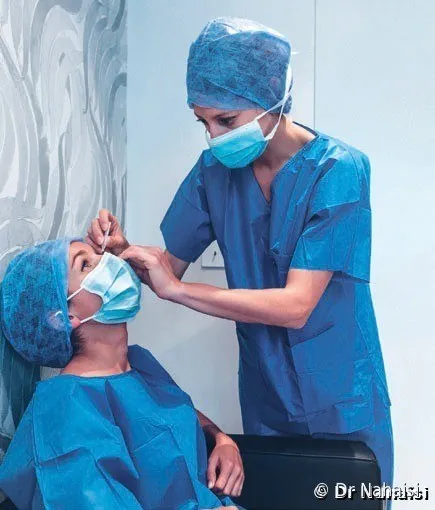
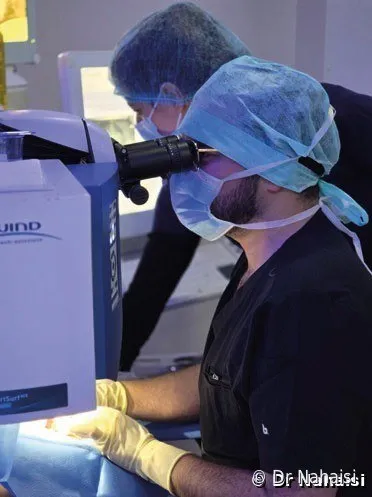
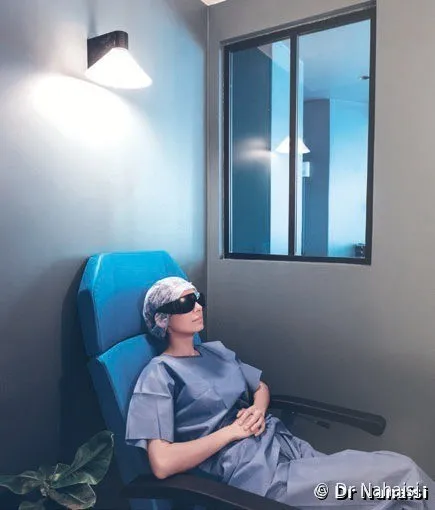
The three stages of surgery day at the Institut Voltaire. On the left, preparation and instillation of the anesthetic drops. In the center, the procedure under the laser. On the right, the recovery room, where you stay until the first sensations settle down.
Right after the procedure
You go to the recovery room for a short rest, until the first sensations settle. I give you UV-protective glasses. After SMILE, there is no need for eye shields at night. My secretaries schedule your first check-up, and I go over the instructions for the first few days again before you leave.
You can go home accompanied, which is what I recommend, or alone by taxi or ride-hailing service. You will not be fit to drive in the hours following the procedure.
Surgery and the check-up
I operate on Friday mornings at the Institut Laser Ophtalmologique Voltaire, 5 rue La Vacquerie in Paris 11th. The first check-up takes place the following Monday afternoon, at my office in Paris 19th (19e arrondissement), rue Archereau. It is a short consultation: checking the cornea, making sure there is no inflammation, measuring the visual acuity achieved. Further check-ups are scheduled at 1 month, then at 3 months or later depending on your situation.
RECOVERY AFTER SMILE
Visual recovery and post-SMILE instructions
The first few hours
Right after the procedure, you see through a haze, like a fog. Behind this haze, you can already tell that your vision is sharper. People with high corrections often describe a striking effect within the first few minutes.
This discomfort comes with stinging, watery eyes and sensitivity to light, with the urge to keep your eyes closed. It lasts a few hours. Most of my patients go home and take a nap thanks to the anti-anxiety tablet, and wake up feeling much better.
The first few days
Recovery after SMILE is comparable to LASIK. Most of your vision returns within the first 24 to 48 hours. The difference, when there is one, is a visual haze that sometimes lasts a little longer: some patients describe slightly milky or less contrasted vision that takes a few more days to clear than after LASIK. It always fades in the end, but it is good to know beforehand, so as not to worry about it.
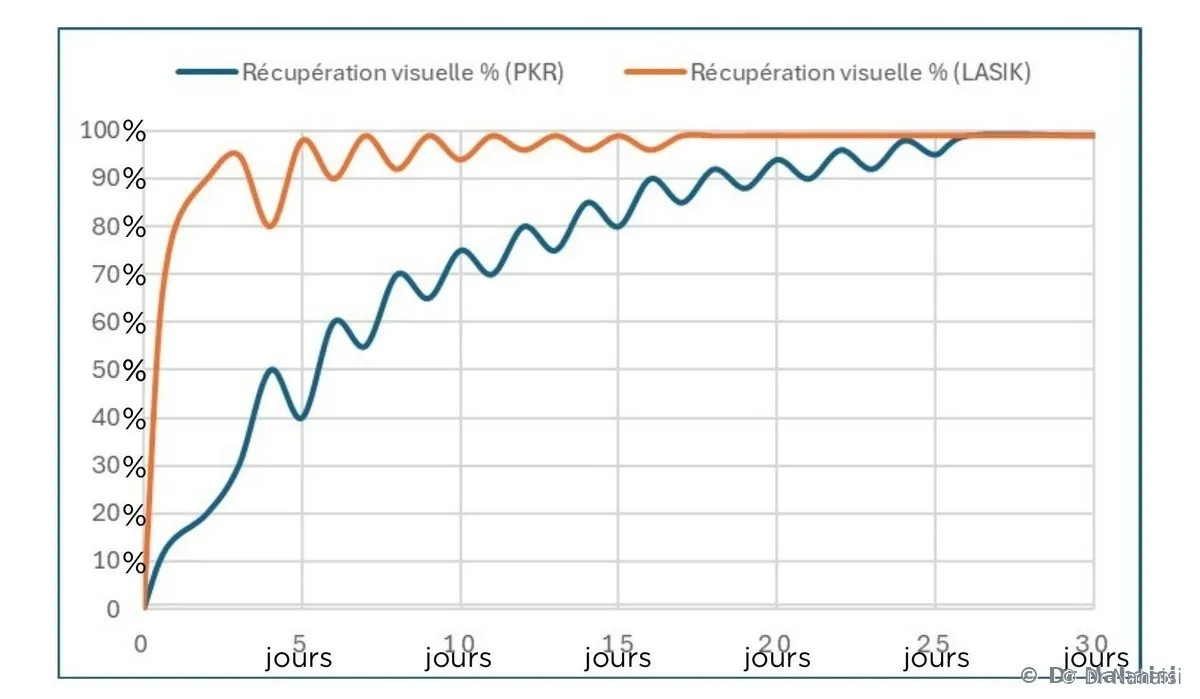
Visual recovery over 30 days, taken from my booklet. The SMILE curve follows the LASIK curve, in orange: vision is already usable the next day, then it stabilizes over a few weeks. TransPRK, in blue, rises more slowly. The green curve shows the discomfort felt, which fades within the first few days.
The first 48 hours: instructions
- Do not rub or touch your eyes. This is the most important instruction, as after LASIK.
- No eye shields at night after SMILE: there is no flap to protect. The instruction that matters is not to rub.
- UV-protective sunglasses outdoors, for light comfort.
- No shower directly on the face for the first few days. A damp washcloth around the eyes is enough.
- No eye makeup for one week.
- No swimming pool, steam room or sauna for two weeks.
Returning to your activities
Most of my patients go back to work the very next day, screens included. The first day is a bit tiring, but manageable. Driving is generally possible again the next day, once vision has stabilized.
Non-contact sports can resume the next day. For combat sports, which are often the very reason for choosing SMILE, you can resume at three weeks, once the micro-incision has fully healed. After this period, having no flap protects you from the only mechanical risk specific to LASIK.
If you work in a dusty environment or one exposed to chemicals, wide protective glasses generally allow you to return the next day. I can provide a sick note (time off work) on a case-by-case basis, typically from Friday to the following Tuesday or Wednesday.
Post-operative eye drops
You use eye drops for about one month, on a tapering schedule:
- An antibiotic combined with an anti-inflammatory, such as Tobradex: 4 drops a day for 5 days, then 3 drops a day for 5 days, then 2 drops a day for 5 days.
- Preservative-free artificial tears, such as Vismed or Hyabak: 4 to 6 times a day for one month, then as needed.
- Dacudose to rinse the eye in case of discomfort or dust. Optional most of the time.
To apply them, stand in front of a mirror and gently pull the lower eyelid down, pulling on the cheek rather than on the eyelid itself. Never on the upper eyelid. One drop placed in the pocket formed under the eye is enough.
Temporary effects in the first few weeks
Several normal phenomena may appear in the first few weeks:
- Dry eye in the first few weeks, relieved by artificial tears. On paper, SMILE spares the corneal nerve fibers more, since the micro-incision is much shorter than the peripheral cut of a flap. In practice, my patients describe roughly the same sensations after SMILE and after LASIK.
- Halos around lights and increased sensitivity to light in low lighting, with a temporary increase and a peak around the 2nd month, then a gradual decrease. Car headlights look a little spread out. Final night vision is generally better than before the procedure.
- Visual fatigue on screens, with headaches at the end of the day, which fades within a few weeks.
- Difficulty focusing in the first few days. The eye takes a little time to adjust its focus. I often say it feels like being a digital camera for a few days.
- Visual fluctuations from one day to the next and from one eye to the other. Recovery is never perfectly linear. Everything evens out over about one month.
These are part of the normal recovery and do not indicate any flaw in the treatment. The cornea gradually stabilizes over 1 to 3 months.
RISKS AND COMPLICATIONS
SMILE: the risks explained
SMILE is a well-established surgery, with a high satisfaction rate. Like any procedure, it carries possible side effects and complications. They remain rare, and you need to know about them to make an informed decision.
Dry eye
This is the most common effect after any corneal refractive surgery. With SMILE, it is generally slightly less pronounced than after LASIK, without a major difference. The 2 to 3 millimeter micro-incision cuts far fewer corneal nerve fibers than the peripheral cut of a flap, so the surface nerve supply is less disrupted.
Dry eye remains possible, especially in the first few weeks. It is treated with preservative-free artificial tears. In the rare more pronounced cases, I have a complete range of treatments: stronger tears, tear gels in the evening, sometimes doxycycline tablets in particular cases, notably dermatological ones.
Prolonged visual haze
Some patients describe slightly milky or less contrasted vision for a few more days than after LASIK. This is related to the interface left by the removal of the lenticule, which takes a little time to become perfectly transparent. It clears up. I mention it because it is the comment I hear most often at check-ups after SMILE.
Halos and night vision
Halos around lights, glare and slightly reduced night vision can appear in the first few weeks, with a peak around the 2nd month. This is temporary and gradually fades in almost all patients. At 6 months and at one year, night vision is generally better than before the procedure.
Difficulties removing the lenticule
This is the complication specific to SMILE. The lenticule must come out whole through an incision a few millimeters long. It can tear, or a fragment can remain in place, which means it has to be found and removed. This makes the procedure longer and can delay visual recovery.
Small tears at the edges of the micro-incision have also been described. They heal with no consequence for the result.
The quality of the cut plays a big role in this risk. The Visumax 800 separates the lenticule much more cleanly than earlier generations of femtosecond lasers, which makes extraction simpler and more reproducible.
An imperfect result and enhancement
Part of the correction may be missing, or the result may not be exactly the one aimed for. After SMILE, an enhancement is less simple than after LASIK. There is no flap to lift again, so the retreatment is done differently: either by surface TransPRK, with its 7 to 10 days of recovery, or by creating a flap afterward to perform LASIK. Both routes work and make it possible to reach the target result; they simply ask more of the patient.
The enhancement is included in the initial fee during the first year. After that, it is offered at a preferential rate up to 5 years after surgery.
Serious complications
Infection, corneal ectasia and lasting loss of visual quality are exceptional events. They occur mainly when pre-operative safety criteria have not been strictly followed. As with any surgery, zero risk does not exist. I carry out a complete assessment beforehand and remain very selective on candidacy criteria, precisely to minimize these risks.
SMILE does not touch the optic nerve, the retina or the internal structures of the eye. It does not cause blindness in the usual sense of the word. Like any surgery, it can in exceptional cases lead to reduced visual quality, a loss of lines of corrected acuity, significant dryness or bothersome light phenomena. These situations remain rare, and the purpose of the pre-operative assessment is to reduce them as much as possible.
DURABILITY, ENHANCEMENT AND FOLLOW-UP
SMILE results over time
A lasting result
The correction obtained by removing the lenticule is lasting. The corneal stroma does not regenerate after tissue is removed, so the new curvature is maintained over time. You will never go back to your original refractive error.
A slight change remains theoretically possible over 10 to 15 years, on the order of 0.25 or 0.50 diopter. It is minimal. If it bothered you, a laser retreatment is possible in most cases, as described above.
The natural evolution of the eye remains independent
SMILE acts on the cornea. It changes neither the length of the eye nor the lens. The natural evolution of your vision continues normally from the day of the procedure. Two phenomena occur with age, independently of the surgery:
- Presbyopia, which appears around age 40 to 45 in everyone, whether they have had surgery or not. If it bothers you, strategies exist, PresbyLASIK or blended vision (monovision), and I will discuss them with you when the time comes.
- Cataracts, which typically appear after age 60 to 65. They are treated with a specific lens surgery, independent of SMILE. Having had laser surgery does not complicate cataract surgery.
Post-operative follow-up
Follow-up is included in the fee, with no limit on the number of consultations. You can contact me again at any time by message and come in for a consultation as often as needed. I remain available. The relationship I build with each patient does not end on surgery day.
A possible enhancement is included during the first year. After that, up to 5 years, it is offered at a preferential rate.
FEES AND COVERAGE
How much does SMILE eye surgery cost in Paris
SMILE fee: €3,800 for both eyes, i.e. €1,900 per eye. The fee is fixed, whatever the correction to be treated.
That is €600 more than LASIK. This difference comes from the cost of using the Visumax 800 per treatment, which is higher than that of a procedure combining the femtosecond and excimer lasers. My fees are aligned with those of my colleagues at the Institut Voltaire.
What the fee includes
- The procedure, using the Zeiss Visumax 800 laser.
- Clinic fees at the Institut Voltaire.
- Complete post-operative follow-up, with no limit on the number of consultations.
- A possible enhancement during the first year.
- Prescriptions for post-operative medication.
The pre-operative consultation
The pre-operative consultation is charged at the standard rate set by French national health insurance. The arrangements differ depending on the location:
- Offices in Paris 10th (10e arrondissement) and 19th: nothing to pay upfront (direct billing).
- Institut Voltaire (Paris 11th): €50 paid upfront, including a €30 fee supplement (above the standard rate). Your complementary health insurance reimburses at least €20, and often the full amount depending on your plan.
You do not need a referral letter or a prescription from another ophthalmologist to book an appointment.
Payment
Payment is made on surgery day, at the front desk, before the procedure. Accepted methods: bank card, check, bank transfer or direct debit. Payment in 4 installments is possible, by check or direct debit.
Complementary health insurance does not pay the clinic directly. You are the one reimbursed upon presentation of the invoice. If your complementary health insurance covers a significant amount, a payment corresponding to that sum can be deferred and cashed only once you have received your reimbursement. I can send you a quote for your complementary health insurance before the procedure.
Frequently asked questions
Your questions about SMILE eye surgery
Do you perform SMILE laser eye surgery?
Yes, SMILE is available at the Institut Voltaire and I offer it when the indication is there. It is not my first-line technique for myopia: I prefer LASIK, which I find superior in quality of correction, enhancement options and clinical experience. I reserve SMILE for targeted indications, mainly high-level combat sports requiring a quick return, and patients who wish to avoid a flap without a longer recovery.
What is the difference between SMILE and LASIK?
LASIK uses two lasers: the femtosecond cuts a corneal flap, the excimer sculpts the stroma underneath, then the flap is repositioned. SMILE uses only the femtosecond: it cuts a lenticule inside the cornea, which I remove through a micro-incision of 2 to 3 mm. No flap. On pure myopia, the results are similar. LASIK remains more precise on astigmatism, allows simpler enhancements and has longer clinical experience behind it. SMILE avoids the flap and its lifelong constraint.
What is the difference between SMILE and TransPRK?
Both techniques do without a flap. TransPRK is a surface treatment with the excimer laser, with no contact with the eye, with a recovery of 7 to 10 days and an uncomfortable period of 48 to 72 hours. SMILE works inside the cornea with the femtosecond laser, with a recovery of 24 to 48 hours and little pain afterward. TransPRK better preserves corneal thickness and is suitable for thin corneas. SMILE requires more tissue, but gives you back your autonomy much faster.
Does SMILE hurt?
No. The procedure is done under anesthesia with drops and is painless. You feel gentle pressure while the eye is docked to the laser, then brief tugging during removal of the lenticule. The first few hours are uncomfortable, with watery eyes, stinging and sensitivity to light. A nap is usually enough to get through it.
How long does SMILE surgery take?
About ten minutes for both eyes. The laser itself works for only about fifteen seconds per eye. The rest of the time is taken up by positioning, the explanations I give you at each step, and removing the lenticule.
Does SMILE correct hyperopia?
No. SMILE removes tissue from the center of the cornea, which flattens it. Correcting hyperopia requires steepening the center, by removing tissue at the periphery. For hyperopia, the choice is between LASIK and TransPRK.
Does SMILE correct astigmatism?
It does, but less precisely than LASIK. The cylindrical treatment depends heavily on the alignment of the lenticule, and SMILE does not benefit from the iris recognition of the excimer laser, which automatically compensates for the rotation of the eye between the sitting and lying positions. As soon as astigmatism weighs in your correction, I will steer you toward LASIK.
Can an enhancement be done after SMILE?
Yes, but it is less simple than after LASIK. After LASIK, the existing flap is lifted again and readjusted with the excimer laser; it is a quick step. After SMILE, there is no such flap. The retreatment is done either by surface TransPRK, with 7 to 10 days of recovery, or by creating a flap afterward for LASIK. Both options make it possible to reach the target result. The enhancement is included in the first year and offered at a preferential rate up to 5 years.
Why does SMILE cost more than LASIK?
Because the cost of using the Visumax 800 per treatment is higher. SMILE is €3,800 for both eyes, LASIK €3,200. I charge this difference at what it costs me. I will also tell you honestly that, in most situations, this extra cost does not seem to me justified by the benefit it brings. When the indication is there, it is fully justified.
Is SMILE really less invasive than LASIK?
The incision is smaller, that is a fact, and the surface corneal nerve supply is less disrupted. But SMILE remains an intrastromal surgery that uses up corneal thickness, like LASIK. The term "minimally invasive" is widely used in marketing and deserves to be qualified. What SMILE really brings is the absence of a flap.
I practice a combat sport. Is SMILE right for me?
It is my main indication for this technique, provided your correction is suitable. With no flap, there is no later risk of traumatic displacement, and the recovery allows you to get back to work very quickly. TransPRK meets the same need for mechanical safety, but it involves a week of reduced visual autonomy. If that delay is a problem for you, SMILE becomes the right answer. We discuss it in consultation, after the assessment.
When can I go back to work after SMILE?
Most patients go back the very next day, screens included. The first day is a bit tiring. I can provide a sick note (time off work) on a case-by-case basis, typically from Friday, surgery day, to the following Tuesday or Wednesday.
When can I drive after SMILE?
Generally from the next day, once vision has stabilized and after the first check-up if it takes place soon. On the day of the procedure, you cannot drive. You need to go home accompanied, or alone by taxi or ride-hailing service.
When can I get back to sports after SMILE?
Non-contact sports: from the next day. Combat sports and ball sports with a risk of a direct blow: at three weeks, once the micro-incision has fully healed. Swimming, pool, steam room and sauna: after two weeks.
When can I fly after SMILE?
Flying poses no particular problem. You can travel from the next day if your activity requires it. Take your artificial tears with you; the air conditioning in the cabin is drying.
When can I wear makeup after SMILE?
No eye makeup for one week, to avoid any contact or particles on the operated area. Makeup on the rest of the face is possible from the next day.
Can I rub my eyes after SMILE?
Not during the first few days, while the micro-incision heals. After that, there is no flap that could move, so the constraint is less than after LASIK. In the long term, I recommend that all my patients limit chronic eye rubbing, which weakens the cornea. This is general eye-care advice, independent of the surgery.
Is dry eye less significant after SMILE?
In theory, yes: the micro-incision cuts far fewer corneal nerve fibers than the peripheral cut of a flap. In my experience, the differencefelt by patients is small, and temporary dryness in the first few weeks remains possible in both cases. It is treated with preservative-free artificial tears.
Are SMILE results lasting?
Yes. The stromal tissue removed does not regenerate, so the cornea keeps the new shape obtained. A slight change is possible over 10 to 15 years, on the order of 0.25 to 0.50 diopter; it remains minimal. The natural evolution of the eye with age, presbyopia after 40 to 45 and cataracts after 60 to 65, occurs independently of the surgery.
From what age can you have SMILE?
From age 18, provided the prescription has stabilized. Most cases of myopia stabilize between 18 and 24. There is no strict upper limit, but the question of presbyopia arises from age 45 and often points toward another strategy.
Can I have SMILE during pregnancy or while breastfeeding?
This is assessed case by case. Pregnancy is avoided as a precaution, since hormonal fluctuations can temporarily change the refraction. Breastfeeding is not an absolute obstacle. You don't need to wait until you have had all your children; it is entirely possible to have surgery between two pregnancies or before.
Do I need a letter from another ophthalmologist before consulting for SMILE surgery?
No. No referral letter or prescription needed. You can book an appointment directly on Doctolib or by phone.
Can I choose my laser surgery technique myself, SMILE or another one?
Not exactly. The technique follows from the pre-operative assessment and the characteristics of your cornea. It is not an à la carte choice. When several techniques are possible for your profile, then yes, the decision is made together, and the constraints of your daily life weigh in the balance.
BOOK AN APPOINTMENT
Ready to have your eyes assessed?
The first step is simple: a consultation to examine your eyes, your prescription and the options available to you. There is no commitment and no pressure. A complete assessment and a frank discussion, including about what surgery will not be able to do for you.
I see patients at three locations in Paris:
- Institut Laser Ophtalmologique Voltaire, 5 rue La Vacquerie, 75011 Paris, on Wednesday afternoons. Metro Voltaire (9), Philippe Auguste (2).
- Cabinet Ophtavie, 37 rue Archereau, 75019 Paris, on Monday afternoons. Metro Crimée (7).
- Centre Santé Plus, 12 rue du Faubourg Saint-Martin, 75010 Paris, on Thursday afternoons. Metro Strasbourg-Saint-Denis (4, 8, 9).
Surgery takes place on Friday mornings at the Institut Voltaire, sometimes on Wednesday afternoons, and the first check-up on the following Monday afternoon.
More than 10 years of experience in ophthalmology, including refractive surgery since residency, more than 3,500 refractive surgeries performed, 350 corneal transplants, and more than 450 Google reviews left by my patients.
Book an appointment on Doctolib
Phone and WhatsApp:01 84 80 28 04 · Email:nahaisi@laservisionparis.com · Doctolib messaging
Download the information booklet (PDF)
"I don't operate on eyes, I operate on patients."
Dr Steven Nahaisi, ophthalmic surgeon in Paris, specialist in laser refractive surgery.
Author: Dr Steven Nahaisi, ophthalmic surgeon, specialist in laser refractive surgery, Institut Laser Ophtalmologique Voltaire, Paris 11th.
Your surgeon
Dr Steven Nahaisi
Ophthalmic surgeon dedicated exclusively to laser refractive surgery. He operates at the Institut Laser Ophtalmologique Voltaire and consults in three Paris offices. Consultations in English.