Vision problem
Hyperopia Laser Surgery in Paris
Hyperopia (farsightedness) is one of the most common vision problems, and yet one of the least understood. Most of the population (apart from nearsighted people) actually has a slight natural hyperopia, which the eye compensates for on its own through a mechanism called accommodation. Many people are farsighted without knowing it.
Dr Steven Nahaisi
Updated on 15 October 2026 · 26 min read
Unlike myopia, where the discomfort is immediate and obvious, hyperopia can be compensated silently for a long time. This compensation comes at the cost of visual fatigue, headaches, sometimes even strabismus.
It is an error I regularly correct with the laser. I have had the opportunity to operate on many farsighted patients, including high cases up to +8.50 diopters, and all of them were delighted with the results. The treatment works well and recovery is quick.
Here I explain what hyperopia is, how the laser corrects it, what the limits are, and the real questions my patients ask me every week.
On this page9 sections
UNDERSTANDING HYPEROPIA
What is hyperopia? Why do the eyes get tired?
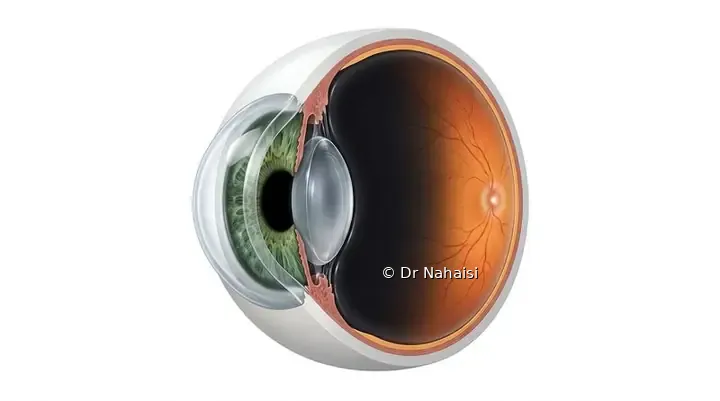
To see clearly, light rays must converge exactly on the retina, the “film” at the back of the eye. It is the cornea, the clear surface at the front of the eye, that does most of this focusing.
Understanding normal vision and accommodation
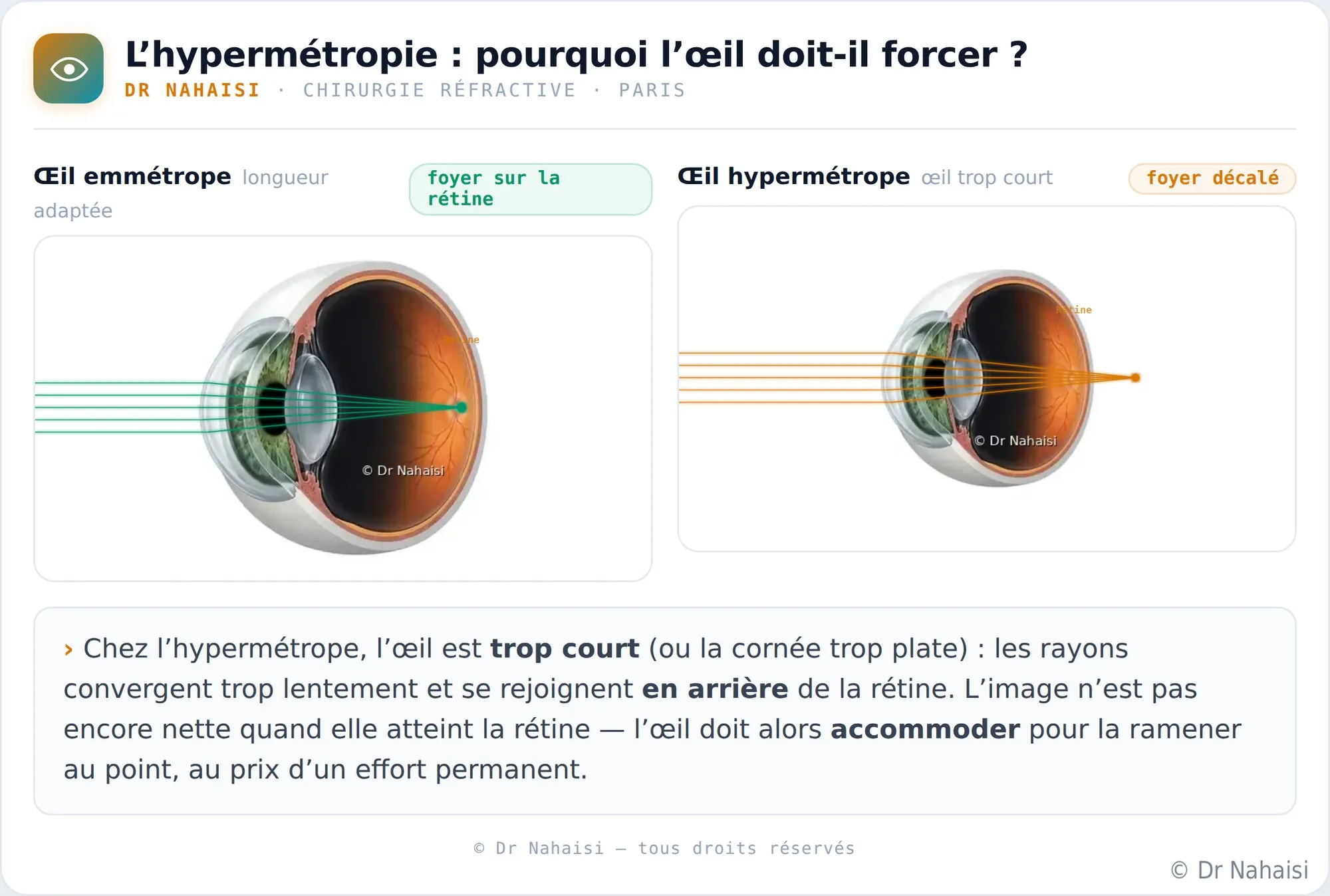
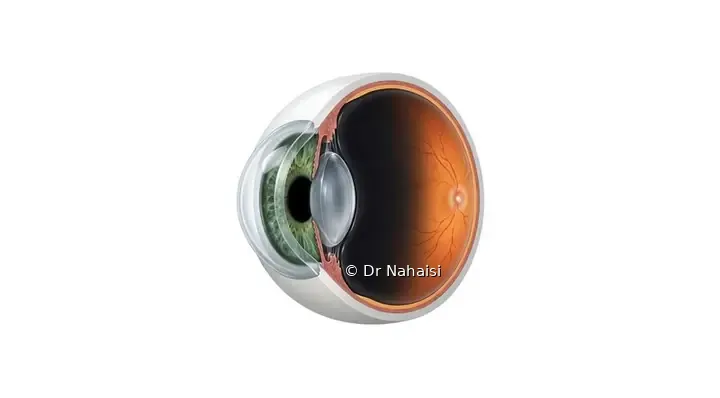
In a farsighted person, the eye is too short, or the cornea too flat. In both cases, the rays converge too slowly and focus behind the retina. It is the exact opposite of myopia.
In a farsighted eye, the eye is too short (or the cornea too flat): the rays meet behind the retina. To see clearly, the eye has to accommodate constantly, hence the fatigue. In an emmetropic eye (no prescription for distance), the length of the eye matches the curvature, and the rays meet right on the retina, effortlessly.
Accommodation: the hidden mechanism of hyperopia
Hyperopia has a particular feature. Unlike a nearsighted person, who sees blurry at distance and has no way to compensate alone, a farsighted person has a natural mechanism: accommodation.
Accommodation is the ability of the crystalline lens (the eye’s natural lens) to increase its curvature, and therefore the optical power of the eye. The eye has the ability to make itself nearsighted. This is what normally allows us to see up close.
In a farsighted person, this mechanism is used constantly, including for distance vision, to “catch up” with the error and bring the image back onto the retina. When looking up close, the rays converge even farther behind the retina, and the eye has to strain even more.
It is this double demand, constant for distance vision and even more intense for near vision, that eventually causes symptoms of visual fatigue.
And beyond a certain degree of hyperopia, accommodation is no longer enough: near blur appears, and even distance blur with the highest corrections.
A young farsighted person can often see clearly without glasses, but at the cost of constant effort.
It is this effort that causes the typical symptoms:
- Visual fatigue, especially at the end of the day, on screens, or when reading a book
- Headaches, with a feeling of a heavy band above the eyebrows, pressure on the temples, or heaviness at the back of the head
- Difficulty concentrating, during prolonged reading or on screens
- Fluctuating blurry vision, which comes and goes depending on the level of fatigue
- A feeling of dryness and stinging, at the end of the day, with a need to blink frequently and a burning sensation in the eyes, even though the surface of the eye shows no real dryness
- Eye redness, at the end of the day, linked to dilation of the conjunctival vessels from fatigue and a local inflammatory reaction. The white of the eye looks red, the vessels more visible, especially in the inner corner
Many patients discover their hyperopia late. They come in for visual fatigue, recurring headaches, sometimes simply a feeling of dryness. None of them knows that a vision error is the cause.
The different levels of hyperopia
| Degree | Typical profile | Main complaint |
|---|---|---|
| Low: +0.50 to +1.50 D | Well compensated by accommodation. Patient has relaxing glasses, or is often uncorrected. | Visual fatigue, headaches at the end of the day, discomfort on screens. |
| Moderate: +2.00 to +4.00 D | Glasses always worn for near vision, or often all the time. Sometimes contact lenses. | Blurry vision without correction, especially up close; thick lenses with a “magnifying” effect; cosmetic concerns. |
| High: +4.50 to +7.00 D | Total, permanent dependence on glasses. Very thick lenses, marked magnifying effect. | Major visual handicap at distance as well as up close. Strabismus or amblyopia sometimes associated. |
Low hyperopia (+0.50 to +1.50 D). These patients often live without glasses, or wear them occasionally. Their discomfort is insidious: visual fatigue, recurring headaches, a feeling of “straining” on screens. Some don’t even know they are farsighted. The laser brings them real comfort by eliminating the constant accommodative effort.
Moderate hyperopia (+2.00 to +4.00 D). Dependence on glasses is daily or nearly so. Accommodation still manages to maintain acceptable distance vision, but near vision is blurry without correction. These patients struggle to read a text or their phone for more than a few minutes. The corrective lenses are thick, with a magnifying effect perceived as unattractive. The eyes look bigger behind the lenses, and even with lenses thinned as much as possible, the magnifying effect remains visible. Switching to the laser eliminates this cosmetic concern in addition to the functional dependence.
High hyperopia (+4.50 to +7.00 D). Total dependence on glasses or contact lenses. The lenses are very thick and the magnifying effect is pronounced. Accommodation can no longer compensate for distance vision, which is blurry without correction, while near vision is almost impossible. A convergent strabismus (inward turn of the eye) may sometimes be associated, often intermittent, appearing with fatigue or when patients take off their glasses. Amblyopia (incomplete visual development of one eye compared with the other) is sometimes present, especially when there is a large difference between the two eyes.
Most farsighted patients up to about +8 diopters can be treated with the laser, within the limits of the cornea. Beyond that, other solutions exist. The pre-operative assessment determines the most suitable technique.
Hyperopia and strabismus
The association of hyperopia and convergent strabismus is very common. The mechanism is simple: to compensate for the error, the eye accommodates constantly. But accommodation and convergence are coupled. When the eye accommodates, it also converges, and it turns inward, intermittently or permanently.
When the strabismus improves with glasses, that is proof that it is linked to the accommodative effort caused by the hyperopia. I have treated many cases of hyperopia with convergent strabismus, and laser correction considerably improves the situation by reducing this effort. There is no need to correct the strabismus by another method beforehand. Strabismus surgeries, for their part, concern permanent strabismus, which is generally not linked to hyperopia.
Hyperopia and amblyopia
Amblyopia is incomplete visual development of one eye. It develops in childhood, when one eye receives a much poorer image than the other during the period when the visual pathways mature.
It is found in two common situations in farsighted patients. The first is a large difference in prescription between the two eyes (anisometropia). The more farsighted eye receives a blurrier image, and its pathways develop less. The second is an intermittent convergent strabismus linked to high hyperopia, which favors the development of one eye at the expense of the other.
Some patients were fortunate enough to be screened and treated in childhood. They often remember wearing a patch over one eye for a few months. For them, vision is generally good in both eyes. For those who did not benefit from this treatment, a difference in maximum potential acuity persists between the two eyes, even with the best optical correction.
The laser corrects hyperopia, but it cannot improve the amblyopia itself. The problem lies in the brain’s visual pathways, not in the eye. After the laser, the amblyopic eye will see as well as it did with glasses, but not better. Most patients understand and readily accept this, because the gain in freedom is considerable even with this limit.
Hyperopia and presbyopia
Presbyopia is the gradual loss of accommodation from age 40-45. It results from two combined phenomena: loss of elasticity of the crystalline lens, which stiffens with age, and reduced contractility of the ciliary muscle, the muscle that normally allows the lens to bulge.
Yet a farsighted person uses precisely this accommodation to compensate for their error. When presbyopia sets in, they are therefore doubly penalized. Around age 40, near vision declines first, because that is the part of accommodation that required the most intense effort. Then, around age 50, distance vision deteriorates in turn, because even small accommodative efforts become impossible.
This is often when people with low hyperopia, who lived without glasses, discover that they need a double correction, for distance and near. They then end up with progressive lenses.
Laser treatment can then be a lifesaver, with a strategy adapted to presbyopia: PresbyLASIK, monovision, or hybrid treatment. We discuss it together during the consultation, based on your needs and your habits.
Presbyopia laser correction in Paris
Hyperopia and astigmatism
Hyperopia is often associated with astigmatism. The laser corrects both components in the same procedure. This is the most common scenario in my practice: most of my farsighted patients also have associated astigmatism, even if mild.
Astigmatism laser surgery in Paris
Understanding your glasses prescription
On a glasses prescription, your correction is written with three values per eye: the sphere, the cylinder and the axis.
The sphere corresponds to your hyperopia (positive value, for example +3.00) or your myopia (negative value). It is the base correction, uniform across the whole surface of the lens.
The cylinder corresponds to your astigmatism. It is written in parentheses on your prescription. It is the difference in correction between the two main axes of your cornea. For example, a cylinder of -1.00 means that one axis of your cornea is 1 diopter more farsighted than the other.
The axis (in degrees, from 0° to 180°) indicates the orientation of this astigmatism on your cornea.
Example 1. Simple hyperopia. RE (OD): +3.00. No cylinder, no axis. The cornea is uniformly too flat; the correction is the same in all axes of vision.
Example 2. Hyperopia with astigmatism. RE (OD): +3.00 (-1.00 at 90°). The eye is farsighted by +3.00 in the 90° axis, and by +2.00 (3 - 1) in the perpendicular axis (180°). The laser will correct both components simultaneously, adapting its treatment to each axis.
THE PRINCIPLE OF LASER CORRECTION
How the laser corrects hyperopia
How glasses and contact lenses work
A farsighted person’s glasses have converging lenses. They concentrate the light rays so that they focus farther forward, exactly on the retina. It is the opposite of lenses for nearsighted people, which are diverging. It is also what creates the magnifying effect typical of farsighted glasses: the eyes look bigger through the lenses.
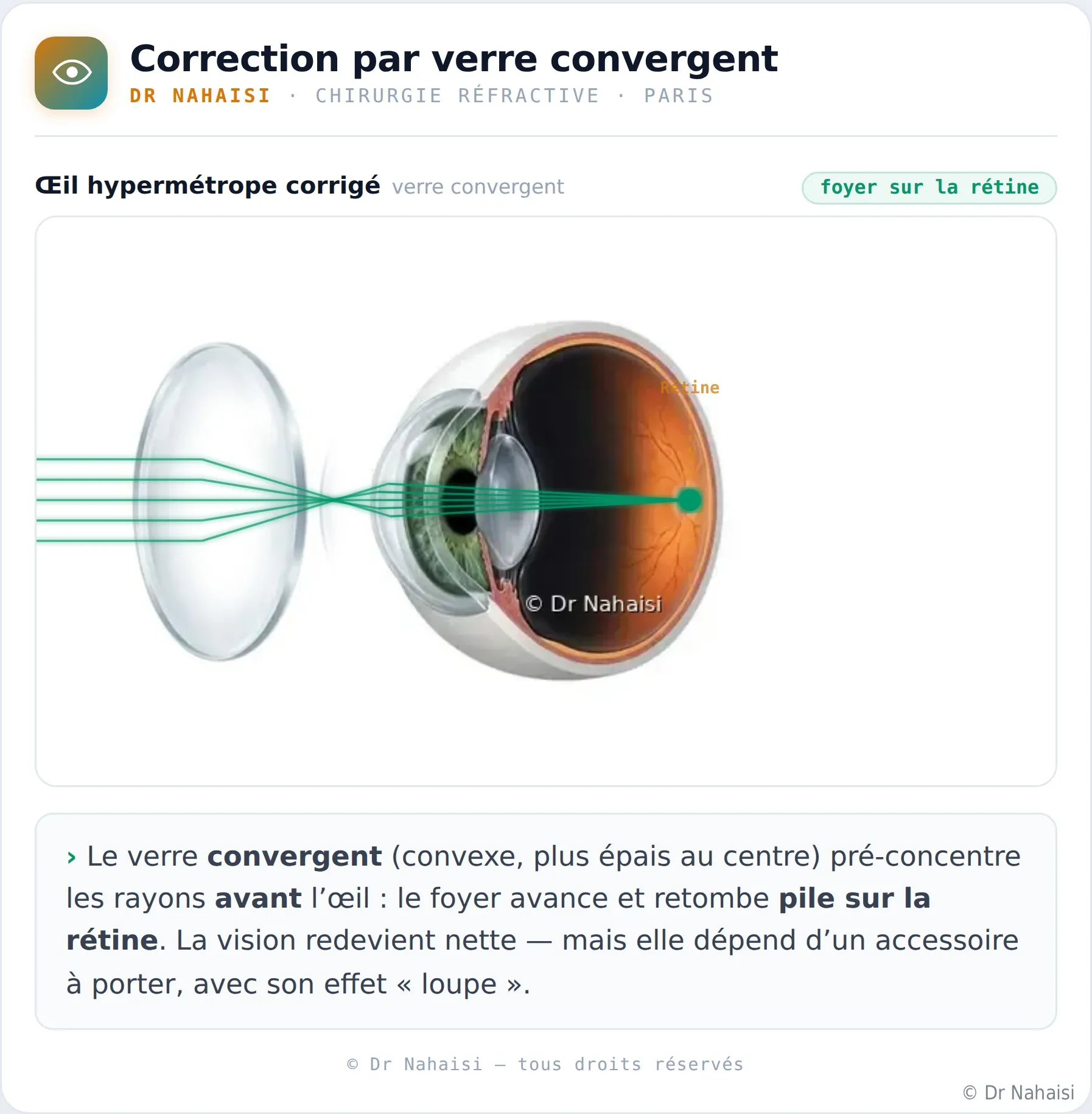
The farsighted lens, like the contact lens, is converging (convex, thicker at the center): it pre-concentrates the rays before the eye, which brings the focal point back onto the retina. It is also what creates the typical “magnifying” effect. The eyes look bigger behind the lenses.
The laser: steepening the center of the cornea
The excimer laser reshapes the cornea by steepening it at the center. It is the opposite of the myopic treatment (which flattens). By increasing the central curvature of the cornea, we increase its optical power, and the rays that were focusing behind the retina are brought back exactly onto it.
The laser removes tissue at the periphery of the cornea, which has the effect of making the center relatively steeper. The correction is built directly into the eye, in a lasting way. The cornea becomes more curved at the center, and therefore more powerful.
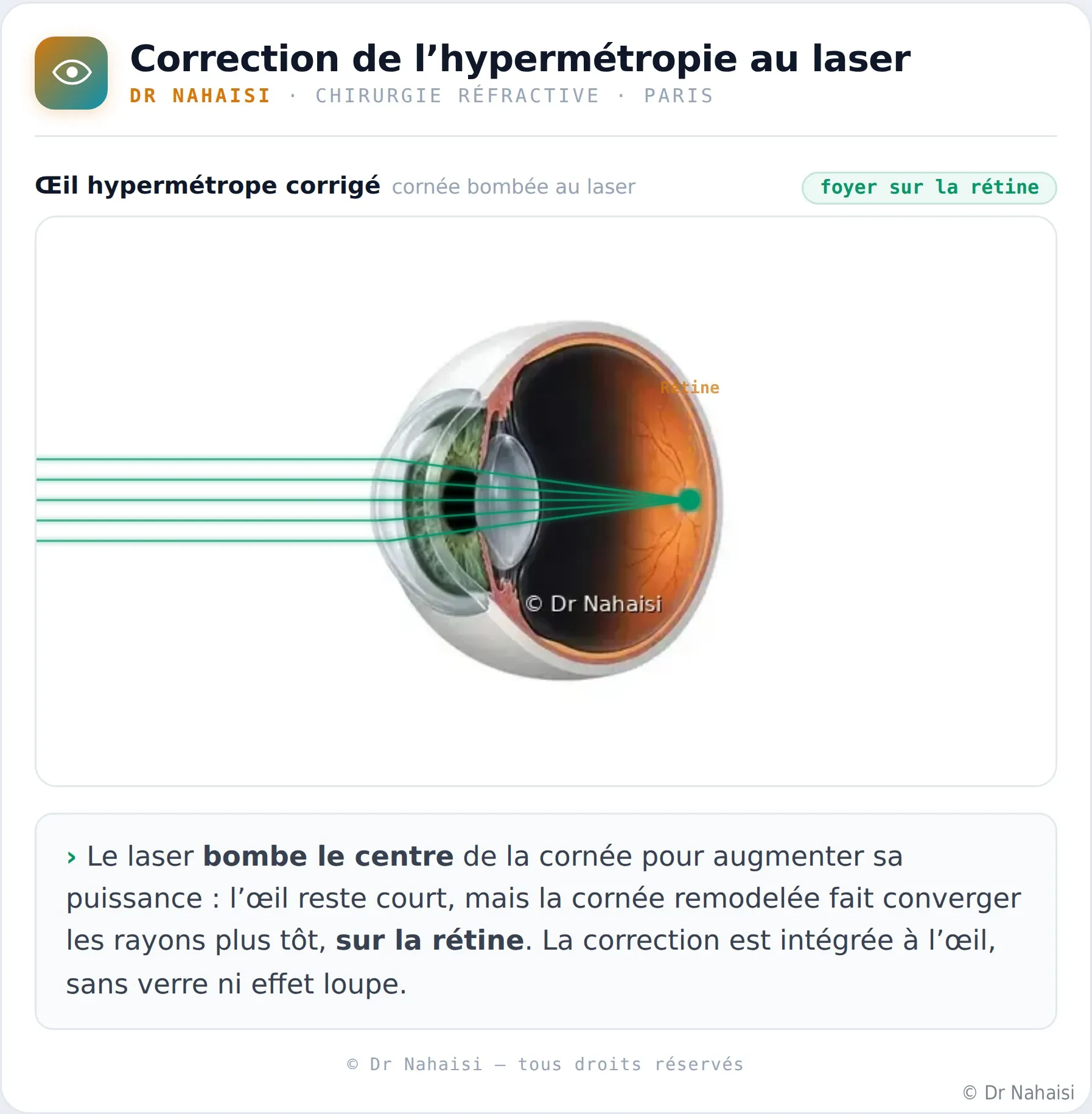
The laser does the same job as the lens, but differently: it steepens the center of the cornea to increase its power. The focal point moves forward and lands back on the retina. The difference is that the correction is built directly into the eye. No more lenses, no more magnifying effect.
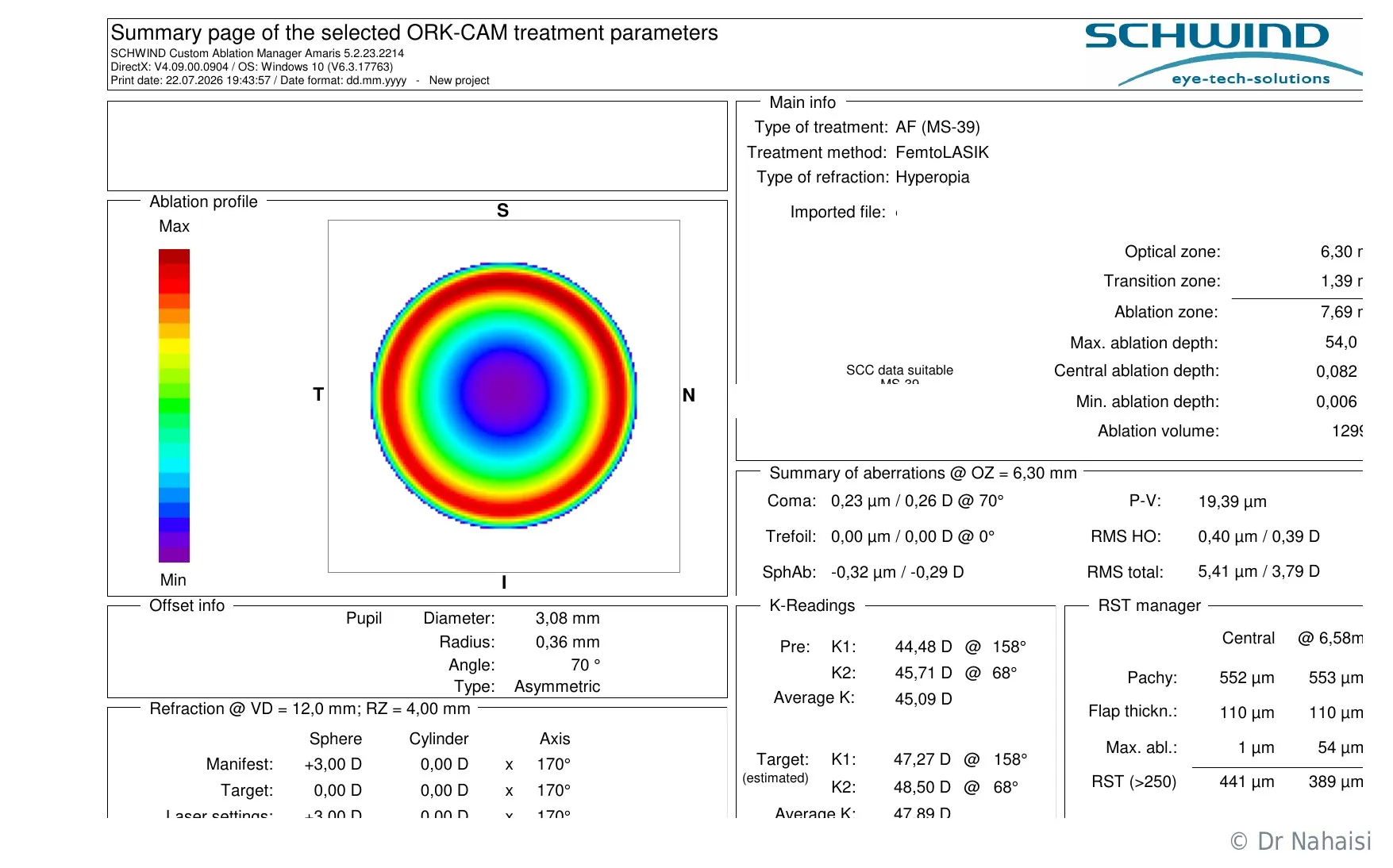
The treatment plan for a hyperopia of +3.00 diopters on the console of the Schwind Amaris 750S. The map gives the depth removed at each point of the cornea: red where the laser works the most, purple where it barely touches. The complete opposite of a myopic treatment. The ablation forms a ring at the periphery of the optical zone, here 54 microns at most, and the center is spared. This preserved center becomes relatively steeper than its periphery, and therefore more powerful, and the focal point returns to the retina.
The advantage of the laser over glasses: the lens-to-eye distance
Glasses sit 12-14 mm from the eye. This is a point I often explain during consultations. This distance creates optical distortions. The image is enlarged, the visual field is reduced at the sides, and the correction is only good at the center of the lens. In farsighted patients, these distortions are particularly marked because of the thickness of the lenses: pronounced magnifying effect, uneven sharpness between the center and the edges of the lens, sometimes bothersome reflections.
The laser, on the other hand, acts directly on the cornea, at zero distance. No more distortion from the gap between lens and eye, no more magnifying effect, and quality of vision often better than with glasses. This is an advantage farsighted patients particularly appreciate.
Customized treatment: Schwind aberration-free
As with myopia, laser treatment does not reproduce a simple average correction the way glasses do. The Schwind excimer platform we use at the Institut Voltaire allows customized, point-by-point treatment.
Take a patient with a glasses prescription of +3. In reality, their eye does not have a uniform optical error of +3 everywhere. It is a surface with an infinite number of points, each with its own correction: some at +2.80, others at +3.20. With glasses, we have to average all these points. The laser, on the other hand, corrects each point individually, thanks to the aberrometry map taken just before the procedure. This is the Schwind aberration-free profile, the world reference for precision in excimer laser treatment.
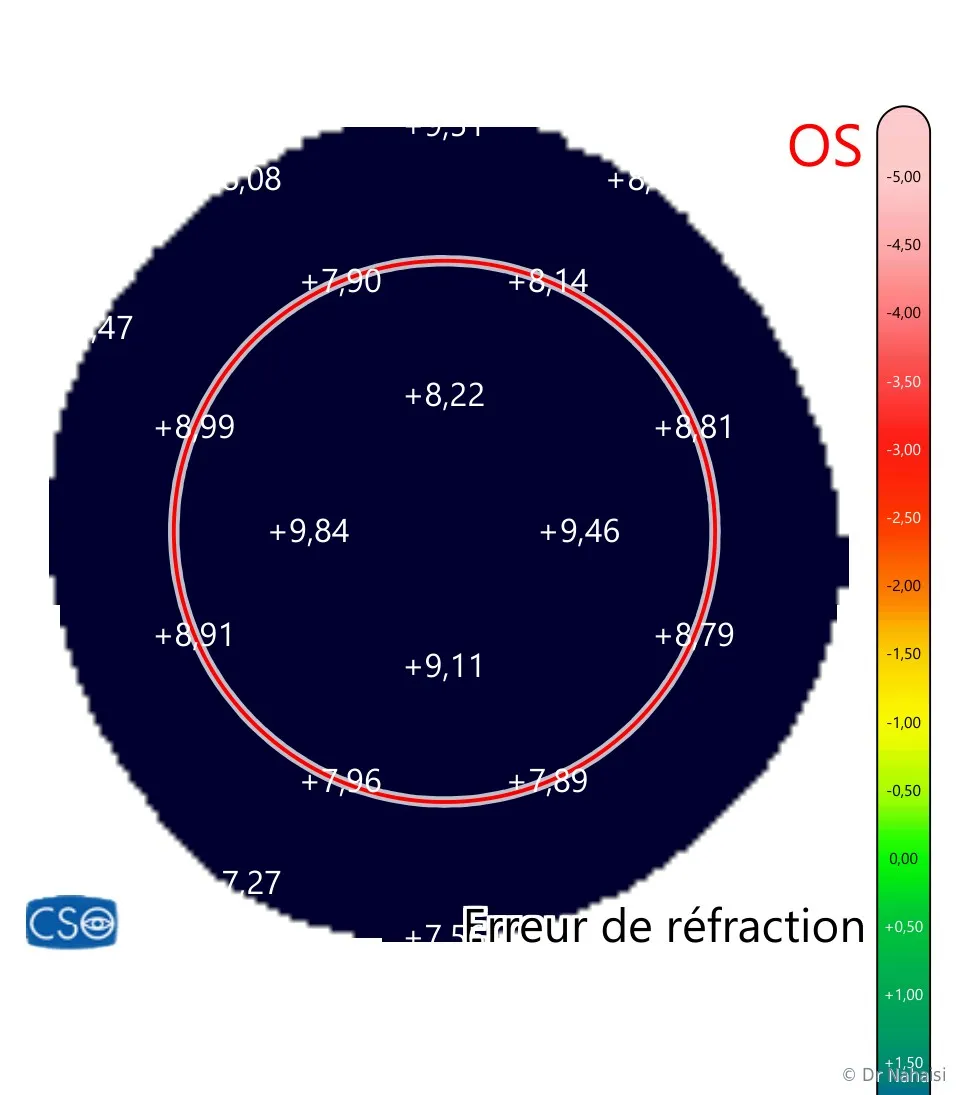
Here is the aberrometry of the left eye of one of my patients, who is highly farsighted. When we say an eye is “at +9,” it is an average. In reality, the correction is not the same everywhere: here it ranges from about +7 to nearly +10 diopters depending on the zone, point by point. Glasses only correct the average. The laser, on the other hand, treats each point of the cornea according to its own value. This is the “aberration-free” treatment of the Schwind platform.
TECHNIQUES FOR HYPEROPIA SURGERY
Which technique to correct your hyperopia with the laser?
As with myopia, the choice of technique is made during the pre-operative assessment. For hyperopia, LASIK has a specific advantage that I detail below.
LASIK: the reference technique for hyperopia
LASIK is generally more effective for treating hyperopia than TransPRK, when it can be performed safely. A femtosecond laser (Visumax 800) creates a thin corneal flap, then the Schwind excimer laser reshapes the cornea underneath. The flap is put back in place. Clear vision from the next day, return to work within 24 to 48 hours.
For hyperopia, LASIK requires perfect mastery of flap cutting with the femtosecond laser, notably with large-diameter cuts suited to peripheral treatment. It is precisely for this expertise that many patients come to see me. I have long experience with hyperopic LASIK. In addition, epithelial regression, a phenomenon more marked with hyperopic treatments, is generally better controlled with LASIK than with surface treatment. That is why I favor it as the first-line option.
Suitable for hyperopia up to about +7/+8 diopters, within the limits of the cornea.
Price: €3,200 for both eyes (€1,600/eye). Follow-up included.
TransPRK: when LASIK is not possible
It is a surface treatment, with no flap and no contact. The safest technique biomechanically. I recommend it when LASIK is not the best option for your profile, whether because of corneal thickness or regularity.
The results are excellent, but recovery is more gradual: allow about a week before returning to work comfortably. For high hyperopia, the risk of regression is slightly higher than with LASIK, which explains my preference for LASIK when it can be performed.
Price: €2,800 for both eyes (€1,400/eye). Follow-up included.
SMILE: not suitable for hyperopia
SMILE is not suitable for correcting hyperopia. The technique is designed to extract a lenticule from the center of the cornea, which flattens the cornea instead of steepening it. For hyperopia, the choice is between LASIK and TransPRK.
What if my hyperopia comes with astigmatism?
This is very common. LASIK and TransPRK correct hyperopia and astigmatism in the same procedure.
ARE YOU A CANDIDATE?
Who can have laser surgery for hyperopia?
The vast majority of farsighted people are candidates. The pre-operative assessment confirms this and helps choose the most suitable technique. Hyperopic treatment benefits from a specific flexibility: the laser sculpts the cornea at the periphery rather than at the center, and the cornea is naturally thicker at the periphery than at the center. This offers more comfortable margins than for myopic treatments.
Age
Refractive surgery is possible from age 18. For hyperopia, the prescription generally stabilizes earlier than for myopia.
There is no upper age limit for laser surgery. But from age 65, refractive cataract surgery becomes more relevant.
Stability
As with myopia, absolute stability does not exist. The eye has natural fluctuations of 0.25 to 0.50 diopter from one exam to another. For hyperopia, these fluctuations are often linked to residual accommodation.
One common phenomenon deserves to be highlighted. Many patients with moderate or high hyperopia come to the consultation with a history of prescriptions that seem to have increased over the years. +1 in youth, then +2, then +3. Prescriptions change as visual demands intensify, with studies, screen work, prolonged reading. These patients feel that their vision is deteriorating, that their error is progressing. In reality, their hyperopia was there from the start and has not changed. It is their ability to compensate that has decreased, gradually revealing an error they had without knowing it. When this is pointed out to them, these patients often recognize that they have always had headaches or visual fatigue at the end of the day, without ever paying attention to it. It is a gradual decompensation of a stable error, not an instability of the prescription.
In rare cases of inconsistency between measurements, an additional exam under dilating drops (cycloplegia with Skiacol) may be needed to measure the true prescription without accommodative effort. But this is relatively rare in my practice, because the aberrometry measurements we perform at the Institut Voltaire already give me a reliable diagnosis of the prescription in almost all cases.
There is no point waiting for years, comparing each prescription to the decimal. Come directly for a consultation; the full assessment will settle the question.
The cornea: different criteria from myopia
Hyperopic treatment removes tissue at the periphery of the cornea, where it is naturally thicker. This makes it possible to operate on patients whose cornea would be considered too thin for a nearsighted patient, because it is the peripheral thickness, at the ablation zone, that counts.
The limiting factor for hyperopia is more often the pre-operative corneal curvature. The laser has to steepen the cornea, but there is a limit beyond which we cannot go: about 50 diopters of post-operative corneal curvature. Given that the laser adds about one diopter of corneal curvature per diopter of hyperopia in glasses, a cornea that is already fairly steep at the start will reach this limit sooner.
Just as with high myopia, it is sometimes necessary to accept a compromise when the corneal curvature does not allow a full treatment, in highly farsighted patients. We may then choose to treat as far as the cornea allows, accepting a slight residual. For example, a +7 farsighted patient could be offered surgery with a post-operative target of +1. That would already be a liberation compared with thick lenses. In these cases, almost all patients understand and are delighted with the result.
The corneal topography must also be regular, with no sign of keratoconus or deformation.
Pregnancy and breastfeeding
I do not operate during pregnancy. It is a precaution: hormonal fluctuations can temporarily change refraction. Breastfeeding, on the other hand, is not a problem and does not prevent surgery. And there is no reason to wait until you have had all your children: we can perfectly well operate before a pregnancy or between two.
What if I am not a candidate for laser surgery?
It happens. That is exactly why the assessment exists. For hyperopia beyond the limits of the laser, or for incompatible corneas, other solutions exist. I say so clearly and refer you to the most suitable solution.
An ICL (intraocular implant) can be an option, but it requires enough space inside the eye to place the implant. However, unlike nearsighted people, who have elongated eyes where the space is often sufficient, farsighted people by definition have a shorter eye. This space may therefore be insufficient, and no surgical solution may be possible. It is rare, but transparency requires mentioning it. The only option would then be clear lens (or cataract) surgery, generally performed from age 50.
When laser surgery is not possible: alternatives and referral
HIGH HYPEROPIA
High hyperopia: beyond +4 diopters, what is specific?
I regularly operate on high hyperopia. Patients at +5, +6, sometimes +7 diopters. I have treated cases up to +8.50, the maximum I have performed with the laser.
The question of regression
For high hyperopia (beyond +4/+5), a slight regression over time can be expected. The corneal epithelial tissue, especially at the periphery, tends to heal slightly thicker after large hyperopic treatments, gradually reducing the effect of the laser. A patient treated for +6 could see a residual hyperopia of +1 return a few years after surgery.
This regression generally does not cause a significant drop in vision in young patients, because the eye can still accommodate to compensate. It can, however, cause visual fatigue, and relaxing glasses may be prescribed for screen work.
For lower hyperopia, regression is smaller, and patients are generally very satisfied. In all cases, highly farsighted patients bothered by magnifying lenses readily accept this limit because the gain in quality of life remains considerable.
The correction may not be 100% complete
For high hyperopia, I always warn patients: a very slight post-operative hyperopia may persist (on the order of +0.50 to +0.75), which may require occasional relaxing glasses. I say this for the sake of transparency. Most of these patients no longer wear glasses day to day.
Associated strabismus and amblyopia
High hyperopia is more often associated with convergent strabismus and/or amblyopia. The laser is effective at correcting vision, but it is not meant to correct strabismus any more than glasses did. The goal is to free you from dependence on lenses, not to treat strabismus.
I take the time to explain precisely what surgery can and cannot achieve, depending on each situation.
RESULTS AND DURABILITY
Results of hyperopia laser surgery: what to expect?
The goal is good vision without glasses or contact lenses in everyday life. Not a 0.000 correction, because that does not really exist.
Why do we aim for a slight residual hyperopia?
We aim for a slight residual hyperopia of +0.25 to +0.50 diopter. It is the same principle as for myopia. This target maintains excellent distance vision and anticipates a possible regression. It is also, typically, the correction that people who “have never needed glasses” have.
The immediate post-operative phase: the result cannot be judged on day one
This is a point specific to hyperopia that I always explain to my patients. After the laser, there is always a slight initial overcorrection that regresses over a few days to a few weeks. In a treated farsighted eye, this overcorrection makes the eye temporarily nearsighted, by about -0.50 diopter. Distance vision is then slightly blurry, and near vision very good at first.
This is entirely normal and expected. The regression happens gradually, and distance vision improves as it goes, over 1 to 2 months. You can still resume everyday activities from the next day after LASIK, and after one week with TransPRK.
Hyperopic treatments take longer than myopic treatments to stabilize. If your nearsighted friends who had surgery saw clearly from the next day, it is normal that things are a little different for you. It is the usual process, not a sign of failure.
The correction is lasting
The result lasts for several decades. As with myopia, there are possible mechanisms of change after surgery:
Epithelial regression. This is the main mechanism of regression after hyperopic treatments. The corneal epithelium, at the periphery, tends to heal slightly thicker, gradually reducing the effect of the laser. This phenomenon was significant with older generations of lasers. Today, with the Schwind platform and current treatment profiles, regression has become much smaller. It can still be seen with high corrections, but moderately and proportionally small compared with the initial hyperopia.
Axial lengthening of the eye. Unlike in nearsighted people, this mechanism is generally not a problem in farsighted people. Farsighted eyes are by definition short eyes, and axial lengthening is very rare. If it did occur, it would actually offset the epithelial regression mentioned above.
If despite everything a more marked hyperopia reappeared and became bothersome a few years after surgery, a laser enhancement would be possible in most cases. In the first year, it is included in the price. After that, a preferential rate applies up to 5 years after surgery.
PRICES AND INSURANCE COVERAGE
Prices for hyperopia laser surgery in Paris
| Technique | Price per eye | Price for both eyes |
|---|---|---|
| LASIK | €1,600 | €3,200 |
| TransPRK | €1,400 | €2,800 |
| PresbyLASIK | €1,800 | €3,600 |
Included in the price: complete post-operative follow-up, with no limit on the number of visits, and a possible enhancement in the first year.
Pre-operative consultation: at the standard rate set by French national health insurance. At the practices in Paris 10th (10e arrondissement) and Paris 19th (19e arrondissement), there is no fee supplement and nothing to pay upfront (direct billing). At the Institut Voltaire (Paris 11th), you pay €50 upfront, including a €30 fee supplement, of which at least €20 is reimbursed by your complementary health insurance.
Payment: on the day of surgery, by bank card, check, bank transfer or direct debit. Payment in 4 installments is possible, by check or direct debit.
Refractive surgery is not reimbursed by French national health insurance, but your complementary health insurance may cover part of the cost. I provide you with a personalized quote to send to your insurer.
Frequently asked questions
Your questions about hyperopia laser surgery
Can the laser really correct hyperopia?
Yes. Today we have very good mastery of laser surgery for hyperopia. I have operated on many farsighted patients, including high cases up to +8.50 diopters. Depending on the pre-operative assessment, we can treat hyperopia up to about +8 diopters.
Why is laser surgery for hyperopia more complex than for myopia?
Hyperopic treatment steepens the center of the cornea rather than flattening it. This reshaping places more demand on peripheral healing, which can lead to slight regression with high corrections. It also requires perfect mastery of flap cutting with the femtosecond laser, with large-diameter cuts. It is precisely for this expertise that patients come to see me, and LASIK is the technique I perform most. Recovery is also a little more gradual. But the results are very satisfying, and recent advances in laser platforms have considerably reduced these difficulties.
Why is distance vision blurry after hyperopia surgery?
After a hyperopic treatment, there is always a slight initial overcorrection that makes the eye temporarily nearsighted. This is expected and normal. This overcorrection regresses within a few days to a few weeks. You need to be patient. This slight distance blur does not prevent you from resuming activities from the same evening or the day after the procedure.
Can hyperopia come back after laser surgery?
For low and moderate hyperopia, regression is rare and minimal. For high hyperopia (beyond +4/+5), a slight regression is possible, typically a return of about +1 diopter a few years later. In a young patient, accommodation generally compensates for this change without any problem. If discomfort appears, relaxing glasses for screens or reading, or a laser enhancement, can be considered.
Can hyperopia be treated with the laser if you have strabismus?
Yes. The association of convergent strabismus and hyperopia is very common. If the strabismus improves with glasses, it is directly linked to the hyperopia. The laser corrects the hyperopia and therefore reduces the strabismus, as glasses do, but does not eliminate it. There is no need to correct the strabismus by another method beforehand.
Does the laser eliminate the magnifying effect of farsighted glasses?
Yes, it is actually one of the benefits farsighted patients appreciate most. The laser builds the correction directly into the eye: no more lenses, no more magnifying effect. And optical quality is often better than with glasses, because the correction is applied directly to the cornea, without the lens-to-eye distance that creates distortions.
LASIK or TransPRK: which technique for hyperopia surgery?
LASIK is generally more effective for hyperopia, and I favor it as the first-line option. When LASIK cannot be performed (cornea too thin, irregularity), TransPRK gives excellent results, with a slightly more gradual recovery. The choice is always made together, during the consultation.
Can SMILE correct hyperopia?
No. SMILE is not suitable for correcting hyperopia. The technique is designed for myopia. For hyperopia, the choice is between LASIK and TransPRK, or in rare cases an intraocular implant (ICL) when the laser is not possible.
How long does hyperopia laser surgery take?
About ten minutes for both eyes. The laser itself only lasts a few seconds per eye. The rest of the time is spent getting you settled, explanations, and a little music to relax the atmosphere.
When can I go back to work after refractive surgery for hyperopia?
After LASIK: the next day or the day after. After TransPRK: allow about a week. A sick note (time off work) is possible on a case-by-case basis.
Is hyperopia laser surgery painful?
The procedure is done under local anesthesia with eye drops, and it is painless. With LASIK, the first few hours can be uncomfortable: watery eyes, stinging, sensitivity to light. A good nap is usually enough. With TransPRK, the first 48 hours can be uncomfortable.
Do I need a referral letter from an ophthalmologist to consult for hyperopia surgery?
No. No referral letter or prescription needed. You can book an appointment directly on Doctolib or by phone.
Can hyperopia and presbyopia be corrected at the same time with the laser?
Several strategies exist to treat hyperopia and presbyopia at the same time: full bilateral hyperopic correction, monovision, PresbyLASIK. The choice depends on your prescription, your expectations and your visual profile. We discuss it together during the consultation.
What are the side effects of hyperopia laser surgery?
In the first few weeks: dry eye relieved by artificial tears, halos around lights in low light (a temporary increase around the 2nd month, then gradual regression), visual fatigue on screens, and, specifically for hyperopia, slightly blurry distance vision in the first few days that gradually improves.
Do I need to remove my contact lenses before a pre-operative assessment for hyperopia surgery?
Removing contact lenses is not always essential for the pre-operative assessment, but it can be useful in borderline cases because contact lenses slightly alter the measurements. It is best to remove them 24 hours before the consultation, and 48 hours before surgery.
Is a laser enhancement possible after hyperopia surgery?
Yes. If a slight residual correction persists and bothers you, a laser enhancement can be considered, generally not before 6 months after surgery to allow time for stabilization. In the first year, the enhancement is included in the price. After that, a preferential rate applies up to 5 years after surgery.
BOOK AN APPOINTMENT
Ready to see without glasses?
The first step is simple: a consultation to review your eyes, your prescription, and the options available to you. No commitment and no pressure, just a complete assessment and a frank discussion.
Book an appointment on Doctolib
Phone and WhatsApp: 01 84 80 28 04 · Email: nahaisi@laservisionparis.com · Doctolib messaging
Download the information booklet (PDF)
Author: Dr Steven Nahaisi, ophthalmic surgeon, specialist in laser refractive surgery, Institut Laser Ophtalmologique Voltaire, Paris 11th.
Your surgeon
Dr Steven Nahaisi
Ophthalmic surgeon dedicated exclusively to laser refractive surgery. He operates at the Institut Laser Ophtalmologique Voltaire and consults in three Paris offices. Consultations in English.