Vision problem
Laser Astigmatism Surgery in Paris
Astigmatism is a very common vision problem, yet it is often poorly understood. Many patients who come to see me for myopia or hyperopia also have some associated astigmatism, even if mild. Many of them don’t know it.
Dr Steven Nahaisi
Updated on 15 October 2026 · 28 min read
Astigmatism can be corrected with a laser, on its own or combined with myopia or hyperopia. It is even one of the cases where the advantage of the laser over glasses is most pronounced. The laser treats the problem at its source, directly on the cornea, at zero distance: it eliminates the optical distortions that a corrective lens imposes. And thanks to aberrometry, it corrects astigmatism point by point, with a precision no pair of glasses can match.
Here I explain what astigmatism is, why the laser can offer a real advantage over glasses, which techniques I use, and the real questions my patients ask me every week.
On this page9 sections
- 02UNDERSTANDING ASTIGMATISM
- 03WHY THE LASER CORRECTS ASTIGMATISM BETTER
- 04TECHNIQUES FOR ASTIGMATISM SURGERY
- 05ARE YOU A CANDIDATE?
- 06COMBINED ASTIGMATISM: MYOPIA + ASTIGMATISM, HYPEROPIA + ASTIGMATISM
- 07RESULTS AND DURABILITY
- 08FREQUENTLY ASKED QUESTIONS ABOUT ASTIGMATISM SURGERY
- 09FEES AND INSURANCE COVERAGE
- 10BOOK AN APPOINTMENT
UNDERSTANDING ASTIGMATISM
What is astigmatism? Why is vision doubled or stretched?
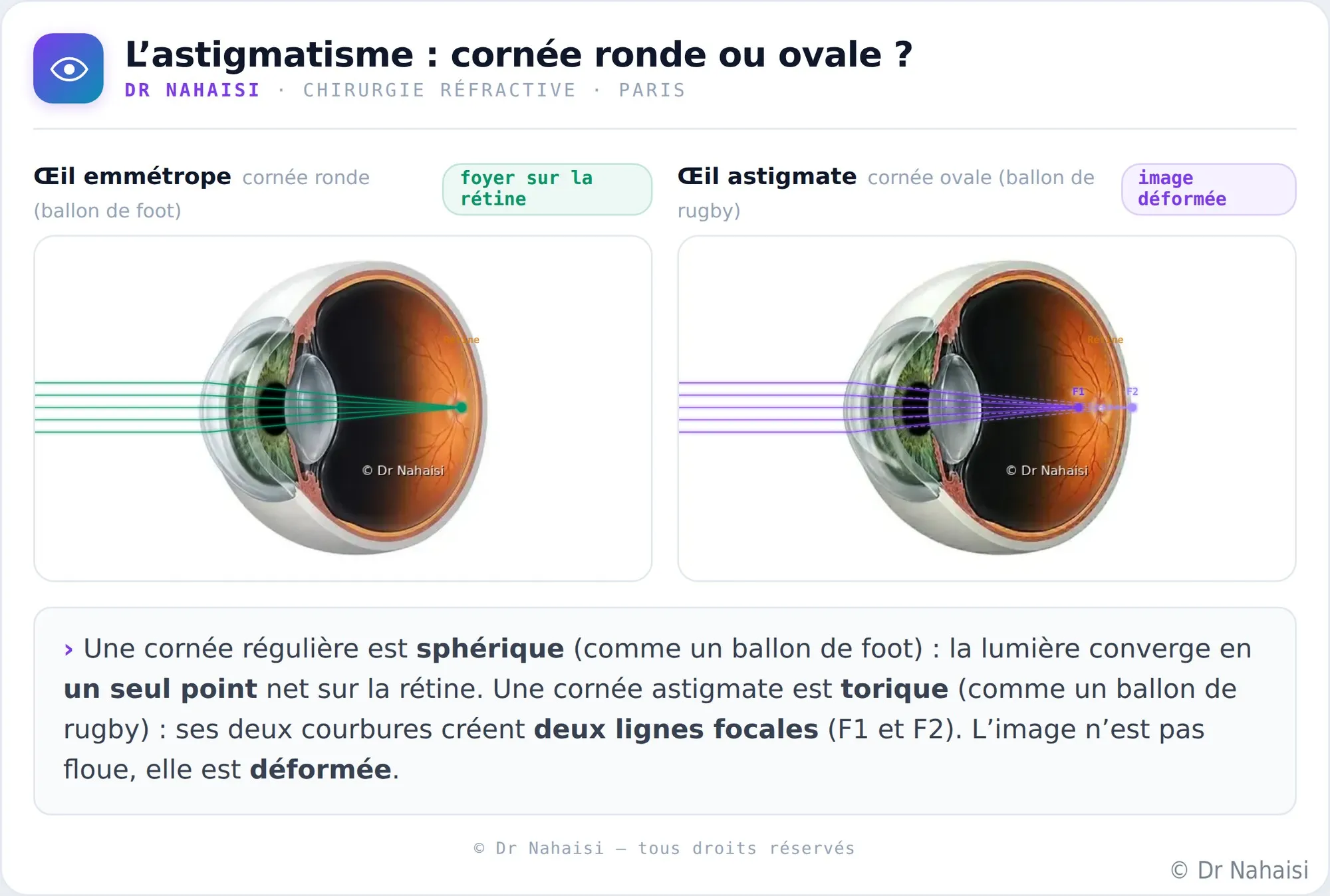
To see clearly, light rays must converge on a single point, exactly on the retina. The cornea, the transparent surface at the front of the eye, does most of this focusing.
In someone without astigmatism, the cornea is regular in every direction: it is spherical, like a soccer ball. All the rays converge at the same place.
In someone with astigmatism, the cornea does not have the same curvature along every axis. Instead of being round, it is slightly oval, like a rugby ball. There is a steeper axis (optically more powerful) and a flatter axis (less powerful). Light rays passing through the steep axis converge faster than those passing through the flat axis. Instead of meeting at a single point, they form two focal lines at different distances from the retina. This is what is called corneal toricity. The image is never formed sharply. It always stays somewhere between these two focal lines, which produces the doubled, stretched or slightly blurred vision typical of astigmatism.
A regular cornea is spherical (soccer ball): light converges on a single sharp point on the retina. An astigmatic cornea is toric (rugby ball). Its two curvatures create two focal lines (F1 and F2), and the image is distorted.
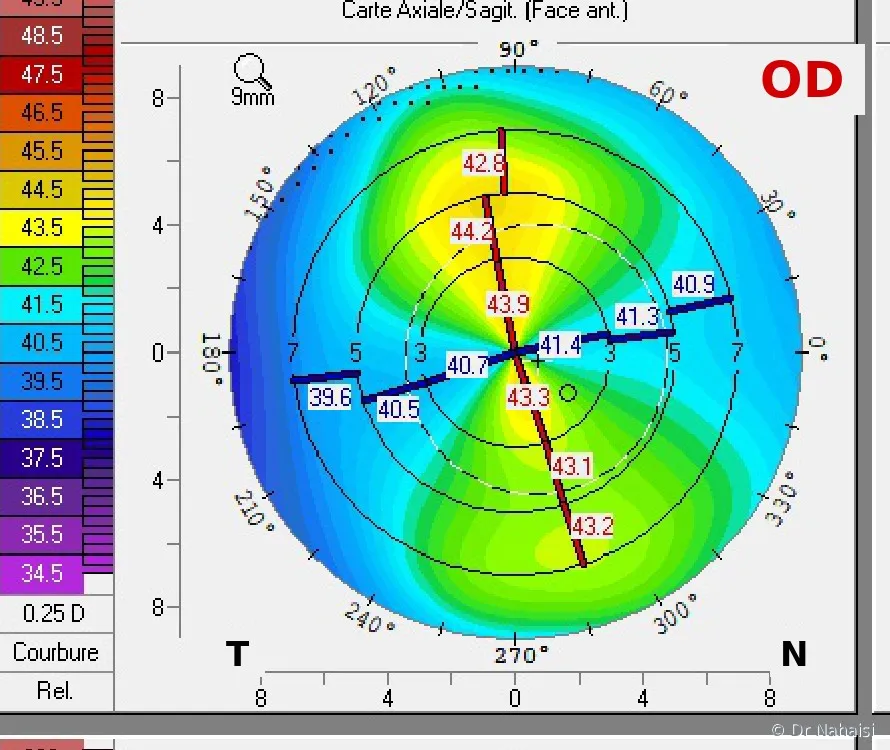
Here is the curvature of a real astigmatic eye, measured axis by axis (axial map). The vertical “bow tie,” in warm colors, is the steepest meridian, and therefore the most nearsighted. The blue horizontal areas are the flattest. The cornea is toric.
Corneal astigmatism and lenticular astigmatism
Most of the time, astigmatism comes from the cornea. It is the corneal surface that is toric, and it is what creates the double focus described above. This is called corneal astigmatism, by far the most common type.
In some cases, the crystalline lens, the natural lens located behind the iris, also has its own toricity. This is called internal, or lenticular, astigmatism. It adds to the corneal astigmatism to form the total astigmatism, the one measured during the consultation and found on your glasses prescription.
The laser treats the cornea based on the total astigmatism, that is, the sum of the corneal and lenticular components. The pre-operative assessment quantifies the share of each and allows the treatment to be adapted accordingly.
Typical symptoms of astigmatism
Unlike myopia (where distance vision is blurry) or hyperopia (where the eyes tire mainly up close), astigmatism is bothersome at all distances. Vision is not necessarily blurry in the classic sense. It is rather imprecise, as if the image were never perfectly sharp.
The most common symptoms:
- Doubled or stretched vision, with two slightly offset versions of the same image
- Difficulty reading signs at a distance or subtitles on a screen
- Halos around headlights at night, stretching into stars or streaks
- Eye strain, headaches, a feeling of constantly straining
- Confusing similar letters: H and M, E and B, O and D
- Frequent squinting to try to sharpen vision
The different levels of astigmatism
| Degree | Typical profile | Main complaint |
|---|---|---|
| Low: 0.25 to 0.75 D | Often not corrected in glasses, or discovered by chance during an eye exam. | Slight imprecision, insidious eye strain, faint halos at night. |
| Moderate: 1.00 to 2.50 D | Glasses worn all or almost all the time. Sometimes toric contact lenses. | Marked double vision, stretched halos at night, difficulty reading. |
| High: > 3.00 D | Total dependence on glasses or contact lenses. Thick lenses with a marked axis. | Very blurry vision without correction. Significant halos. Major functional impairment. |
Low astigmatism (0.25 to 0.75 D). Many patients don’t even know they have astigmatism. The discomfort is subtle: slight visual imprecision, fatigue at the end of the day. Some also notice barely perceptible halos at night. In glasses, this astigmatism is frequently not corrected at all, as some ophthalmologists prefer to leave it alone because patients get used to it. With the laser, I always correct it, because the aim is the best possible vision.
Moderate astigmatism (1.00 to 2.50 D). The discomfort is clear-cut. Vision is doubled or stretched without correction, and halos are pronounced at night. Reading quickly becomes tiring. Glasses correct the problem well, but with the limitations inherent to lenses (see the next section). The laser brings a very worthwhile gain in visual quality for these corrections.
High astigmatism (above 3.00 D). Total dependence on glasses or contact lenses. Uncorrected vision is very poor. At this stage, glasses themselves become problematic: high-cylinder lenses create many optical aberrations and distortions, and they are uncomfortable. In fact, astigmatism is often not fully corrected on the glasses prescription, because the full correction would be poorly tolerated.
Soft contact lenses are often poorly tolerated. Rigid lenses can be very effective, but are fairly difficult to wear. In these cases, the laser comes into its own: by treating the cornea directly, it does better than glasses or contact lenses, without the tolerance constraints of the lens.
Astigmatism and halos
Halos at night are directly linked to astigmatism: the two focal lines stretch point light sources (headlights, streetlights) into streaks or stars.
At night, the pupil dilates and a larger area of the cornea comes into play in vision. Optical aberrations increase with this pupil dilation. That is why halos are more pronounced in the dark, and why astigmatism is more bothersome in the evening and at night.
After surgery, you will have some post-operative halos during the first month. They will already be less pronounced than those you had with your astigmatism. They then gradually fade. The peak is at around two months, after which they decrease steadily. In the end, night vision is generally better than before the surgery.
Astigmatism is a stable condition
Unlike myopia, which can progress until age 23–24, astigmatism almost never changes in adulthood. The cornea takes on its adult shape very early in childhood and remains stable throughout life, apart from conditions such as keratoconus, which we systematically screen for during the assessment.
When a patient tells me that “their astigmatism has changed” between two prescriptions, it is almost never a real change. I explain why in detail in the section “Are you a candidate?”.
Understanding your glasses prescription
On a glasses prescription, your correction is written with three values per eye: the sphere, the cylinder and the axis.
The sphere corresponds to your myopia (a negative value, for example -3.00) or your hyperopia (a positive value, for example +2.00). It is the base correction, uniform over the whole surface of the lens.
The cylinder corresponds to your astigmatism. It is the difference in correction between the two main axes of your cornea. For example, a cylinder of -1.50 means that one axis of your cornea is 1.50 diopters more nearsighted than the other.
The axis (in degrees, from 0° to 180°) indicates the orientation of this astigmatism on your cornea.
Example 1, pure astigmatism. OD (right eye): 0.00 (-1.50 at 180°). No myopia or hyperopia. The eye is emmetropic along the horizontal axis at 180°, and nearsighted by -1.50 along the perpendicular axis at 90°. The laser will correct this difference.
Example 2, myopic astigmatism. OD: -3.00 (-1.50 at 90°). The eye is nearsighted by -3.00 along the vertical axis at 90°, and nearsighted by -4.50 along the perpendicular horizontal axis at 180°. The laser will correct both components simultaneously, adapting its treatment to each axis.
Example 3, hyperopic astigmatism. OD: +3.00 (-1.00 at 90°). The eye is farsighted by +3.00 along the vertical axis at 90°, and farsighted by +2.00 along the horizontal axis at 180°. The laser adapts its treatment to both components.
Example 4, mixed astigmatism. OD: +2.00 (-3.00 at 180°). The eye is farsighted by +2.00 along the horizontal axis at 180°, and nearsighted by -1.00 along the perpendicular axis at 90°. One axis is farsighted, the other is nearsighted: this is what is called mixed astigmatism. The laser corrects both components during the same procedure.
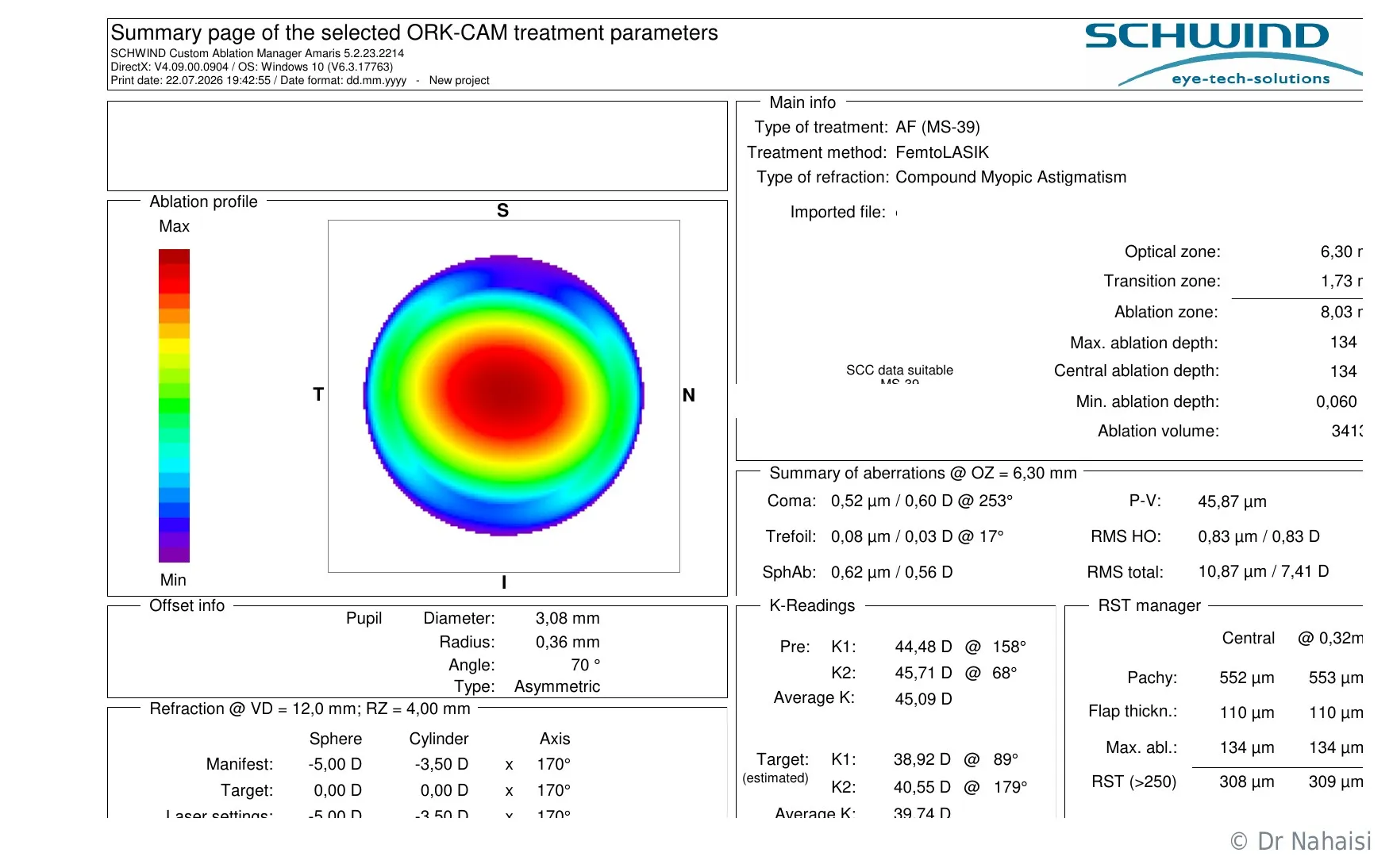
The treatment plan for myopia combined with astigmatism, -5.00 (-3.50 at 170°). Both corrections are blended into a single ablation profile: the oval central hollow treats the myopia, and its horizontal stretch treats the astigmatism. Maximum depth 134 microns, on a 552-micron cornea, with a 110-micron flap. The residual stromal bed calculated by the laser is 308 microns, well above the safety threshold.
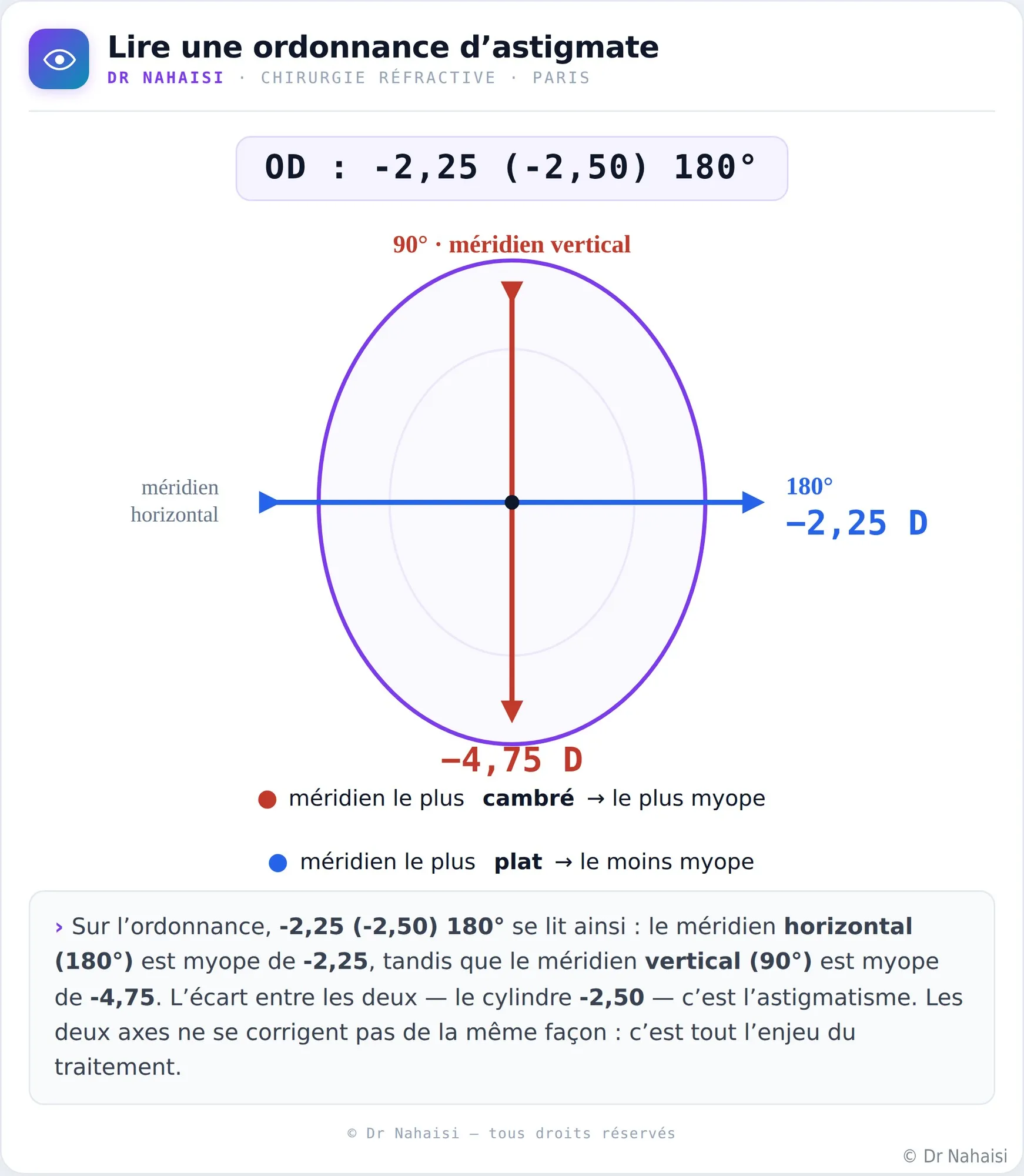
A real case decoded: -2.25 (-2.50) 180°. The horizontal meridian (180°) is nearsighted by -2.25, the vertical meridian (90°) by -4.75. The difference between the two, the -2.50 cylinder, is the astigmatism.
WHY THE LASER CORRECTS ASTIGMATISM BETTER
The advantages of the laser over glasses and contact lenses
The problem with glasses: the lens-to-eye distance
This is the first point I explain during the consultation, and it is fundamental to understanding why the laser can do better than glasses for astigmatism.
Your glasses sit 12–14 mm from your eye. This distance creates optical distortions. With a simple spherical lens (pure myopia or hyperopia), they remain moderate. With a cylindrical lens, the one that corrects astigmatism, they are much more pronounced, because the lens magnifies differently depending on the meridian. Opticians call this meridional magnification: the image is stretched along one axis and not the other, which distorts the outlines of objects and can interfere with binocular fusion.
A cylindrical lens corrects along only one axis. At 12 mm from the eye, the slightest rotation of the lens on your nose shifts this axis and degrades the correction. Even when perfectly centered, a cylindrical lens produces areas of uneven sharpness between the center and the periphery, and patients instinctively learn to turn their head rather than their eyes to avoid the edges of the lens.
The laser, on the other hand, works directly on the cornea, at zero distance. No more distortion from the lens-to-eye gap, no more axis rotation. The areas of uneven sharpness also disappear. The correction is built into the eye, stable and permanently centered. For someone with astigmatism, this changes a lot.
Under-corrected astigmatism in glasses: a common problem
I regularly find that astigmatism is not fully corrected by glasses. This is common practice, not a mistake by the ophthalmologist. Some patients prefer to keep a small uncorrected residual, because the full correction in glasses can be unpleasant (a feeling of “swaying” with a strongly cylindrical lens). It is a matter of habit and individual tolerance.
Some ophthalmologists of the older generation systematically halved the astigmatism correction on the prescription. Today, this practice is less common, except for high astigmatism, where tolerance to the cylindrical lens is a problem. Similarly, for mild astigmatism (less than -0.50), it is common to see patients wearing purely spherical lenses, with no astigmatism correction. Finding it on a new prescription, or having it prescribed for the first time, more often reflects a difference in habit between two ophthalmologists than a real change in the condition.
With the laser, this problem does not arise. The correction is built directly into the cornea, without the constraints of a lens.
Astigmatism and contact lenses
Contact lenses are often poorly tolerated by people with astigmatism. The reason is simple: just like glasses, the contact lens must be oriented along the right axis to correct astigmatism. Except that glasses sit on the nose and rotate very little, whereas a contact lens can in theory rotate fully on the cornea.
To keep the lens in the right position, manufacturers use a stabilization system called a ballast: a slight weight is built into the lower part of the lens so that it stays oriented downward. This weight means the lens is thicker, which makes it stiffer and less comfortable to wear.
Despite this mechanism, the lens keeps rotating on the eye, sometimes with every blink. With each micro-rotation, the correction axis shifts, vision blurs for a fraction of a second, and the eye has to readjust. Repeated thousands of times a day, this creates considerable eye strain.
Most of my patients with astigmatism tell me they can no longer tolerate their contact lenses after only a few hours. This is quite typical, and it is often what leads them to consider surgery. The laser solves this problem. The correction is built into the cornea: it stays centered and can no longer rotate.
Custom treatment: point-by-point aberrometry
Beyond the lens-to-eye distance, the laser offers a second decisive advantage: the precision of the treatment.
When you are prescribed glasses with a cylinder of -1.50, the astigmatism is assumed to be uniform over the whole surface of the eye. In reality, it is not. The eye is a surface made of an infinite number of points, and each one has its own correction. Some points are at -1.40, others at -1.65, others at -1.30. Glasses cannot create a specific correction for each point. They necessarily give an average.
The laser, on the other hand, treats the cornea point by point. This is the Schwind aberration-free treatment, a profile developed by the excimer platform we use at the Institut Voltaire. Just before the procedure, we perform a complete aberrometry map of your cornea. The laser then uses this map to correct each micro-point of the corneal surface exactly as it should be. The correction is unique to your eye, and to no other.
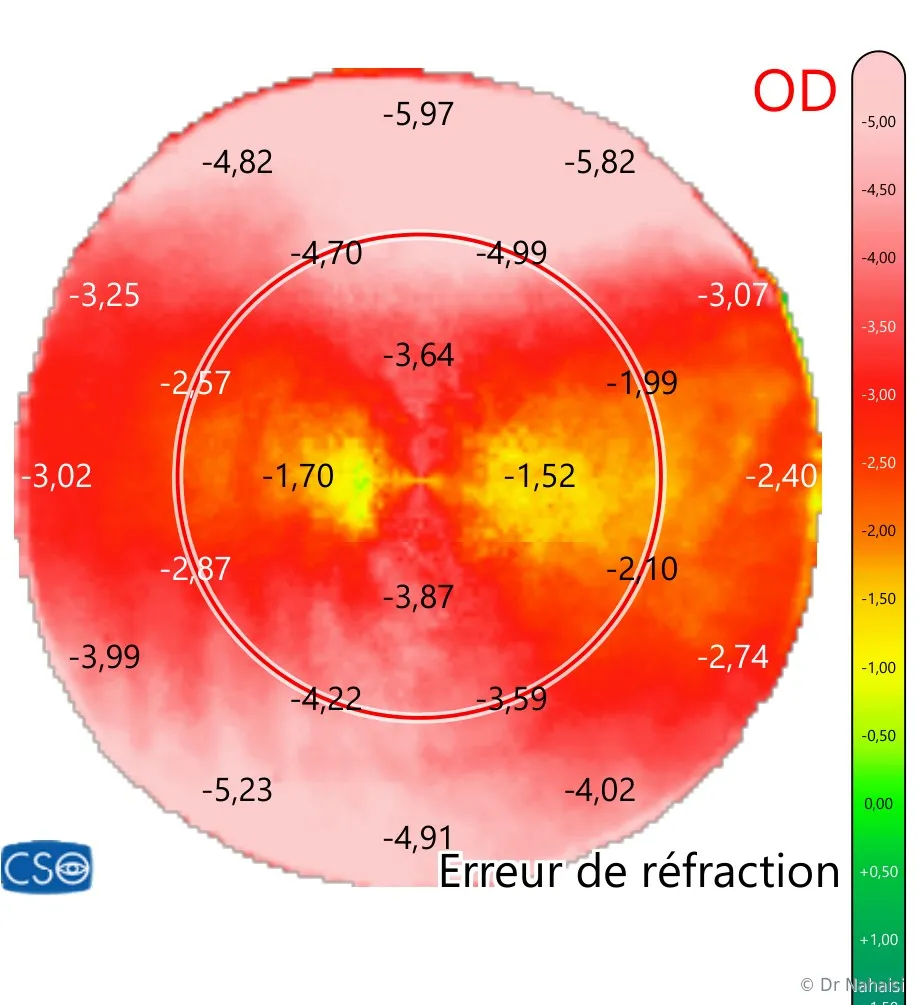
The aberrometry of an astigmatic eye: the optical error measured point by point. The vertical values (top and bottom) are much more nearsighted (-4 to -6 diopters) than the horizontal values (-1.5 to -3). This is the signature of astigmatism, and it is this complete map that is sent to the laser, not an average value.
Vision after laser surgery is often better than with glasses, because the treatment is more precise than what lenses can offer. This is especially true for people with astigmatism.
The practical principle: making the cornea regular
Astigmatism comes from a cornea that does not have the same curvature along every axis. The laser corrects this by adjusting the curvature differently depending on the axis: it flattens the steepest axis and/or steepens the flattest axis, to make the corneal surface as spherical as possible.
When astigmatism is combined with myopia or hyperopia, the laser incorporates both components into a single treatment, performed in a single session.
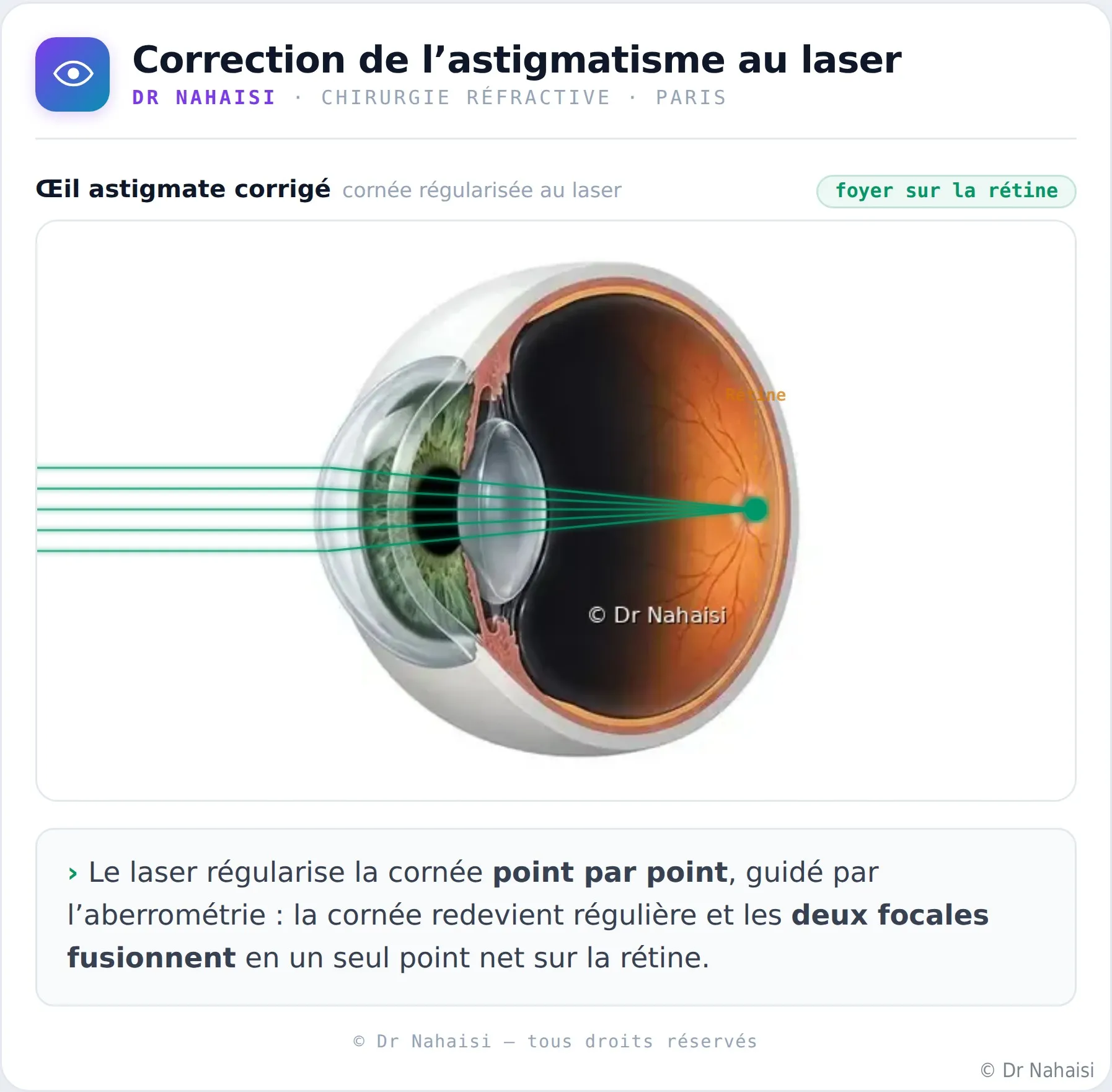
The laser regularizes the cornea point by point: it becomes spherical again and the two focal points merge into a single sharp point on the retina.
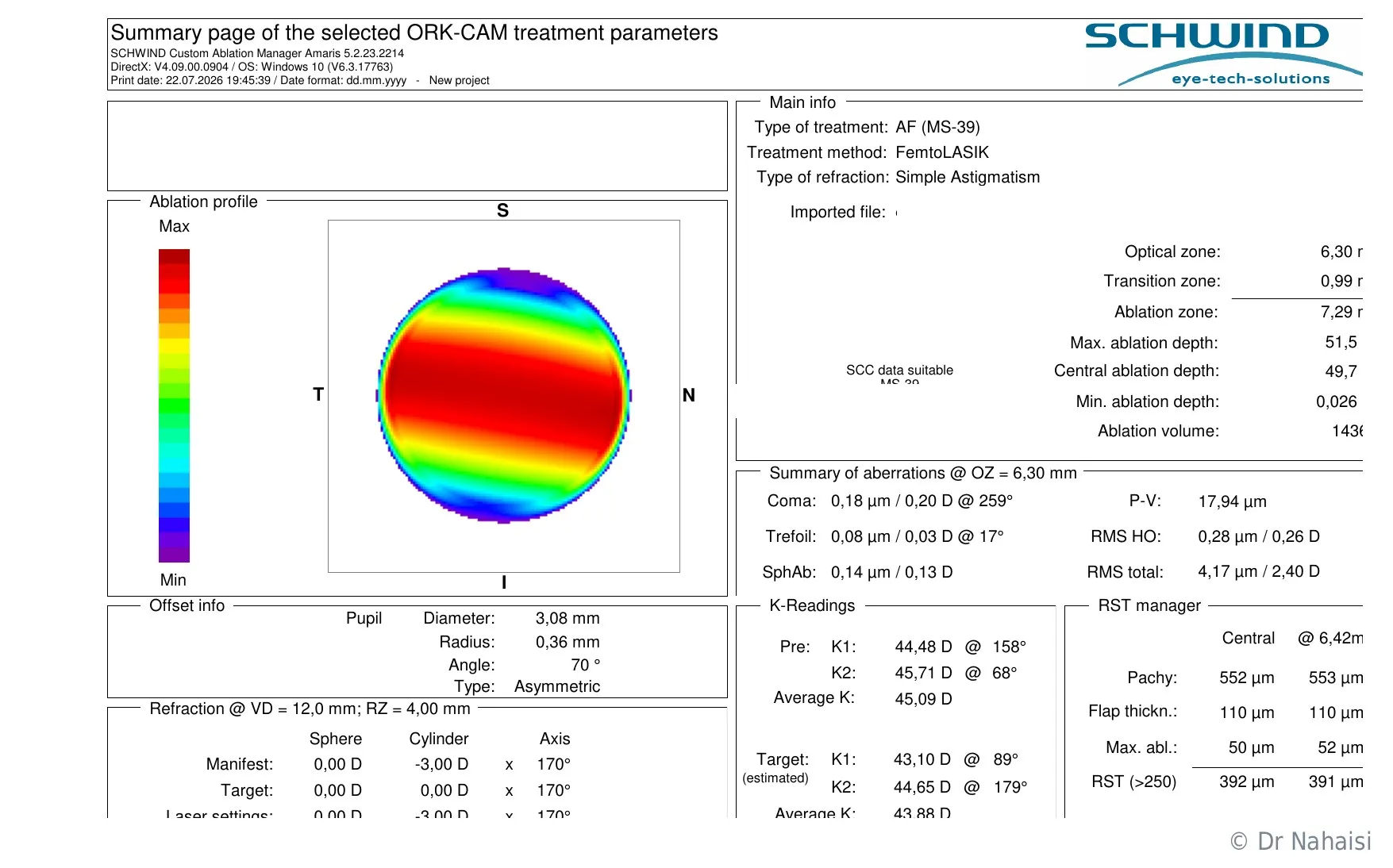
The treatment plan for pure astigmatism of -3.00 diopters at 170°, as displayed on the Schwind Amaris 750S console before the procedure. The map shows the depth of tissue removed at each point: red corresponds to the maximum, here 51.5 microns, blue and purple to almost no ablation. The laser carves a horizontal band and barely touches the top or bottom of the cornea. By removing tissue this way, it flattens the vertical meridian, the steepest one, and leaves the horizontal meridian as it is. The two curvatures meet, and the cornea becomes spherical again.
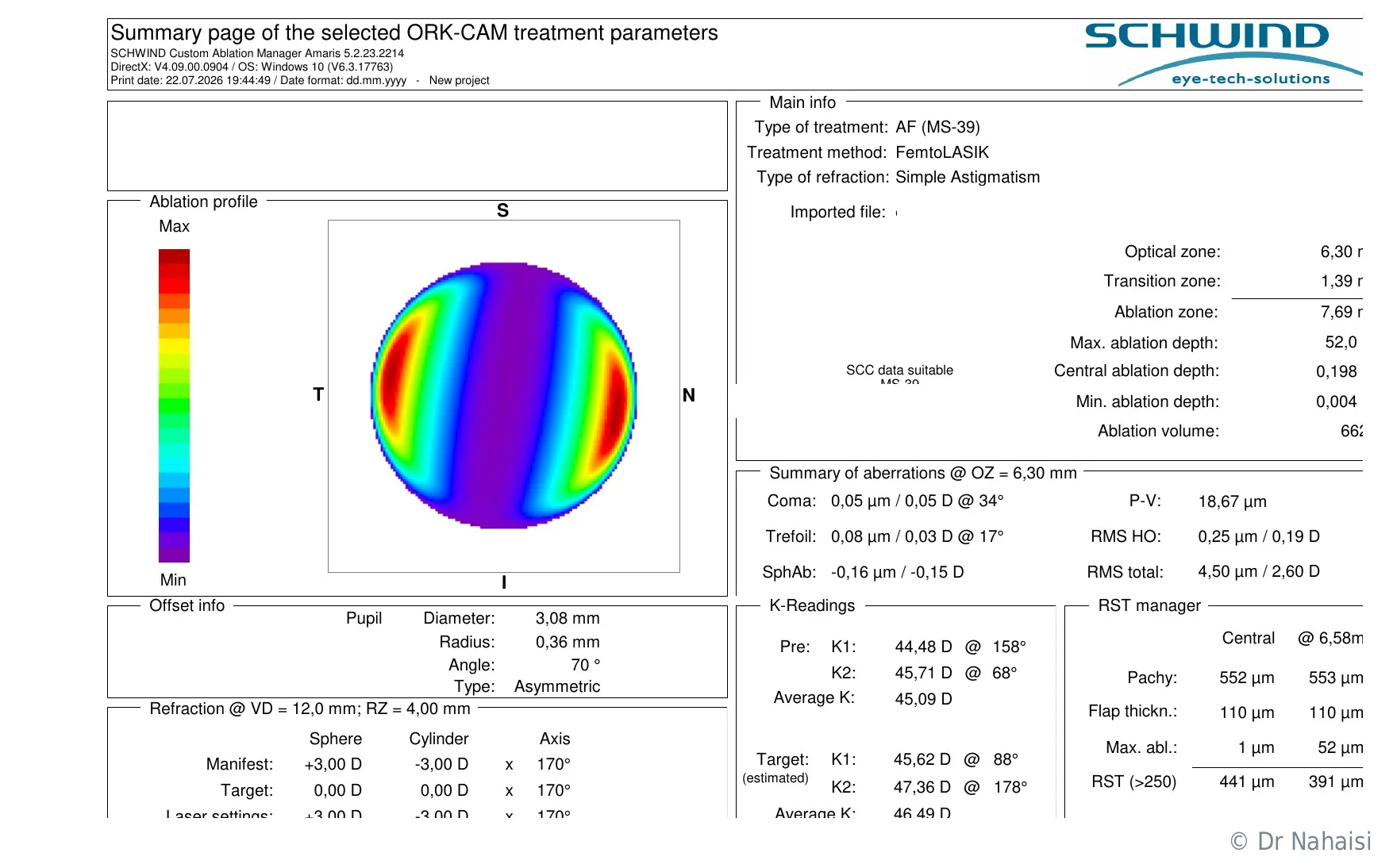
Another scenario, on the same laser: hyperopic astigmatism, +3.00 (-3.00 at 170°). Here the laser works in the periphery, at 3 and 9 o’clock, where the map is red. By carving on either side of the horizontal meridian, it steepens it so that it matches the vertical meridian. The center of the cornea is barely touched, 52 microns at most. This demonstrates what the laser can do and glasses cannot: it does not merely add or remove power, it gives each meridian back the curvature it lacks.
Taking cyclotorsion into account
An important technical point, particularly relevant for astigmatism: the eye rotates on itself depending on the position of the body. You go from the sitting position, in which the measurements are taken, to the lying position, in which you are operated on. Between the two, the eye makes a slight rotation called cyclotorsion.
If this rotation is not compensated for, the axis of the laser treatment no longer exactly matches the axis of the astigmatism, and the correction loses precision. This is especially true for high astigmatism, where a few degrees of offset are enough to affect the result.
The Schwind Amaris 750S platform we use at the Institut Voltaire includes an iris recognition system: before the treatment, the laser identifies unique landmarks on your iris, then automatically compensates for any rotation of the eye during the procedure. The treatment axis is thus perfectly aligned with the axis of your astigmatism, whatever the position.⁴·⁵
TECHNIQUES FOR ASTIGMATISM SURGERY
Which technique to correct your astigmatism with a laser?
As with myopia and hyperopia, the technique is chosen during the pre-operative assessment, based on your prescription, the characteristics of your cornea and your needs. All procedures are performed on the Schwind Amaris 750S excimer laser and Visumax 800 femtosecond laser platform, at the Institut Voltaire.
LASIK: the gold-standard technique
The most widely performed technique in the world. A femtosecond laser (Visumax 800) creates a thin corneal flap (the “flap”), then the Schwind excimer laser reshapes the cornea underneath according to your prescription, guided by point-by-point aberrometry. The flap is then repositioned. Clear vision from the next day, return to work within 24 to 48 hours.
It is my first-line technique for most patients with astigmatism, when the characteristics of the cornea allow it. LASIK corrects astigmatism up to about -6 diopters.⁶
Fee: €3,200 for both eyes (€1,600 per eye). Follow-up included.
TransPRK: maximum safety, no flap
A surface treatment, with no flap and no contact. The safest technique biomechanically. I favor it when LASIK is not the best option for your profile: borderline corneal thickness, a less regular cornea, or simply your apprehension. I also recommend it for patients exposed to impacts (combat sports, law enforcement).
Recovery is more gradual: allow about a week before returning to work comfortably.
Fee: €2,800 for both eyes (€1,400 per eye). Follow-up included.
SMILE: less precise for astigmatism
SMILE is a minimally invasive technique that I reserve for specific indications. Its results are less precise for astigmatism than LASIK or TransPRK. I therefore do not recommend it as a first-line option when astigmatism is the main component of the correction. Cyclotorsion compensation is also less precise than with the excimer laser (LASIK or TransPRK), which further penalizes astigmatism correction. SMILE is also not suitable for correcting hyperopia.
Fee: €3,800 for both eyes (€1,900 per eye). Follow-up included.
ARE YOU A CANDIDATE?
Who can have laser astigmatism surgery?
The vast majority of people with astigmatism are candidates. The pre-operative assessment confirms this and helps choose the most suitable technique.
Age
Refractive surgery is possible from age 18. Unlike myopia, astigmatism has almost no reason to change in adulthood. The question of stability therefore mainly concerns the associated component (myopia or hyperopia), not the astigmatism itself.
At 24, it is a very good age. At 45 too. I have operated on patients at every age of adult life, up to 65.
Stability, a concept that needs nuance
As I explain in the pages on myopia and hyperopia, absolute stability does not exist. The eye has natural fluctuations. For astigmatism, the question is even simpler: it almost never changes.
When a patient tells me that “their astigmatism has changed” between two prescriptions, it is almost never a real change. Several phenomena explain these apparent variations:
1. Accommodation. The crystalline lens can deform in a slightly toric way when it accommodates. The measured astigmatism then varies from one exam to the next, including its axis, without the cornea having changed.
2. Frequent under-correction in glasses. Astigmatism is very often only partially corrected, sometimes even ignored, on the glasses prescription. Finding a higher astigmatism on a new prescription does not necessarily mean it has progressed: it is often the same condition, simply measured better or finally corrected at its true value (see section 3 for more details).
3. Aberrometry. Glasses are only an average of all the corrections across the surface of the eye. Each point of the cornea has its own correction, and the astigmatism value written on the prescription depends on how the examiner averaged these values. If you take ten measurements on the same day, you will find variations of ±0.50 diopters depending on the examiner.
It is this natural stability of the cornea that makes the results of refractive surgery long-lasting.⁷·⁸
I suggest that patients come directly for a consultation to have the full assessment. In the vast majority of cases, we will be able to reassure you and move forward.
Laser hyperopia surgery in Paris
The cornea
This is the most important criterion. Corneal thickness, regularity, curvature and the post-operative residual stromal bed determine feasibility and the choice of technique. The classic threshold for LASIK is a pre-operative thickness of 500 microns, but it is not the only factor. A regular 490-micron cornea with a small amount of astigmatism will be better suited to LASIK than an irregular 520-micron cornea with a high correction.
Keratoconus screening is an integral part of my pre-operative assessment. This is particularly important for people with astigmatism, because keratoconus shows up precisely as progressive irregular astigmatism. Having spent years managing weakened corneas and advanced keratoconus at Cochin Hospital gives me a different perspective on every topography I analyze.
Correction limits
The laser can correct astigmatism up to about -6 diopters, within the limits of the cornea. Beyond that, other solutions exist. For combined corrections (myopia + astigmatism or hyperopia + astigmatism), it is the overall profile that determines whether you are a candidate, not each component in isolation.
Pregnancy and breastfeeding
I do not operate during pregnancy. This is a precaution: hormonal fluctuations can temporarily change the refraction. Breastfeeding, on the other hand, is not a problem and does not prevent surgery. And there is no reason to wait until you have had all your children: surgery can perfectly well be done before a pregnancy or between two.
What if I am not a candidate for laser surgery?
It happens, and that is precisely why the assessment exists. When the laser is not the right option for your eyes, I say so clearly and refer you to the most suitable solution. I would rather not operate than take the slightest risk.
When laser surgery is not possible: alternatives and guidance
COMBINED ASTIGMATISM: MYOPIA + ASTIGMATISM, HYPEROPIA + ASTIGMATISM
Astigmatism rarely comes alone: associated myopia and hyperopia
Pure astigmatism, without myopia or hyperopia, exists, but it is relatively rare. Most often, it is combined with another vision problem. It is even the most common scenario in my practice.
Myopia and astigmatism
This is the most common combination. If you are nearsighted, there is a good chance you also have associated astigmatism. On your prescription, you will then see a negative sphere (the myopia) and a cylinder (the astigmatism), as in example 2 of the previous section.
The laser corrects both components during the same procedure. You do not need two separate procedures. The myopia and the astigmatism are incorporated into one single laser program, adapted to your combined profile, and corrected simultaneously. All three techniques (LASIK, TransPRK and SMILE) can treat them together, although LASIK and TransPRK are more precise on the astigmatic component.
Hyperopia and astigmatism
The combination of hyperopia + astigmatism is also very common. Most of my farsighted patients also have associated astigmatism. LASIK and TransPRK correct both components during the same procedure.
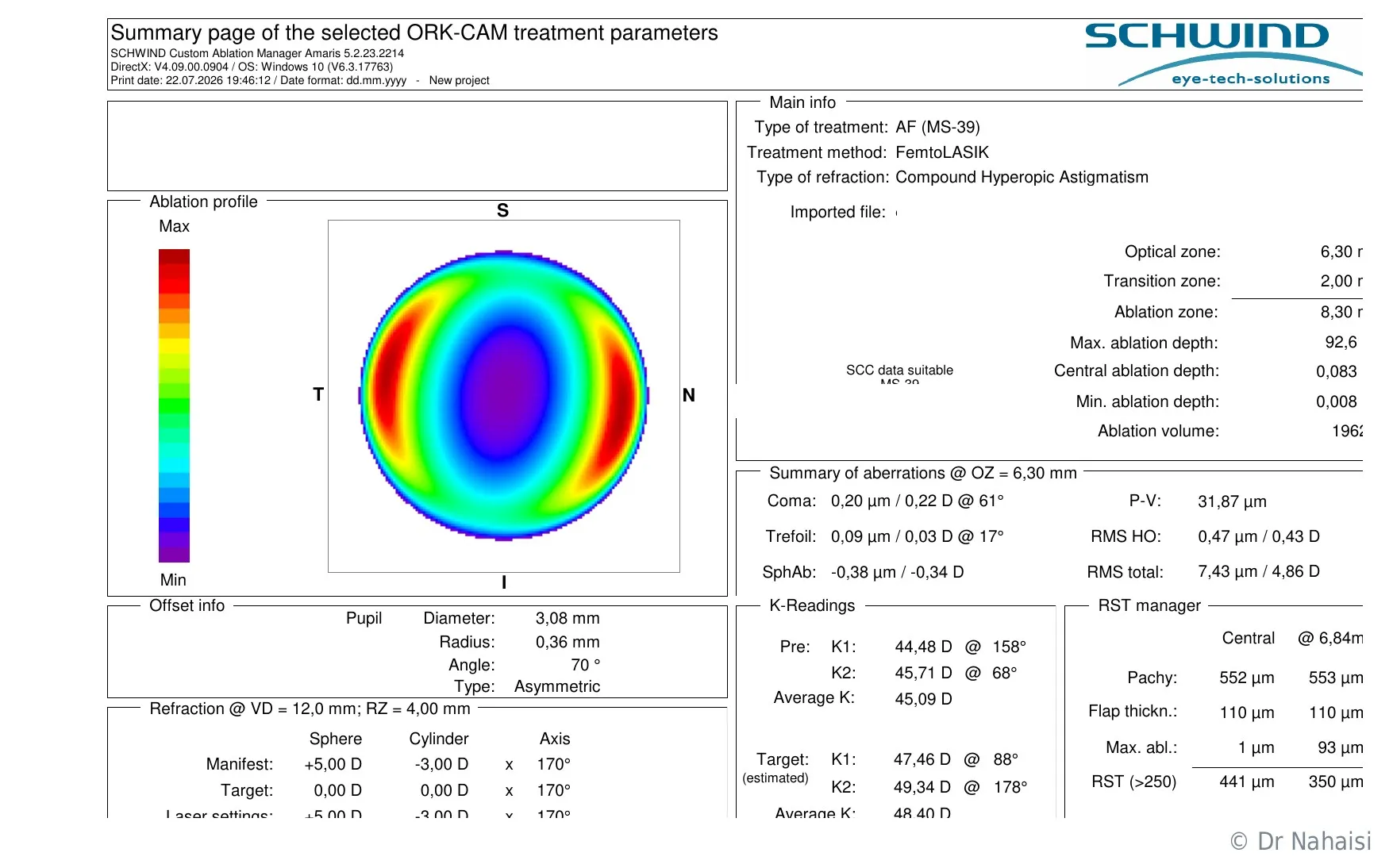
High hyperopia combined with astigmatism, +5.00 (-3.00 at 170°). The laser removes tissue in the periphery, over two lobes located at 3 and 9 o’clock, and spares the center. The central cornea ends up relatively steeper, and therefore more powerful, and the flat meridian is steepened in the process. Maximum ablation 92.6 microns.
For hyperopia with astigmatism, LASIK is generally my first-line technique when it can be performed safely, because it offers better control of regression in hyperopic treatments. SMILE is not suitable for this combination.
Laser hyperopia surgery in Paris
Astigmatism and presbyopia
Around age 40–45, presbyopia adds to astigmatism (and to myopia or hyperopia where applicable). Several strategies exist to treat everything: PresbyLASIK, monovision, hybrid treatment. The choice depends on your prescription, your expectations and your visual profile. We discuss it during the consultation.
RESULTS AND DURABILITY
Results of astigmatism surgery: what to expect?
The goal is clear: good vision without glasses. Not a perfect 0.000. What I aim for is your independence from glasses in everyday life, not an absolute zero on the refractometer.
For moderate astigmatism, the result is generally excellent. The correction is complete, vision is sharp, and the halos disappear. For high astigmatism, a slight residual may persist, but the improvement is considerable compared with the starting point.
Regression of astigmatism after surgery
The principle of the surgery is to reshape the cornea by removing a layer of tissue from the corneal stroma. Regression consists of a long-term re-thickening of the epithelium (the “skin” of the cornea), which can partially offset the ablation. This phenomenon is normal, but very limited most of the time.
If it is more pronounced, astigmatism may reappear a few years after surgery, but it will never reach the values you have now. If you have -2 of astigmatism today, at most it could rise to -0.50 in 5 to 10 years. And astigmatism of -0.50 generally does not bring vision below 10/10 (20/20).
The correction is long-lasting
The cornea is a remarkably stable tissue in adulthood. It takes on its final shape in early childhood and no longer changes over the course of life, apart from conditions such as keratoconus, which we systematically screen for before any surgery. The laser correction is therefore long-lasting.
Laser enhancement
If a residual persists or reappears, a laser enhancement (touch-up) is possible. It is included in the first year after the procedure, and offered at a preferential rate up to 5 years after surgery. An enhancement is generally not considered before 6 months after surgery, to allow the cornea to stabilize.
Learn more about fees, quotes and complementary health insurance reimbursement
FEES AND INSURANCE COVERAGE
Laser astigmatism surgery fees in Paris
Fees are fixed, the same whatever the correction to be treated. The price does not change if astigmatism is combined with myopia or hyperopia, since the treatment is performed in a single procedure.
| Technique | Fee per eye | Fee for both eyes |
|---|---|---|
| LASIK | €1,600 | €3,200 |
| TransPRK | €1,400 | €2,800 |
| SMILE | €1,900 | €3,800 |
Post-operative follow-up is included in the fee. The enhancement is included in the first year and offered at a preferential rate up to 5 years after surgery.
Pre-operative consultation: at the standard rate set by French national health insurance. At the offices in Paris 10th and 19th (10e and 19e arrondissements), there is no fee supplement and nothing to pay upfront (direct billing). At the Institut Voltaire (Paris 11th, 11e arrondissement), you pay €50 upfront, including a €30 fee supplement, reimbursed at least €20 by your complementary health insurance.
Refractive surgery is not reimbursed by French national health insurance, but your complementary health insurance may cover part of the cost. I provide a personalized quote for you to send to your insurer.
Payment can be spread over 4 installments by check or direct debit, or adapted to your complementary health insurance’s reimbursement schedule.
Learn more about fees, quotes and complementary health insurance reimbursement
Frequently asked questions
Your questions about laser astigmatism surgery
Can the laser correct astigmatism?
Yes. The excimer laser corrects astigmatism by regularizing the curvature of the cornea: it adjusts the tissue differently depending on the axis to make the corneal surface as spherical as possible. Correction is possible up to about -6 diopters of astigmatism, within the limits of the cornea.
Can myopia and astigmatism be corrected at the same time with a laser?
Yes, it is even the most common case. Myopia and astigmatism are corrected during the same procedure, in a single session. The laser incorporates both components of your prescription into a single treatment program, adapted to your combined profile. All three techniques (LASIK, TransPRK and SMILE) can correct this combination.
Can the laser correct hyperopia and astigmatism at the same time?
Yes. Hyperopia and astigmatism are corrected simultaneously, during the same procedure. LASIK is generally the first-line technique for this combination, because it offers better control of regression in hyperopic treatments. SMILE is not suitable for correcting hyperopia.
Why does the laser correct astigmatism better than glasses?
Two main reasons. First, the lens-to-eye distance: glasses sit 12–14 mm from the eye, which creates optical distortions that are particularly pronounced with cylindrical lenses. The laser works directly on the cornea, at zero distance. Second, precision. Glasses correct an average of the correction over the whole eye, whereas the laser treats each point of the corneal surface individually thanks to aberrometry.
Can astigmatism come back after laser surgery?
Slight regression is possible over the long term, linked to the natural re-thickening of the corneal epithelium. But it remains very limited. If you have -2 diopters of astigmatism today, any reappearance would generally not exceed -0.50 in 5 to 10 years, a value that does not bring vision below 10/10 (20/20). If necessary, a laser enhancement is possible.
Is laser astigmatism surgery painful?
No. The procedure is done under local anesthesia with eye drops, without injections. You feel no pain during the surgery. For your comfort, I prescribe an anti-anxiety medication to take one hour before the procedure. After LASIK or SMILE, discomfort is minimal (a few hours of stinging). After TransPRK, the first 48 hours can be uncomfortable, but you get through it quickly.
How long does laser astigmatism surgery take?
The procedure itself takes about ten minutes for both eyes. The actual laser treatment lasts only a few seconds per eye. The rest of the time is spent on preparation and positioning.
When can I return to work after astigmatism surgery?
With LASIK or SMILE, you can return to work the next day or the day after. Surgery days are on Friday mornings, and most patients go back to work on Monday. With TransPRK, recovery is more gradual: allow 7 to 10 days. The final result is assessed around 2 to 3 months after surgery.
LASIK, TransPRK or SMILE: which technique for astigmatism surgery?
The choice depends on your corneal profile, your prescription and your needs. LASIK is my first-line technique for most people with astigmatism. TransPRK takes over when LASIK is not the best option. SMILE is less precise for astigmatism and is not suitable for hyperopia. The choice is made during the pre-operative assessment.
My astigmatism changed between two prescriptions: is that a problem for surgery?
No. Astigmatism rarely truly changes in adulthood. The variations seen from one prescription to another are most often linked to the measurement conditions and each doctor’s habits, not to instability of the condition. If you take ten measurements on the same day, you will find variations of ±0.50 diopters depending on the examiner. The pre-operative assessment I perform at the Institut Voltaire uses far more advanced measurements than those of a glasses prescription.
Do I need a referral letter from an ophthalmologist to book a consultation for astigmatism surgery?
No. You can book an appointment directly on Doctolib or by phone, with no referral letter needed. There is no need to see another ophthalmologist before the consultation.
Is astigmatism always associated with myopia or hyperopia?
Not always, but very often. Pure astigmatism (without myopia or hyperopia) exists, but most patients with astigmatism also have a myopic or hyperopic component. In all cases, the laser corrects the entire prescription in a single procedure.
Will halos get worse after astigmatism surgery?
The halos you currently have are linked to your astigmatism. After surgery, you will have some post-operative halos during the first month, but they will already be less pronounced than those you have with your uncorrected astigmatism. They then gradually decrease. The peak is at around two months, after which they fade steadily. In the end, night vision is generally better than before the surgery.
Should I stop wearing my toric contact lenses before a pre-operative assessment for refractive surgery?
Yes. Contact lenses temporarily change the curvature of the cornea, which can distort the measurements. For soft toric lenses, stopping a few hours before the assessment is generally enough. For rigid lenses, you need to stop for longer (several weeks). I will tell you the exact duration when you book your appointment.
Is a laser enhancement possible after astigmatism surgery?
Yes. If a residual persists or reappears after a few years, an enhancement can be considered, generally not before 6 months after surgery, to allow the result to stabilize. The enhancement is included in the first year and offered at a preferential rate up to 5 years.
What are the side effects of laser astigmatism surgery?
The most common side effects are temporary dry eye (a few weeks to a few months, managed with artificial tears) and transient halos (which gradually fade). These effects are common to all refractive surgery and are not specific to astigmatism. I take the time to explain them in detail during the consultation.
BOOK AN APPOINTMENT
Ready to see clearly?
The first step is simple: a consultation to review your eyes, your prescription and the options available to you. No commitment, no pressure. A full assessment and a frank discussion.
No referral letter needed, and no need to see another ophthalmologist beforehand. You can book an appointment directly.
Book an appointment on Doctolib
Phone and WhatsApp:01 84 80 28 04 · Email:nahaisi@laservisionparis.com · Doctolib messaging
Download the information booklet (PDF)
Author: Dr Steven Nahaisi, ophthalmic surgeon specializing in laser refractive surgery, Institut Laser Ophtalmologique Voltaire (Voltaire Laser Eye Institute), Paris 11th.
Your surgeon
Dr Steven Nahaisi
Ophthalmic surgeon dedicated exclusively to laser refractive surgery. He operates at the Institut Laser Ophtalmologique Voltaire and consults in three Paris offices. Consultations in English.