Your journey
Laser Eye Surgery, from the First Consultation to the Last Check-up
Before having surgery, we all ask ourselves the same questions. How does it work? How many appointments? Does it hurt? When will I be able to go back to work? How does vision change afterward? And if something is wrong, what happens?
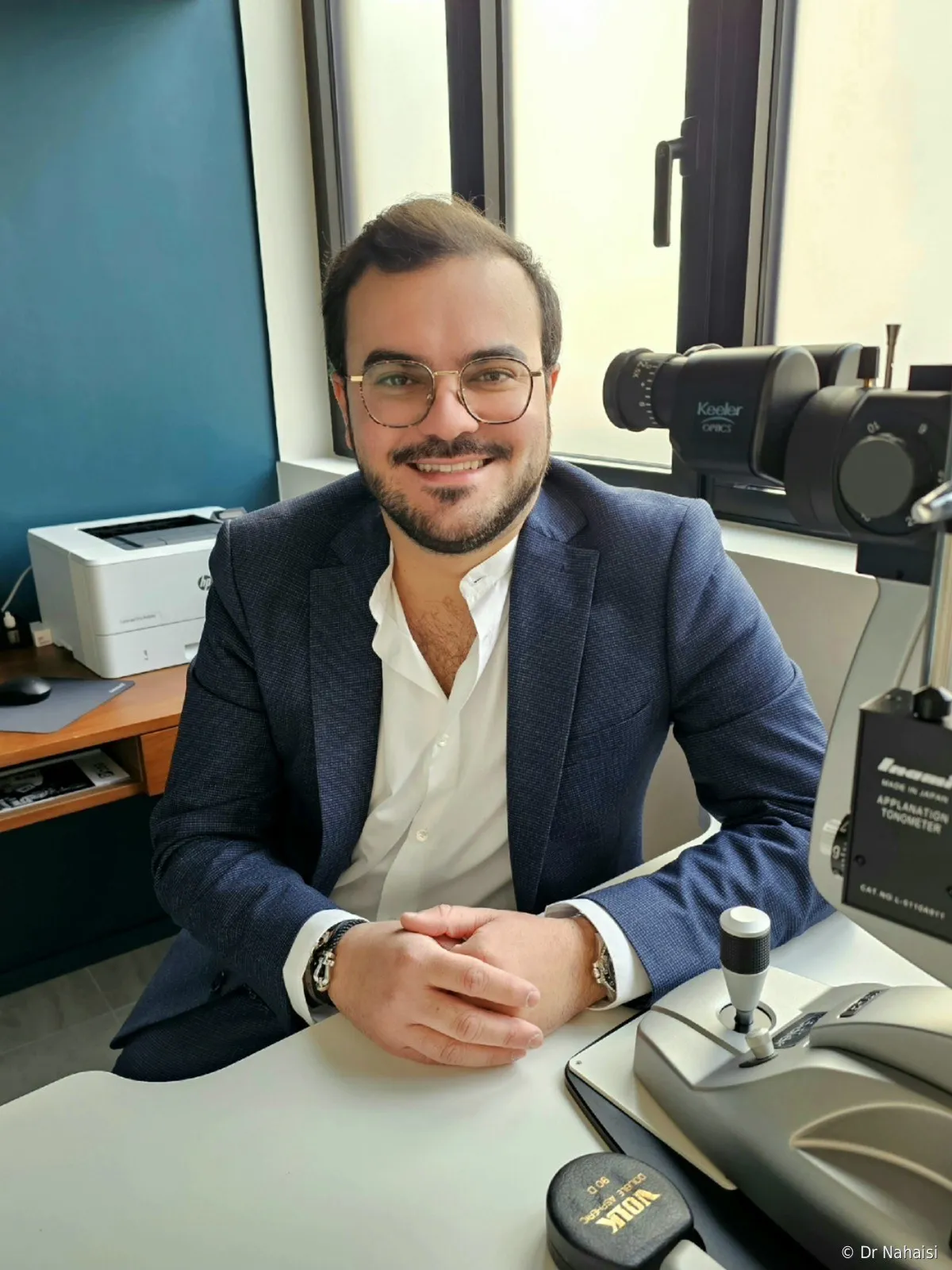
Dr Steven Nahaisi
Updated on 15 October 2026 · 12 min read
I designed this page to answer them, step by step, as clearly as possible. The whole journey is here, from the first contact to the last check-up.
You can also download the information booklet I send to every patient. It covers the techniques, the fees, how the surgery goes and the post-operative course.
On this page9 sections
STEP 1: FIRST CONTACT
Booking a refractive surgery consultation
You can book an appointment on Doctolib, by writing to me by email or through the Doctolib messaging service, or by phone at 01 84 80 28 04.
Book an appointment on Doctolib
Write to me through Doctolib messaging
If you do not have Doctolib, you can book an appointment by phone. This number rings on my cell phone; when I am not available, you are transferred to an AI phone assistant that can answer your questions and schedule appointments.
No need for a referral letter or a doctor’s note. You can come and see me as soon as you are looking for a way to get rid of your glasses or contact lenses.
A quick note about Doctolib
You will see two visit types, “Première consultation” (first consultation) and “Consultation préopératoire” (pre-operative consultation). They are the same thing. Click on either one.
Where can you see me?
I see patients in three centers in Paris. Surgery takes place exclusively at the Institut Voltaire.
| Location | Address | Time slots | Metro |
|---|---|---|---|
| Centre Santé Plus, Paris 10th | 12 rue du Fg St-Martin, 75010 | Thursday afternoon | Strasbourg-St-Denis (4,8,9) |
| Cabinet Ophtavie, Paris 19th | 37 rue Archereau, 75019 | Monday afternoon | Crimée (7) |
| Institut Voltaire, Paris 11th | 5 rue La Vacquerie, 75011 | Wednesday afternoon | Voltaire (9) / Ph. Auguste (2) |
Are there any documents to bring?
Not much. Bring your glasses or your recent prescriptions if you have them. You do not need to gather all your prescriptions from the past few years.
Should I wait until my vision is stable?
Stability is a big word. The prescription of an eye naturally fluctuates depending on fatigue, examination conditions and accommodation. A small variation of 0.25 or 0.50 diopters between two consultations is a normal fluctuation, not a progression.
There is no need to wait years before coming. Come for an opinion, we will do a complete assessment, and I will tell you where you stand.
From our very first exchange, I send you the information booklet and personally answer your questions.
STEP 2: THE PRE-OPERATIVE CONSULTATION
The pre-operative assessment, a single consultation is enough
No drawn-out process. Most of the time, a single appointment is enough to carry out the full assessment, discuss your expectations, explain the techniques and answer all your questions. Allow about an hour on site.
What we do during the assessment
The assessment has two parts:
General assessment: visual acuity, eye pressure measurement, retinal photography (fundus exam without drops).
Refractive surgery assessment: precise refraction, analysis of the cornea (topography, anterior segment OCT, thickness measurement), point-by-point aberrometry, evaluation of the ocular surface and of the risk of dry eye. These measurements determine your eligibility and guide the choice of technique.
Learn more about the pre-operative assessment
No drops to dilate your eyes
I almost never need to dilate your pupils. The fundus exam is done with retinal photography, without drops. You leave just as you came, and you can drive normally.
An examination under Skiacol, drops that temporarily paralyze accommodation, is only needed in rare cases. If that applies to you, I will offer to do it on site or for you to come back another time.
Contact lens wearers
Ideally, remove your contact lenses on the morning of the consultation for more accurate measurements. The measurements are still usable if you remove them on site. Before surgery, however, soft lenses must be removed 48 hours beforehand; for rigid lenses, it is decided case by case, with a topographic check of stability.
Consultation fee
The consultation is at the standard rate set by French national health insurance. At the Paris 10th and 19th practices, there is no fee supplement and there is nothing to pay upfront (direct billing). At the Institut Voltaire (11th), you pay €50 upfront, including a €30 fee supplement. Your complementary health insurance reimburses at least €20, and often the full amount depending on your plan.
At the end of the consultation
You leave with a plan and an answer: whether you are a candidate or not, which technique, what result to expect. You receive a quote and a surgery file. The date of the procedure can be chosen at the end of the consultation, but you do not have to. Some patients schedule their surgery in the following weeks. Others come back to me several months or several years later, and others never follow up. There is no obligation. What matters is choosing with peace of mind and being ready.
In any case, I remain available. To get back to me: Doctolib messaging, email, phone or WhatsApp.
STEP 3: PREPARING FOR SURGERY
Surgery file, consent and time before the procedure
Choosing the technique
LASIK, TransPRK or SMILE: the technique is chosen together during the consultation, based on your prescription, your corneal thickness, the topography, the aberrometry and your needs. There is no technique that is better in absolute terms. There is the one that best suits your eye or your profile.
LASIK: everything you need to know
TransPRK: everything you need to know
SMILE: everything you need to know
The surgery file
Once the date is set, I give you your surgery file:
- The appointment notice, with the date, time and place of the procedure
- The prescription, with the anti-anxiety tablet to take before surgery and the post-operative eye drops to pick up at the pharmacy.
- The surgical consent form, to bring back signed on surgery day to authorize the procedure.
- The quote, to send to your complementary health insurance to find out how much it covers.
No anesthesiologist consultation
Unlike conventional surgery, refractive surgery does not require a pre-anesthesia consultation. Anesthesia consists of a few anesthetic drops instilled just before the procedure. No injection, no general anesthesia.
The time between consultation and surgery
Allow about a month between the consultation and surgery. Sometimes less, as slots open up. If you have a date constraint, tell me at the consultation and we will see what is possible. Sometimes we even schedule the procedure before the consultation when the calendar is tight.
Throughout this period, you can write to me at any time.
STEP 4: SURGERY DAY
How laser eye surgery goes, the big day
When and where?
Procedures take place at the Institut Laser Ophtalmologique Voltaire (5 rue La Vacquerie, Paris 11th), on Friday mornings and sometimes on Wednesday afternoons. Both eyes are operated on the same day, except in special cases.
Before going into the operating room
In the surgery file, I prescribe an anti-anxiety tablet (Seresta) to take about an hour before your appointment time. It is not mandatory, but I recommend it: you arrive relaxed and you can let things happen calmly. If you are very stressed, you can take one the night before to sleep well.
It will also help you take a good nap after surgery, so you sleep through the first few hours, which can be a little uncomfortable.
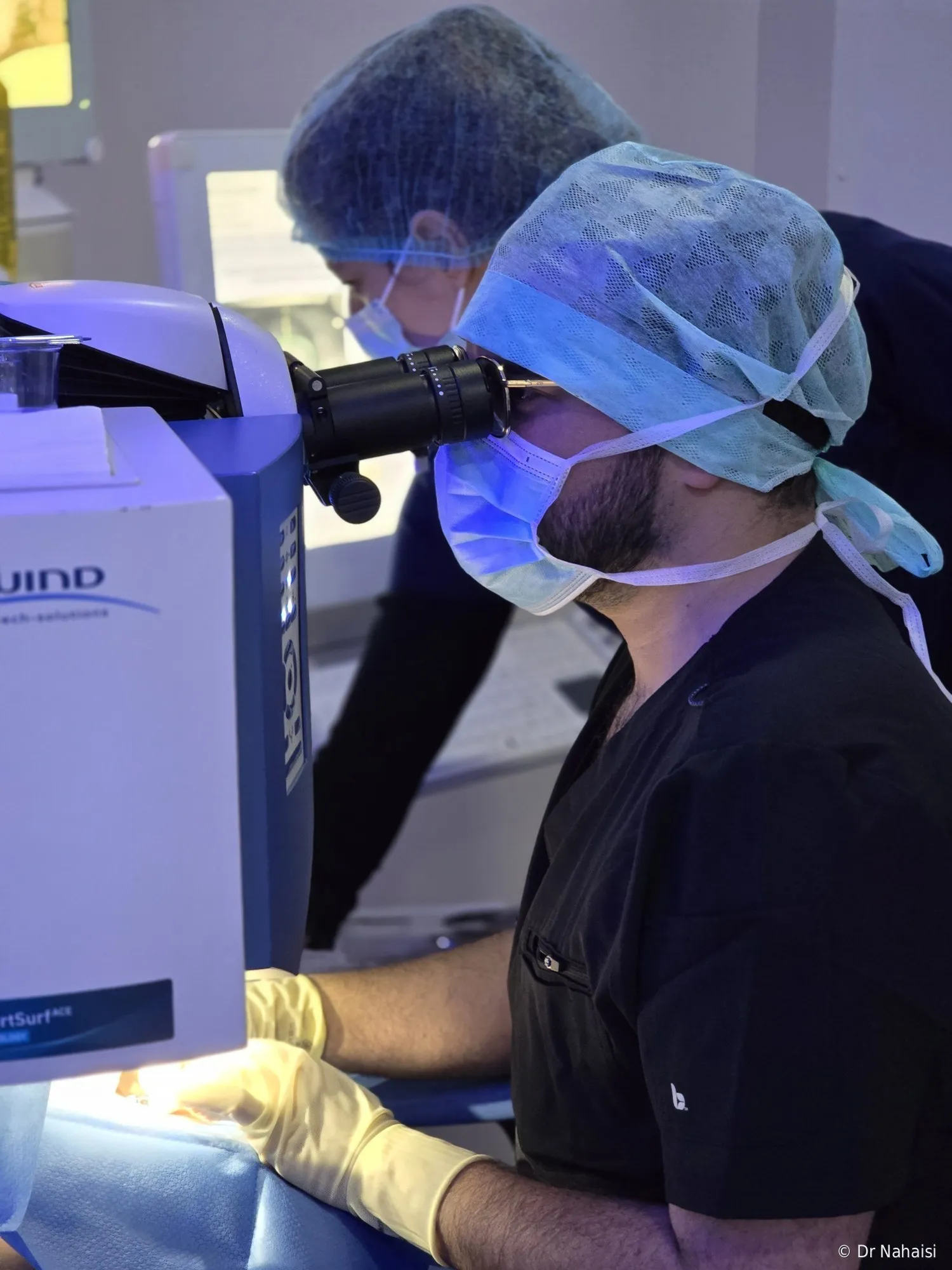
On site, personalized aberrometry measurements are taken on the clinic’s machines, linked directly to the Schwind excimer laser. You are not asked to read letters as in a standard eye exam. These are objective measurements, which allow a fully personalized treatment of your prescription.
The procedure
Surgery lasts about ten minutes, all included. The procedure itself only takes a few minutes per eye.
In the operating room at the Institut Voltaire, during a procedure with the Schwind excimer laser. You are lying down, the eye numbed with drops, and the team stays with you from start to finish.
During surgery, you will feel my hands touching your face, pressure on the eye for short moments, water running when we rinse, and at most a slight stinging here and there. Nothing more. It is a painless surgery, but it can be intimidating. That is why we do everything we can to make the moment as calm as possible. The Institut Voltaire team is there for that.
Allow about one hour to one and a half hours in total on site, between arrival, paperwork, measurements, surgery and the rest period that follows.
Going home
You will not be able to drive in the hours following the procedure, and it may be difficult to take public transportation alone. You can go home with someone, which is what I recommend, or alone by taxi or ride-hailing car.
Payment
Payment is made on surgery day, at the front desk, before the procedure. The accepted payment methods are: credit card, check, bank transfer or direct debit. Payment in installments is possible in 4 installments, by check or direct debit.
Complementary health insurance does not pay the clinic directly: you are the one reimbursed upon presentation of the invoice. If your insurance covers a significant amount, we can defer a payment corresponding to that sum and only cash it once you have received your reimbursement.
| Technique | Fee per eye | Fee for both eyes |
|---|---|---|
| TransPRK | €1,400 | €2,800 |
| LASIK | €1,600 | €3,200 |
| SMILE | €1,900 | €3,800 |
| PresbyLASIK | €1,800 | €3,600 |
Included in the fee: complete post-operative follow-up, with no limit on the number of visits, and a possible enhancement in the first year.
STEP 5: GOING HOME AND THE FIRST FEW DAYS
Recovery after laser eye surgery
After LASIK
Immediate vision: a haze, like a cloudy fog in front of your eyes. But behind that haze, the immediate impression of seeing more clearly, a bit as if you were wearing glasses in a smoke-filled room. For high prescriptions, the effect can be striking within the first few minutes. I like to call it “the WOW effect”.
The first few hours: discomfort such as stinging, watery eyes, sensitivity to light, the urge to keep your eyes closed. This discomfort lasts about 4 to 6 hours. Usually, you go home and take a nap thanks to the anti-anxiety tablet, and when you wake up you already feel fine.
Getting back to normal: most patients return to work the next day, even on a screen. It is a little tiring, but doable. Driving is usually possible from the next day.
Instructions:
- Do not touch your eyes for 3 days. Protective glasses are provided, and after LASIK, clear eye shields to wear for the first three nights
- Do not rub your eyes for a week. Avoid eyelid and eyelash makeup
- Avoid sports with a risk of a blow to the eye and combat sports for 3 weeks, and swimming in a pool for 2 weeks. Simply bathing is allowed
- You can shower the same evening. Avoid rinsing your face directly with the shower head for 2-3 days; wash it at the faucet, avoiding the eyes
After SMILE
Recovery is comparable to LASIK in most respects. The difference is the visual haze, which may last a few more days. On the other hand, the precautions related to rubbing are not the same as for LASIK, since there is no corneal flap.
After TransPRK
TransPRK is a surface surgery, with no corneal flap. Recovery is more gradual.
The first 48 to 72 hours can be uncomfortable: foreign body sensation, sensitivity to light, watery eyes. This is normal. A bandage contact lens is placed on each eye during healing, and removed between day 3 and day 5, at the first check-up.
Vision gradually improves from day 4 or 5. Allow about a week before returning to work comfortably. Some go back earlier, others prefer a few more days.
Post-operative treatment
The treatment is prescribed in the surgery file. It includes:
- Antibiotic + anti-inflammatory eye drops (Tobradex or equivalent), following a tapering protocol: over 15 days after LASIK or SMILE (4 drops/day for 5 days, then 3, then 2), over 20 days after TransPRK (4, 3, 2, then 1 drop/day, in 5-day periods)
- Artificial tears (Vismed, Thealose), in liquid form as often as you like during the day for hydration, and in gel form at bedtime if needed. To be used for at least a month, then according to your comfort
- Saline solution (Dacudose), to clean the eyes during the first few days
How to put in drops without touching your eyes: in front of a mirror, gently pull your cheek down with a clean finger (not the eyelid directly), and place the drop in the conjunctival sac (the small pocket between the eyelid and the eye). Never touch the surface of the eye with the tip of the bottle.
Time off work
I provide a sick note if needed.
THE EXPECTED RESULT
What you can expect from refractive surgery
The goal is good vision without glasses or contact lenses in everyday life. Not a prescription of exactly 0.000, because that does not really exist. The human eye is not a perfect machine, and there are always slight natural fluctuations.
What we aim for is sharp, comfortable vision that lasts. The vast majority of patients never wear glasses again for the corrected error. In the rare cases where a slight change occurs after several years, a laser enhancement can always be considered.
For those who spend a lot of time on screens, relaxation glasses can improve everyday comfort. They are neither mandatory nor systematic, but it is an option I suggest when relevant.
STEP 6: POST-OPERATIVE FOLLOW-UP
Follow-up after refractive surgery, check-ups and support
Follow-up appointments
Several check-up visits are scheduled after the procedure, typically in the first few days and then at one month. Outside these appointments, I remain available at any time if you need me. Many patients do not come back after one month and are doing very well. There is no formal obligation to come and see me again beyond that.
Follow-up by your surgeon, from start to finish
All post-operative follow-up is provided by the surgeon who operated on you. You are not redirected to another practitioner. When you write to me with a question, I know what we did and what to expect.
Available without limits
No time limit, no limit on the number of visits. A patient operated on three years ago will receive the same attention as a patient operated on the day before. Patients who are worried about discomfort in the days following surgery are often seen on the same day they ask.
Follow-up of your surgery is unlimited and included in the fee, and a possible enhancement is included during the first year. You can come for a consultation whenever you wish as part of this follow-up.
Usual side effects
In the first few weeks, it is normal to experience:
- Dry eye, with stinging and a foreign body sensation, relieved by artificial tears
- Halos around lights, especially in low light, with a temporary increase around the 2nd month followed by a gradual decrease
- Eye strain, especially on screens and when reading, which fades within a few weeks. Taking breaks helps (look into the distance for 20 seconds every 20 minutes)
If anything worries you, write to me.
STEP 7: WHAT COMES NEXT?
Life after refractive surgery, without glasses or contact lenses
Life without glasses
Once the surgical follow-up is over and everything is fine, you go back to your normal life. No mandatory annual check-up with me. Most of my patients enjoy sharp vision in everyday life, for the long term.
Regular eye care, with your regular ophthalmologist
When you no longer wear glasses, you tend to stop going to the eye doctor. Yet follow-up remains important: eye pressure, vision check, fundus exam, especially for people with high myopia.
This follow-up is the responsibility of your regular ophthalmologist. I do not provide it, but I wanted to remind you of it here.
BOOK AN APPOINTMENT
Questions? Just one step to get started.
Come and see me for a consultation. We do the assessment, we talk, and you leave with all the answers. No commitment, no pressure.
Book an appointment on Doctolib
Phone and WhatsApp: 01 84 80 28 04. WhatsApp is often the easiest. On the phone, a menu guides you: 1 to book an appointment, 2 for a question about surgery, 3 for an emergency after a procedure. By email: nahaisi@laservisionparis.com, or through Doctolib messaging.
Download the information booklet (PDF)
Author: Dr Steven Nahaisi, ophthalmic surgeon, specialist in laser refractive surgery, Institut Laser Ophtalmologique Voltaire, Paris 11th (11e arrondissement).
Your surgeon
Dr Steven Nahaisi
Ophthalmic surgeon dedicated exclusively to laser refractive surgery. He operates at the Institut Laser Ophtalmologique Voltaire and consults in three Paris offices. Consultations in English.