Vision problem
Myopia Laser Surgery in Paris
Myopia (nearsightedness) is one of the most common vision problems, and the one we correct most often: it affects nearly a third of the population in France and its prevalence keeps rising. It is the leading reason for consultation in my refractive surgery practice.
Dr Steven Nahaisi
Updated on 15 October 2026 · 26 min read
The laser corrects myopia by reshaping the cornea. The result is lasting and recovery is quick. The vast majority of patients never wear glasses again for the corrected error.
There are three techniques (LASIK, TransPRK, SMILE), and the choice depends on your eyes and your profile. Here I explain how it works, what the results are and where the limits lie. And I answer the questions my patients ask me every week.
On this page9 sections
UNDERSTANDING MYOPIA
What is myopia? Why is distance vision blurry?
Vision is a matter of light rays. To see clearly, the light rays entering the eye must converge exactly on the retina, the “film” at the back of the eye.
It is the cornea, the clear surface at the front of the eye, that does most of this focusing.
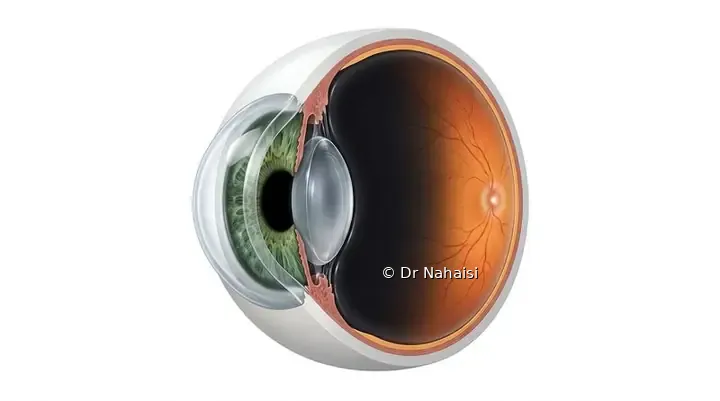
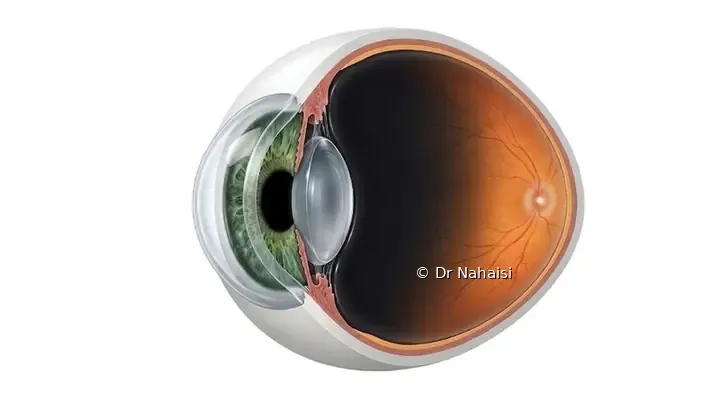
In a nearsighted person, the eye is too long, or the cornea too steep. In both cases, the rays converge too quickly. At rest, rays coming from a distance focus in front of the retina: this is the distance blur typical of nearsighted people.
On the other hand, rays coming from up close, which are more divergent, naturally focus on the retina. A nearsighted person therefore sees blurry at distance and well up close. Even better than people with no vision problem. The higher the myopia, the blurrier the distance vision, and the sharper the vision very close up.
Refraction depends on the length of the eye and the curvature of the cornea. The more curved the cornea, the faster the rays converge. Myopia is the result of an eye that is too long and/or a cornea that is too curved. In a nearsighted eye, the rays meet in front of the retina, and the distance image arrives there blurry. In an emmetropic eye (no prescription for distance), the length of the eye matches the corneal curvature: the rays meet exactly on the retina, and the image is sharp.
The different levels of myopia
| Degree of myopia | Uncorrected acuity | Farthest point of clear vision | Typical profile |
|---|---|---|---|
| -0.25 to -1.25 D | 3 to 6/10 | ~80 cm to 1 m | Occasional wear |
| -1.75 to -3.50 D | 1 to 2/10 | ~30 to 55 cm | Daily wear |
| -4.00 to -6.00 D | < 1/10 | ~15 to 25 cm | Strong dependence |
| > -6.00 D | << 1/10 | < 15 cm | High myopia |
| > -10.00 D | Counting fingers | < 10 cm | Pathological myopia |
Very mild myopia (-0.25 to -1.25 D). These patients get along relatively well day to day. They sometimes come to the consultation without their glasses. What bothers them is the details: street signs, recognizing faces at a distance, the metro arrival time, movie subtitles or the cinema. Rarely contact lens wearers, they prefer wearing glasses occasionally rather than dealing with contact lenses every day. They make up a significant share of the patients who come for a refractive surgery opinion. Laser surgery suits them very well. The correction is permanently built in and recovery is quick. They gain freedom in their daily lives.
Moderate myopia (-1.75 to -3.50 D). Dependence on glasses or contact lenses is daily. Without correction, distance vision is too blurry to drive, recognize someone ten meters away, or read a screen at a normal distance. These are the most frequent candidates for refractive surgery.
High myopia (-4.00 to -6.00 D). Total dependence on glasses or contact lenses for almost all activities. The lenses are thick and the eye-shrinking effect of glasses is marked. Switching to contact lenses is often experienced as a partial liberation. Regular retinal monitoring becomes necessary.
Very high myopia (> -6.00 D). Severely degraded vision without correction. Without glasses, even faces a few meters away are blurry. Dependence is total: it is impossible to get around, work or live normally without correction. Requires a fundus (retina) exam every 2 to 3 years.
Pathological myopia (> -10.00 D). Increased risk of retinal complications. The laser may reach its limits. An intraocular lens implant is sometimes preferred (ICL in younger patients, or lens surgery past a certain age).
All myopia up to about -10 diopters can be treated with the laser, within the limits of the cornea. Sometimes we can go up to -12 on very thick corneas. Beyond that, other solutions exist. The pre-operative assessment determines the most suitable technique.
Why do people become nearsighted?
Myopia is linked to a gradual lengthening of the eye during growth. This process has several peaks: childhood (between ages 6 and 12), puberty, then what is called “student myopia,” a late progression often linked to prolonged near work, between ages 18 and 23-24.
The COMET study, which followed 431 nearsighted children over 14 years, confirms that axial lengthening of the eye stabilizes on average around age 15-16, with most cases stabilized before age 24. Past this age, myopia has practically no reason to progress. That is why refractive surgery gives stable, lasting results in adults.
Ref.: Hou W. et al., « Axial Elongation in Myopic Children and its Association With Myopia Progression », Eye Contact Lens, 2018 (COMET Study, 14-year follow-up, 431 patients).
The cornea, for its part, reaches its near-final shape much earlier, in early childhood, and remains stable throughout adult life. A cross-sectional study of 454 subjects aged 5 to 80 shows that the corneal radius of curvature does not vary significantly after childhood. This point is important: refractive surgery acts only on the cornea, and because the cornea is a remarkably stable tissue, the results of the surgery are stable too.
Apart from corneal diseases that cause deformation (notably keratoconus, the great enemy of refractive surgery, which we screen for systematically during the pre-operative assessment), the cornea does not change shape during adult life.
Ref.: Fledelius HC., Acta Ophthalmol, 1988 (454 subjects, ages 5-80). Hashemi H. et al., J Cataract Refract Surg, 2018 (corneal asphericity stable over 5-10 years in adults).
Myopia and astigmatism
Myopia can be associated with astigmatism. It is actually very common. Astigmatism comes from a cornea whose curvature is not uniform: instead of being spherical (like a soccer ball), it is slightly oval (like a football). There are therefore several different axes of curvature, with different corrections depending on the axis. One axis will be more nearsighted than the other. This is called corneal toricity, and it is what creates the doubled or stretched image typical of astigmatism.
The laser can also correct myopia and astigmatism in the same procedure, by adapting the treatment to both components of your prescription.
Astigmatism laser surgery in Paris
Understanding your glasses prescription
On a glasses prescription, your correction is written with three values per eye: the sphere, the cylinder and the axis.
The sphere corresponds to your myopia (negative value, for example -3.00) or your hyperopia (positive value). It is the base correction, uniform across the whole surface of the lens.
The cylinder corresponds to your astigmatism. It is the difference in correction between the two main axes of your cornea. For example, a cylinder of -1.50 means that one axis of your cornea is 1.50 diopters more nearsighted than the other.
The axis (in degrees, from 0° to 180°) indicates the orientation of this astigmatism on your cornea.
Example 1, simple myopia. RE (OD): -3.00. No cylinder, no axis. The cornea is uniformly too steep; the correction is the same in all directions.
Example 2, myopia with astigmatism. RE (OD): -3.00 (-1.50 at 90°). The eye is nearsighted by -3.00 in one axis, and by -4.50 in the perpendicular axis (90°). The laser will correct both components simultaneously, adapting its treatment to each axis.
THE PRINCIPLE OF LASER CORRECTION
How the laser corrects myopia
How glasses and contact lenses work
Glasses and contact lenses correct myopia by placing a diverging lens in front of the eye: this lens spreads the light rays slightly before they enter the eye, so that they converge farther back, exactly on the retina. The principle works, but it depends on an external accessory worn all day long.
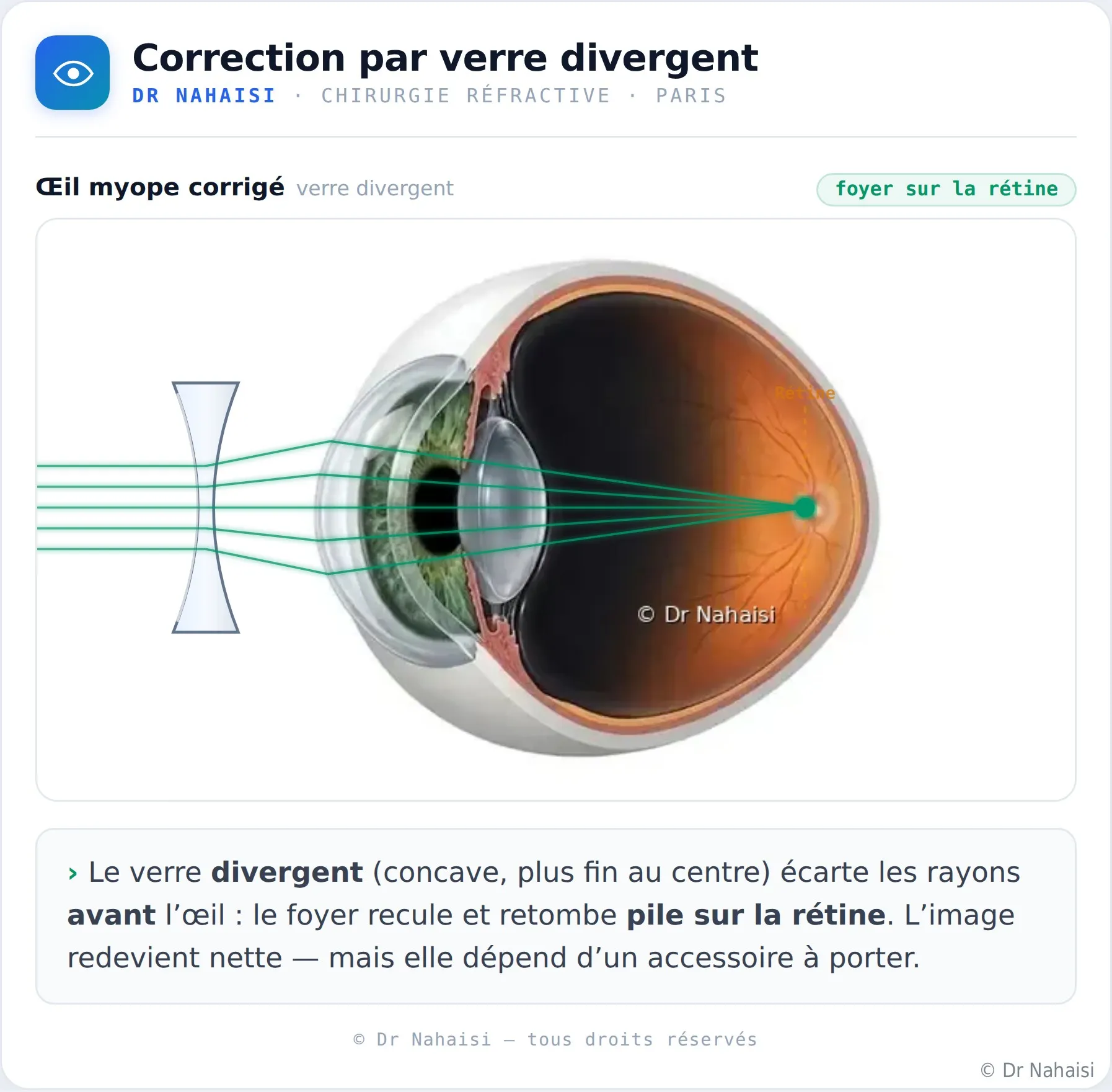
The glasses lens, like the contact lens, is diverging: it spreads the rays slightly before they enter the eye, which pushes the focal point right onto the retina. Vision becomes sharp again, but it depends on an accessory that has to be worn all the time.
The laser: building the correction into the eye
As explained above, myopia comes from an eye that is too long or a cornea that is too steep. We cannot shorten the eye. However, we can change the shape of the cornea to reduce its curvature, that is, to flatten it.
The laser flattens the center of the cornea by removing a few microns of tissue, about 15 microns per diopter of myopia to be corrected. This value also depends on the diameter of the optical zone treated, but it gives the right order of magnitude. For comparison: a cornea is on average 525 microns thick. For a myopia of -3 diopters, the laser therefore removes about 45 microns of corneal tissue.
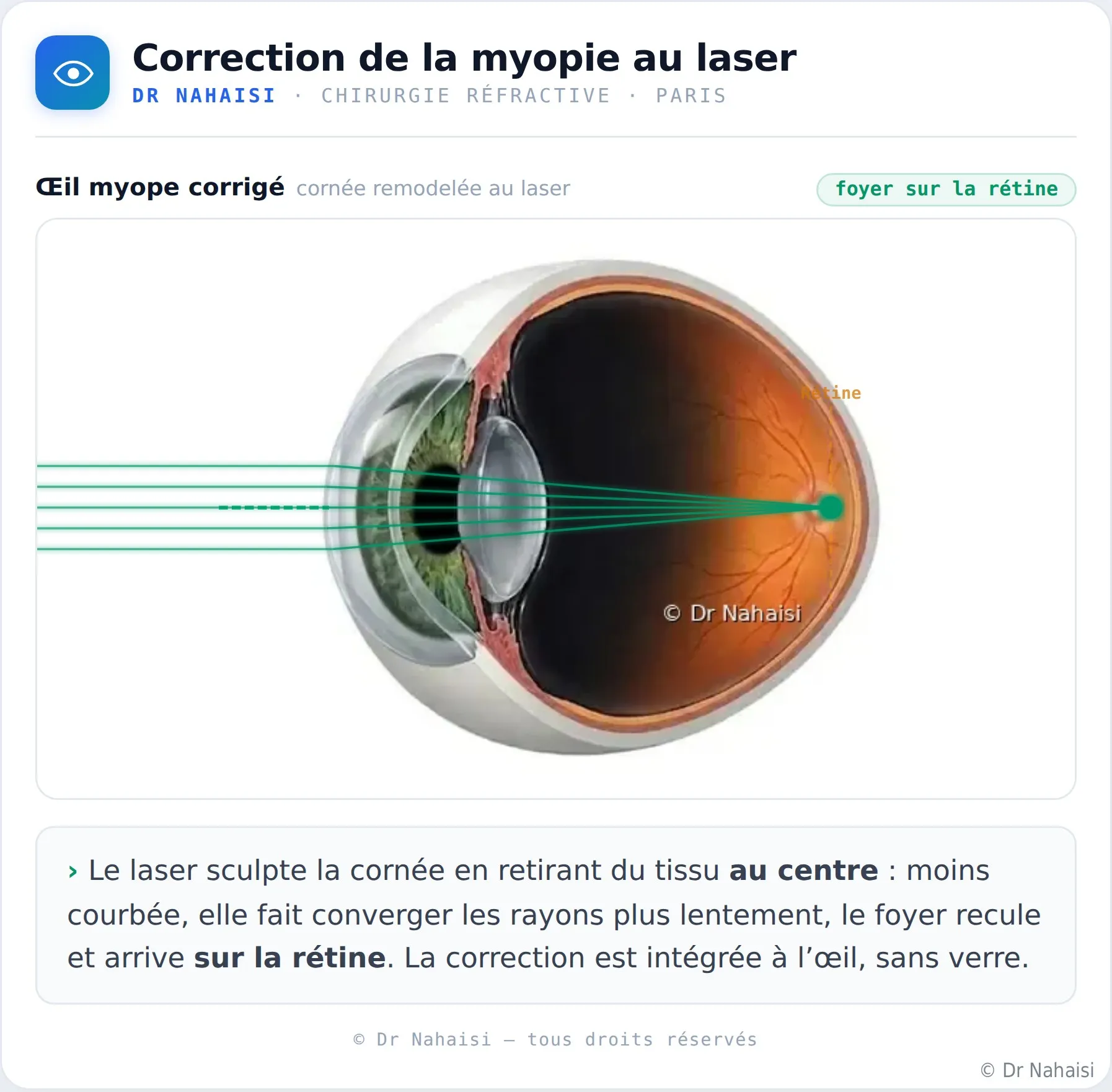
The laser sculpts the cornea to reduce its curvature, by removing tissue at the center of the cornea. Less curved, the cornea makes the rays converge more slowly than before: the focal point then moves back and lands on the retina. The higher the myopia, the more tissue the laser has to remove (see the treatment plan below).
It is a compensation: we give the cornea the curvature it needs for the rays to focus on the retina again. In a way, the result is comparable to that of a pair of glasses, except that the correction is built directly into the eye, with no dependence on an external accessory. And unlike glasses, laser correction is not limited to an average value. It is much more precise.
Customized treatment: Schwind aberration-free
The simple 2D theory is useful for understanding the principle. But real life is more complex. The cornea has areas that are more or less steep, and each point on its surface has its own correction value.
When we say an eye is “-3,” that is an average. In reality, it is an uneven distribution of values across the whole cornea. This is what we see on the aberrometry map.
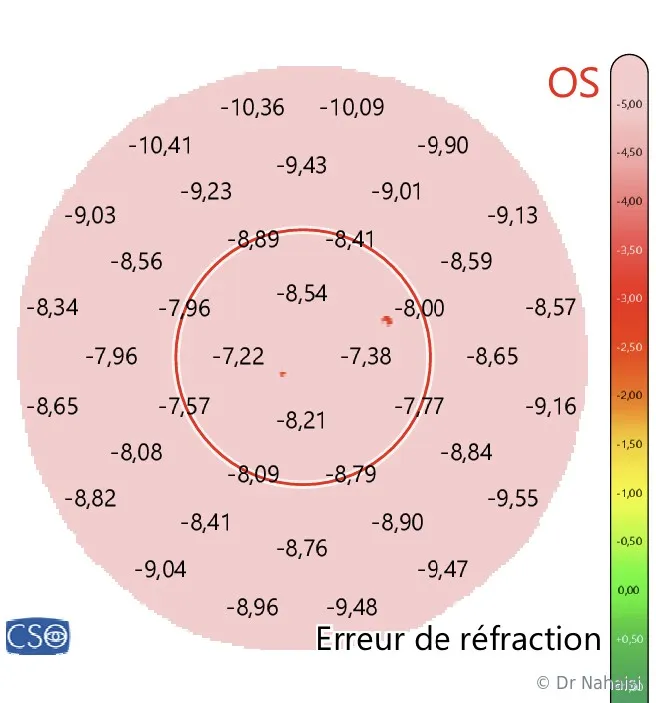
Here is the aberrometry of the left eye of a highly nearsighted patient, at -8.75. When we say an eye is nearsighted at “-8.75,” it is actually an average. In reality, the correction is not the same everywhere: here it ranges from about -7.2 diopters in the center to nearly -10 at the periphery, and varies from zone to zone.
Standard glasses only correct the average of these values. The laser, on the other hand, corrects the cornea point by point. This is the “aberration-free” treatment, a profile developed by Schwind, the platform we use at the Institut Voltaire. It is the world reference for precision in excimer laser treatment.
Your treatment is therefore matched to the exact distribution of myopia across your eye, and not to a simple average value like glasses.
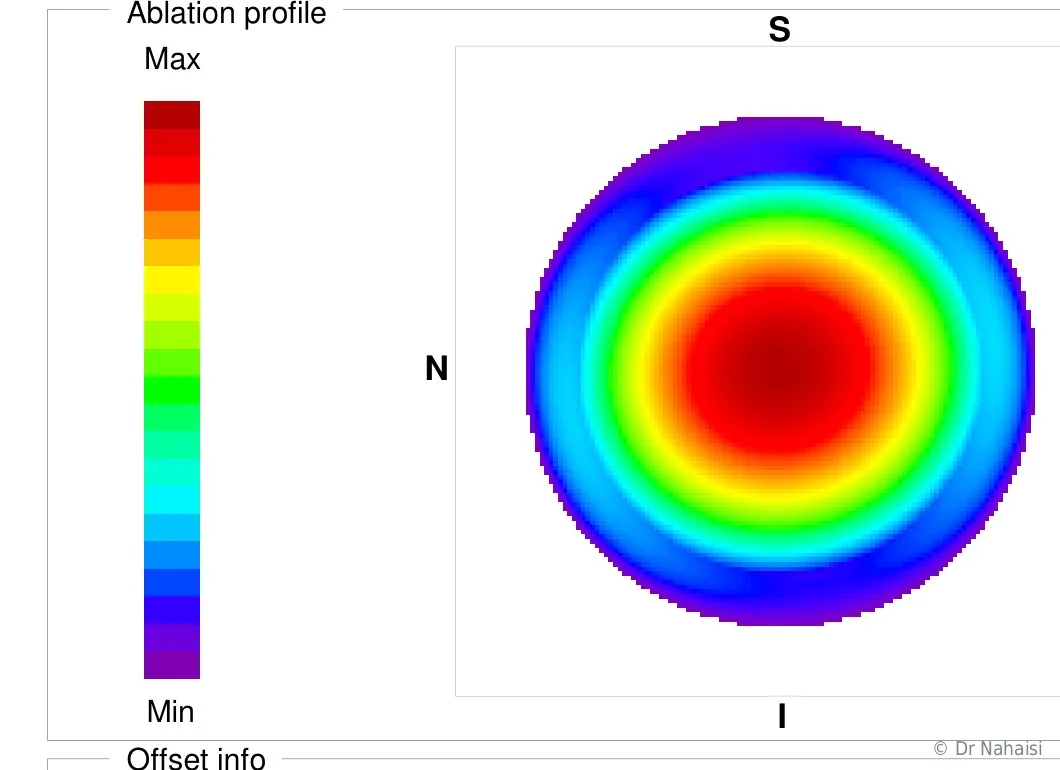
The laser treatment plan for this same patient, calculated from this aberrometry. Each color corresponds to the depth of tissue removed at that spot: in the center, in red, where the most is removed, here about 124 microns to correct a myopia of -8.75 diopters. The green zone is the transition zone. At the periphery, in blue, almost nothing is removed. This sculpting is greatest at the center, then gradually decreases toward the periphery. It flattens the cornea just enough to give it the desired curvature.
TECHNIQUES FOR MYOPIA SURGERY
Which technique to correct your myopia with the laser?
There is no technique that is better than the others in absolute terms. There is the one that best suits your eyes. The choice is made during the pre-operative assessment, based on your prescription, the characteristics of your cornea and your needs. Sometimes your preferences or your apprehension also come into play, and that is normal. I don’t operate on eyes, I operate on patients.
Learn about my background and my philosophy
LASIK: my first-line technique
The most widely performed technique in the world. A femtosecond laser (Visumax 800) creates a thin corneal flap, then the Schwind excimer laser reshapes the cornea underneath. The flap is then put back in place. Clear vision from the next day, return to work within 24 to 48 hours.
It is my first-line technique for most nearsighted patients, when the characteristics of the cornea allow it. It is suitable for myopia up to -10 diopters, sometimes -12 depending on the cornea. The eligibility criteria are detailed in the “Are you a candidate?” section below.
Price: €3,200 for both eyes (€1,600/eye). Follow-up included.
TransPRK: maximum safety, no flap
Surface treatment, with no flap and no contact. It is the safest technique from a biomechanical standpoint. Without a flap, there is no flap-related risk, and the structure of the cornea is preserved as much as possible.
I favor it when LASIK is not the best option for your profile, whether because of corneal thickness, the correction to be treated or your apprehension. I also recommend it for patients exposed to impacts (combat sports, law enforcement), because the absence of a flap gives peace of mind for life.
Recovery is more gradual: allow about a week before returning to work comfortably. The first 48 hours can be uncomfortable, but you get through them relatively quickly.
Price: €2,800 for both eyes (€1,400/eye). Follow-up included.
SMILE: targeted indications
Extraction of a corneal lenticule through a 2-3 mm micro-incision, without creating a flap. A minimally invasive technique that I reserve for specific indications, notably high-level combat sports with a quick return. I consider LASIK superior for myopia in terms of quality of correction, enhancement options and clinical track record.
SMILE is not suitable for correcting hyperopia, and its results are less precise for astigmatism.
Price: €3,800 for both eyes (€1,900/eye). Follow-up included.
What if my myopia comes with astigmatism?
This is very common. All three techniques (LASIK, TransPRK and SMILE) correct myopia and astigmatism in the same procedure. The treatment is simply adapted to your combined profile.
Astigmatism laser surgery in Paris
What if I am nearsighted and presbyopic?
Around age 40-45, presbyopia adds to myopia. Several strategies exist to treat both at the same time: monovision, PresbyLASIK or hybrid treatment. The choice depends on your prescription, your expectations and your visual profile. We discuss it during the consultation.
ARE YOU A CANDIDATE?
Who can have laser surgery for myopia?
The vast majority of nearsighted people are candidates. The pre-operative assessment confirms this and helps choose the technique best suited to your case.
Age
Refractive surgery is possible from age 18. The most favorable time is most often after age 22-23, once myopia has stopped progressing. Younger patients are not excluded, though: when the request is justified, we look closely at stability over the last few years and I warn about the risk of residual progression. If a slight progression occurs, an enhancement can always be considered later.
At 24, it is a very good age. At 45 too. I have operated on patients at every age of adult life, up to 65. Beyond that, refractive cataract surgery becomes more relevant.
Stability, a concept to be nuanced
You often hear that your vision must be “stable for 2 years.” Absolute stability does not exist. A normal eye has natural fluctuations: fatigue, accommodation, examination conditions, optical aberrations. All of this can make the prescription vary by 0.25 to 0.50 diopter from one exam to another, on the same day. Most of the time, when a patient tells me they were judged “still unstable,” it is actually a simple fluctuation and not a progression of their myopia. Especially past age 23.
There is no point waiting for years, comparing each prescription to the decimal from one year to the next. I suggest instead that patients come directly for a consultation to have the full assessment. In the vast majority of cases, we will be able to reassure you and move forward.
Learn more about the pre-operative assessment
Corneal thickness and regularity
This is the most important criterion for choosing the technique. The classic threshold for LASIK is in theory 500 microns of pre-operative thickness. But it is not the only factor. A regular cornea at 490 microns with a small myopia will be better suited to LASIK than an irregular cornea at 520 microns with a correction of -8 diopters. What counts is the whole picture: thickness, regularity, curvature, the correction to be removed, and the residual posterior stromal bed.
The posterior stromal bed is the thickness of cornea that remains intact under the flap after the laser treatment. In LASIK, about 110 microns are taken for the flap, then the microns needed for the treatment (about 15 per diopter). What remains underneath is the residual bed, and it is what guarantees the long-term stability of the cornea. My personal limit is 300 microns, beyond the classic recommendation of 280 microns, to ensure maximum safety. We can also adjust the flap cutting depth and the optical zone to optimize these margins.
When the residual bed would be insufficient with LASIK (cornea too thin or myopia too high), TransPRK becomes the technique of choice for myopia below -10 diopters. For very high myopia above -10 diopters, an intraocular implant (ICL) may be the best option, and I refer these patients to specialized colleagues.
Pregnancy and breastfeeding
I do not operate during pregnancy. It is a precaution: hormonal fluctuations can temporarily change refraction. Breastfeeding, on the other hand, is not a problem and does not prevent surgery. And there is no reason to wait until you have had all your children: we can perfectly well operate before a pregnancy or between two.
Ref.: Fernández-Montero A. et al., Eye, 2017 (10,401 women, 14 years). Naderan M., J Curr Ophthalmol, 2018.
What if I am not a candidate?
It happens. That is exactly why the assessment exists. When the laser is not the right option for your eyes, I say so clearly and refer you to the most suitable solution. I would rather not operate than take the slightest risk with your eyes.
When laser surgery is not possible: alternatives and referral
HIGH MYOPIA
High myopia: beyond -6 diopters, what are the options?
I regularly operate on high myopia; it is a major part of my practice. Patients at -7, -8, sometimes -9 diopters, often with thin corneas.
The technique depends on each patient’s profile. On a sufficiently thick and regular cornea, LASIK remains the reference technique, even for high myopia. When the cornea is thinner, TransPRK can take over, and it gives excellent results even on high corrections, up to -10. SMILE can also be considered in some cases. The decisive criterion is the regularity of the cornea, more than its raw thickness: a thin but regular cornea may be operable, whereas a cornea of average thickness but irregular (showing signs of prior deformation) will not be.
For very high myopia, a compromise is sometimes necessary. To preserve the integrity of the cornea and keep sufficient post-operative thickness, we treat the myopia as far as the cornea allows, accepting a slight residual myopia, for example -0.50 or -1.00 diopter on the stronger eye. A patient at -8 diopters could therefore end up with a residual of -0.50 after surgery: a minimal inconvenience compared with the initial handicap. Most of these patients no longer wear glasses day to day, and the gain in visual freedom is considerable.
When laser surgery cannot be considered (myopia beyond -10 diopters, sometimes -12 depending on the cornea, or a cornea that is too thin, too irregular or deformed), other solutions can be considered, such as an intraocular implant (ICL). I believe it is always preferable to avoid intraocular surgery if the cornea is operable, and I refer you to a specialized colleague when that is the right option for you.
Retinal monitoring for highly nearsighted patients
An important point: refractive surgery corrects your vision, not the structure of your eye. After surgery, your retina is still that of a highly nearsighted person, thinner and more stretched. A fundus (retina) exam every 2 to 3 years remains necessary, even without glasses. This monitoring is done by your regular ophthalmologist.
RESULTS AND DURABILITY
Results of myopia laser surgery: what to expect?
The goal is good vision without glasses or contact lenses in everyday life. Not a 0.000 correction, because that does not really exist. The human eye is not a perfect machine, and there are always slight natural fluctuations.
Why do we aim for a slight residual hyperopia?
We aim instead for a slight residual hyperopia of +0.25 to +0.50 diopter. It is a deliberate technical choice:
- It anticipates a possible regression in the medium term.
- It gives sharp distance vision even when tired or after prolonged accommodation.
- It is typically the correction that people “who have never needed glasses” have.
On the other hand, this slight hyperopia can cause fatigue during prolonged near vision, on screens or when reading. If so, relaxing glasses are enough. They are not there to improve vision, which is already good. They rest the eyes by reducing the need to accommodate to see up close. They are the glasses that people “without glasses” keep somewhere, for long days at the screen.
The correction is lasting
The vast majority of patients never wear glasses again for the corrected myopia. The result lasts for several decades.
There are, however, two possible mechanisms of change after surgery:
Natural myopic progression. Myopia progresses on its own, independently of the surgery, as if you had not been operated on but were changing glasses in a few years. This phenomenon is linked to lengthening of the eye, which hardly occurs anymore past age 23-24. A concrete example: imagine that today you need a correction of -2.00 D. If in 10 years your theoretical need went to -2.50 D (a scenario already rare past age 23) and you had surgery today, you would end up at -0.50 D ten years later. A minimal inconvenience, and an enhancement could always be applied. You will never go back to your original myopia.
Epithelial regression. This is a slight regrowth of corneal tissue in the epithelium (the surface layer of the cornea) that can reduce the effect of the laser over time. This phenomenon was significant 15-20 years ago with older generations of lasers. Today, with the Schwind platform and current treatment profiles, regression has become very rare, especially for simple and moderate myopia. It can still be seen with high corrections, but it remains moderate. Relative to their original myopia, it generally does not cause these patients any problem.
If despite everything, through the combination of these two mechanisms, a slight myopia reappeared after several years and became bothersome again, a laser enhancement would be possible in most cases. In the first year, it is included in the price. After that, a preferential rate applies up to 5 years after surgery.
PRICES AND INSURANCE COVERAGE
Prices for myopia laser surgery in Paris
| Technique | Price per eye | Price for both eyes |
|---|---|---|
| LASIK | €1,600 | €3,200 |
| TransPRK | €1,400 | €2,800 |
| SMILE | €1,900 | €3,800 |
Included in the price: complete post-operative follow-up, with no limit on the number of visits, and a possible enhancement in the first year.
Pre-operative consultation: at the standard rate set by French national health insurance. At the practices in Paris 10th (10e arrondissement) and Paris 19th (19e arrondissement), there is no fee supplement and nothing to pay upfront (direct billing). At the Institut Voltaire (Paris 11th), you pay €50 upfront, including a €30 fee supplement, of which at least €20 is reimbursed by your complementary health insurance.
Payment: on the day of surgery, by bank card, check, bank transfer or direct debit. Payment in 4 installments is possible, by check or direct debit.
Refractive surgery is not reimbursed by French national health insurance, but your complementary health insurance may cover part of the cost. I provide you with a personalized quote to send to your insurer.
Frequently asked questions
Your questions about myopia laser surgery
Can myopia come back after laser surgery?
The correction applied by the laser is lasting. You will never go back to your original myopia. A slight progression remains theoretically possible over 10-15 years, on the order of 0.25 or 0.50 diopter, but it is minimal. And if it bothered you, a laser enhancement can always be considered.
Does refractive surgery reduce the risk of myopia progression?
No. Laser surgery reshapes the cornea to correct your vision, but it has no effect on the lengthening of the eye, which is the mechanism behind myopic progression. If your myopia were still to progress (which is rare past age 23-24), it would do so independently of the surgery. The IMI 2023 report confirms that axial lengthening continues at the same rate in patients who have and have not had surgery.
Can I have laser surgery for myopia as early as 18?
Yes. We will pay closer attention to stability over the last few years, and we will warn you about the residual risk of progression. If a slight progression occurs, an enhancement can always be considered a few years later. For a 20-year-old patient who can no longer stand their glasses, the gain in comfort is considerable.
Is 24 a good age to have myopia surgery?
A very good age. At 24, myopia has usually been stable for a few years. You will enjoy the result for decades.
Can you have myopia surgery after age 45?
Yes, you can. There is no real age limit for enjoying visual freedom without glasses. At that age, however, presbyopia will already have started and will need to be taken into account in the surgical strategy.
Should I wait until I have had all my children before having laser surgery for myopia?
No. It is a persistent myth. We avoid operating during pregnancy as a precaution, because hormonal fluctuations can temporarily change refraction. But these changes are temporary and return to pre-pregnancy levels after delivery. The largest longitudinal study on the subject (the SUN cohort, 10,401 women followed over 14 years) shows that pregnancy is not associated with lasting myopia progression. The study even shows an inverse association: women who had been pregnant showed less myopic progression than the others, which suggests that pregnancy might slow the lengthening of the eye. I myself operated on my own wife before a new pregnancy, with full knowledge of the facts. The recommendation is simple: no surgery during pregnancy, breastfeeding is not a contraindication, and no reason to wait until you have had all your children.
My myopia is high (-7 or -8): am I a candidate for laser surgery?
Very probably. I regularly operate on high myopia, up to -10 diopters, sometimes -12. Whether you are a candidate depends on the thickness and regularity of your cornea. A complete pre-operative assessment confirms it.
Can I lose my sight because of myopia laser surgery?
I would say no: you cannot go blind from refractive surgery performed under normal conditions and with a favorable pre-operative assessment. Complications exist, as with any surgery, but they are very rare and always treatable. Rigorous patient selection is the best prevention.
How do I know if my vision is “stable” enough for myopia surgery?
Stability is not an absolute measurement. The eye accommodates and fluctuates, and two exams on the same day can give different results. What I check is overall consistency: does your current prescription match your glasses? Has there been a significant change in recent years? The assessment allows me to decide, and most often to reassure you.
My ophthalmologist told me to wait before having my myopia operated on: what should I do?
This is advice that many patients receive, often from ophthalmologists who do not specialize in refractive surgery, or from an older generation. Before age 23, some caution about stability can be justified. But past age 23-24, most patients no longer progress. Experience shows that a 24-year-old at -6 will gain at most one more diopter over 10 years, and will still be very happy to go from -6 to good vision. All the more so since an enhancement is possible. It is a shame that motivated patients remain held back by overly strict recommendations. Don’t hesitate to come for a specialist opinion.
LASIK or TransPRK for my myopia?
The choice depends on many factors: corneal thickness, regularity, prescription, residual posterior stromal bed, but also your preferences and your apprehension. I tend to favor LASIK as the first-line option when it is possible. But when TransPRK is the most suitable technique, I recommend it without hesitation, and the results are excellent, even for very high myopia (up to -10 D). We always discuss it together during the consultation.
How long does myopia laser surgery take?
About ten minutes for both eyes. This time includes the technical steps (lifting the flap, the laser treatment, putting the flap back for LASIK, or the few steps of TransPRK), the verbal explanations between each step, getting you settled, and sometimes a little music to relax the atmosphere. The laser itself only lasts a few seconds per eye.
When can I go back to work after myopia laser surgery?
After LASIK: the next day or the day after. After SMILE: 2 to 3 days. After TransPRK: allow about a week. A sick note (time off work) is possible on a case-by-case basis.
Does myopia laser surgery hurt?
The procedure is done under anesthetic eye drops; it is painless. With LASIK, the first few hours can be uncomfortable: watery eyes, stinging, sensitivity to light. A good nap is usually enough. Vision is generally good by the same evening. With TransPRK, the first 48 hours can be uncomfortable (foreign body sensation, sensitivity to light), but you get through them relatively quickly.
Do I need to see another ophthalmologist before consulting for myopia surgery?
No. No referral letter or prescription needed. You can book an appointment directly on Doctolib or by phone.
What are the usual side effects after myopia laser surgery?
In the first few weeks: dry eye relieved by artificial tears, halos around lights in low light (a temporary increase around the 2nd month, then gradual regression), and visual fatigue on screens that fades within a few weeks.
Does high myopia increase the risks of laser surgery?
The risks of surgery are the same regardless of the prescription. What changes is how demanding the selection is: the higher the myopia, the more precise the assessment must be. That is precisely the point of seeing a surgeon who specializes exclusively in refractive surgery.
BOOK AN APPOINTMENT
Ready to see without glasses?
The first step is simple: a consultation to review your eyes, your prescription and the options available to you. No commitment and no pressure. We do a complete assessment and discuss it frankly.
Book an appointment on Doctolib
Phone and WhatsApp: 01 84 80 28 04 · Email: nahaisi@laservisionparis.com · Doctolib messaging
Download the information booklet (PDF)
Author: Dr Steven Nahaisi, ophthalmic surgeon, specialist in laser refractive surgery, Institut Laser Ophtalmologique Voltaire, Paris 11th.
Your surgeon
Dr Steven Nahaisi
Ophthalmic surgeon dedicated exclusively to laser refractive surgery. He operates at the Institut Laser Ophtalmologique Voltaire and consults in three Paris offices. Consultations in English.