
Ophthalmic surgeon
Dr Steven Nahaisi, Refractive Surgeon in Paris
I am Dr Steven Nahaisi, an ophthalmic surgeon practicing exclusively laser refractive surgery in Paris. I operate at the Institut Laser Ophtalmologique Voltaire (Voltaire Laser Eye Institute), in the 11th arrondissement, and I see patients in three practices in Paris (10th, 11th and 19th).
Refractive surgery is my only activity. I do not practice general ophthalmology, glasses consultations or any other surgery. I correct vision with the laser: myopia, astigmatism, hyperopia, presbyopia. It is what I do every day, and it is what I have been trained for over more than 10 years.
To date, I have performed more than 3,500 refractive surgery procedures.
Book an appointment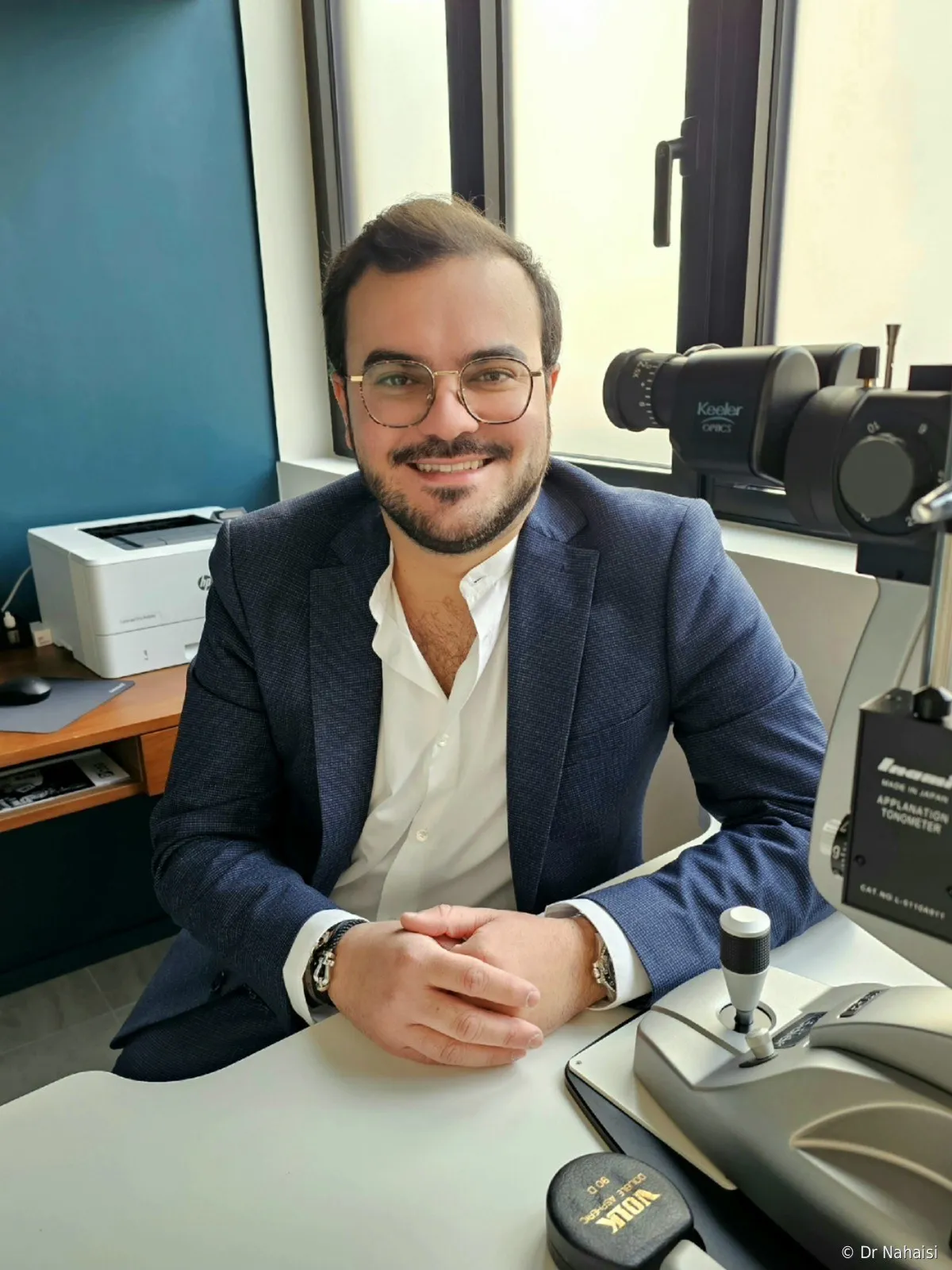
MY BACKGROUND
From medical school to refractive surgery, a career built around the cornea
Medical school
I began medical school at Université Pierre et Marie Curie (Paris VI), where I finished first in my class in first year, out of more than 2,000 students. I then did my clinical rotations as a medical student at Pitié-Salpêtrière and Saint-Antoine. In 2015, I took the ECN (the French national ranking exam) and was ranked 398th out of more than 9,000 candidates. This ranking allowed me to choose ophthalmology in Paris, one of the most sought-after specialties.
Ophthalmology residency in Paris (2015-2020)
For five years, I trained in the best ophthalmology departments in Paris. That is where it all started with the cornea.
My first formative rotation was in the department of Pr Jean-Louis Bourges at Hôtel-Dieu, a French reference center for corneal surgery. There I learned the most recent corneal transplant techniques (DMEK, KLAP, penetrating keratoplasty), as well as the screening and treatment of keratoconus. It is also where I discovered laser corneal refractive surgery. This rotation gave me a taste for everything related to the cornea.
At Kremlin-Bicêtre, I refined my skills in managing infectious corneal lesions (herpetic keratitis, fungal infections, autoimmune inflammatory reactions), as well as severe dry eye syndromes, autoimmune conditions and other ocular surface diseases. This experience with corneal and surface problems helps me a great deal today in managing the post-operative course and any side effects of refractive surgery.
At Eaubonne hospital, alongside Dr Sadri Chahed, I performed my first cataract operations, about a hundred in six months. That is what gave me my surgical skills and my familiarity with the operating room.
At Cochin Hospital, I worked under the supervision of Pr Monnet and Pr Brézin on post-operative inflammation: endophthalmitis, toxic anterior segment syndromes (TASS). It was in this context that I completed my thesis, which identified an inflammatory cause linked to a model of intraocular lens. This discovery led to the withdrawal of the lens from the market and to a better understanding of the mechanisms of ocular inflammatory reactions.
At the Fondation Rothschild, I was trained by two major figures in French ophthalmology. Pr Gabison taught me the most modern corneal surgery techniques, from corneal transplants to corneal prostheses, including refractive surgery. Pr Gatinel, a world reference in refractive surgery, trained me in the advanced theory of laser correction: aberrometry, Q factor, principles of corneal asphericity, management of corneal aberrations. It was with him that I performed my first refractive surgeries.
It was also with Pr Gatinel that I sharpened my ability to detect keratoconus, including its most subtle forms, and to distinguish true positives from false positives on corneal topographies. I also deepened my knowledge of the theory of eye rubbing and its role in corneal deformation. This skill carries a lot of weight in refractive surgery: detecting keratoconus, even subclinical, during the pre-operative assessment means preventing the risk of post-operative ectasia. I do it for every patient, without exception.
My last residency rotation brought me back to Cochin, where I took over from Dr Ferrero to ensure the continuity of the cornea department. At that stage, I was already performing my first transplants on my own, as a resident.
CHIEF RESIDENT AT COCHIN
Former Chief Resident (Chef de Clinique Assistant) at Cochin Hospital, head of the cornea department
Building on this experience and this deeper specialization in corneal diseases and surgery, I was appointed Chef de Clinique Assistant (CCA, Chief Resident) at Cochin Hospital, in charge of the cornea department. For three years, I operated, taught and trained residents.
In total at the hospital, I performed more than 350 corneal transplants and more than 1,000 surgical procedures: cataracts, transplants and refractive surgeries (LASIK, SMILE, TransPRK). Operating on diseased corneas and managing severe infections and post-operative complications in a hospital setting gave me a deep understanding of the cornea, its biomechanics and its limits. It is this expertise that serves my current refractive surgery practice every day.
Keratoconus screening is an integral part of my pre-operative assessment. It must be detected before any refractive surgery, including in its most subtle forms. Having spent years treating weakened corneas, advanced keratoconus and transplants after failure gives me a different perspective on every topography I analyze. I am not simply trying to confirm that “it can be operated on”. I am looking for the slightest reason why it could not be.
THE INSTITUT VOLTAIRE AND AN EXCLUSIVELY REFRACTIVE PRACTICE
Why I chose to do only laser refractive surgery
In November 2022, I completed my chief residency at Cochin. My colleagues Dr Romain Nicolau and Dr Camille Rambaud had just opened the Institut Laser Ophtalmologique Voltaire, a brand-new clinic equipped with the latest technologies. They invited me to join them. In February 2023, I started my private practice.
Demand for refractive surgery grew quickly. More and more patients came, thanks to the reputation I had built at the hospital and to word of mouth. I then chose to devote myself entirely to my passion: laser vision correction.
This choice is not insignificant. It means that I devote all my time and all my attention to a single subject. I master all eye surgery techniques (LASIK, TransPRK, SMILE, but also cataract surgery and intraocular lens implantation) and I chose to focus this experience on laser refractive surgery, on the Schwind excimer and Visumax 800 femtosecond platform.
WHAT SETS ME APART
Beyond the technical procedure, the human approach remains essential in my practice
Refractive surgery is elective surgery; no one has to have it. It is a choice, and that choice creates a great deal of apprehension. Will it work? Will it hurt? What if it goes wrong? I hear these questions every day, and I take the time to answer them every time.
My role is not limited to the surgical procedure. It is to accompany you from start to finish: understanding your expectations, explaining what is possible and what is not, reassuring you when it is warranted, and telling you no when necessary. That is also why people come to me.
I personally answer my patients’ messages, including in the evening and on weekends. Follow-up does not stop just because the operation is over. And when a patient writes to tell me that I have changed their life, it is the greatest reward of my work.
WHAT YOU WON’T READ ANYWHERE ELSE
Yes, I wear glasses.
I am often asked about it, so I might as well answer here. I have mild myopia, and I wear glasses. Quite simply because I like my face with them, they have never bothered me, and my myopia lets me read very close up without correction, which is very practical in everyday life. Refractive surgery is above all a matter of personal motivation. When glasses or contact lenses become a burden, surgery is a great solution. But when you live very well with them, nothing is mandatory.
On the other hand, I have operated on my wife, many members of my family, ophthalmologist colleagues, and thousands of patients. Everyone has their own reasons, and their own timing.
Patients who come from all over France, the French overseas territories and abroad
I regularly see patients who travel from all over France, from the French overseas territories and sometimes from abroad. When someone travels several hundred kilometers to entrust me with their eyes, it is a mark of trust that moves me deeply. For these patients, I organize tailored care pathways. For example, it is possible to have the consultation and the surgery on the same day at the Institut Voltaire, to limit travel.
EDUCATION AND AFFILIATIONS
Degrees, affiliations and continuing education
Education: Université Pierre et Marie Curie (Paris VI), Pitié-Salpêtrière / Saint-Antoine. Prize winner, first in class in first year
ECN 2015 (French national ranking exam): ranked 398th out of 9,000+ candidates
Ophthalmology residency: Paris, from 2015 to 2020, at Hôtel-Dieu, Cochin, Kremlin-Bicêtre, Eaubonne and the Fondation Rothschild
Chief residency: Chef de Clinique Assistant (CCA, Chief Resident) at Cochin Hospital, head of the cornea department
Thesis: Toxic anterior segment syndromes (TASS), identification of a cause linked to an intraocular lens, which led to its withdrawal from the market
Mentors: Pr Bourges (cornea, refractive), Pr Gatinel (refractive, keratoconus), Pr Gabison (cornea, prostheses), Pr Monnet and Pr Brézin (inflammation), Dr Chahed (cataract)
Surgical experience: 3,500+ refractive surgeries, 350+ corneal transplants, 1,000+ hospital procedures
Affiliations: Member of SAFIR and ESCRS (European Society of Cataract and Refractive Surgeons)
Appointment
Would you like to talk about it?
The first step is simply to come and see me for a consultation. We do the assessment, we talk, and you leave with all the answers. No need for a referral letter or to see another ophthalmologist beforehand.
Phone and WhatsApp: 01 84 80 28 04 · Email: nahaisi@laservisionparis.com · Doctolib messaging
Author: Dr Steven Nahaisi, ophthalmic surgeon, specialist in laser refractive surgery, Institut Laser Ophtalmologique Voltaire, Paris 11th (11e arrondissement). Updated on 15 October 2026.