Procedure
PresbyLASIK: Correcting Presbyopia with the Laser
PresbyLASIK corrects presbyopia with the laser, by recreating on the cornea a compensation for the focusing that the crystalline lens can no longer do. It is a LASIK, with the same lasers and the same process. Only the sculpting profile changes. Instead of giving the cornea a single curvature, we give it several, one for distance vision and one for near vision. This is called a multifocal cornea.
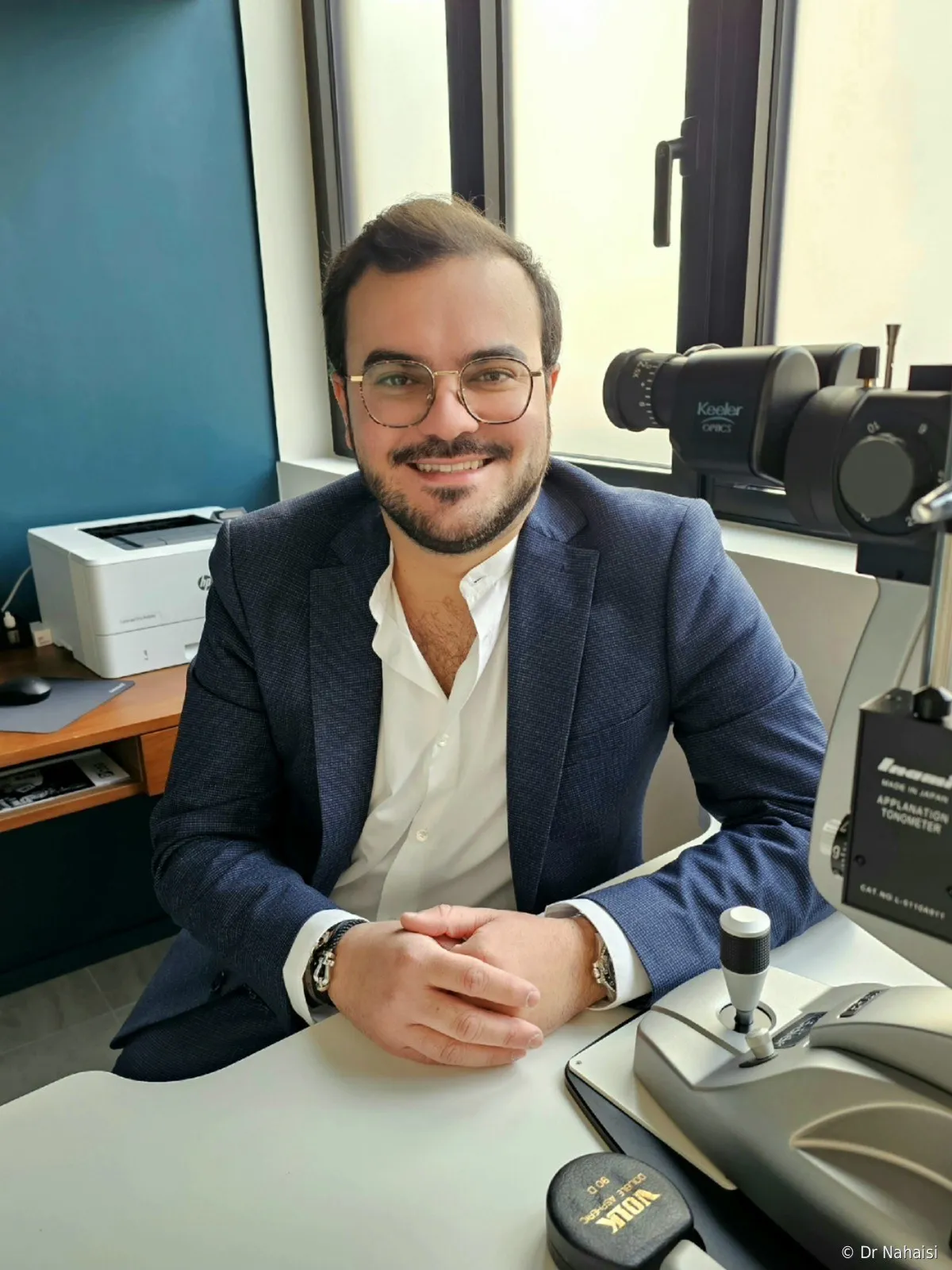
Dr Steven Nahaisi
Updated on 15 October 2026 · 29 min read
It is the solution I offer to presbyopic patients who are emmetropic (those who have always seen well at a distance, without glasses) or farsighted and want to free themselves from their reading glasses or progressive lenses. For presbyopic nearsighted patients, the strategy is different. In that case we use blended vision (monovision), which is a standard LASIK. I explain it in detail below.
I perform PresbyLASIK exclusively at the Institut Laser Ophtalmologique Voltaire (Voltaire Laser Eye Institute), in Paris 11th (11e arrondissement), with the PresbyMAX module of the Schwind Amaris 750S excimer laser and the Zeiss Visumax 800 femtosecond laser to cut the flap.
Presbyopia is the most delicate subject in refractive surgery, because it rests entirely on a compromise between distance vision and near vision. This compromise must be understood and accepted before going ahead, and my role is to find the balance that suits you. On this page, I explain PresbyLASIK from A to Z: how presbyopia works, how the laser compensates for it, who the procedure is for, how it goes, what to expect from recovery, and why the Schwind platform makes it possible to go back if the compromise does not suit you. I also answer the real questions my patients ask me every week.
On this page14 sections
- 02UNDERSTANDING PRESBYOPIA AND THE PRINCIPLE OF PRESBYLASIK
- 03SEEING THE PRINCIPLE
- 04THE PRESBYMAX MODULE AND THE THREE PROFILES
- 05WHO IS PRESBYLASIK FOR?
- 06PRESBYLASIK OR TRANSPRK
- 07HOW THE PROCEDURE GOES
- 08RECOVERY AFTER PRESBYLASIK
- 09HALOS AND THE DISTANCE/NEAR COMPROMISE
- 10A LASTING AND REVERSIBLE TREATMENT
- 11RISKS AND COMPLICATIONS
- 12DURABILITY AND FOLLOW-UP
- 13FEES AND COVERAGE
- 14FREQUENTLY ASKED QUESTIONS
- 15BOOK AN APPOINTMENT
UNDERSTANDING PRESBYOPIA AND THE PRINCIPLE OF PRESBYLASIK
First, what is presbyopia?
To understand PresbyLASIK, you need to understand what we are trying to correct. And everything revolves around one word: accommodation.
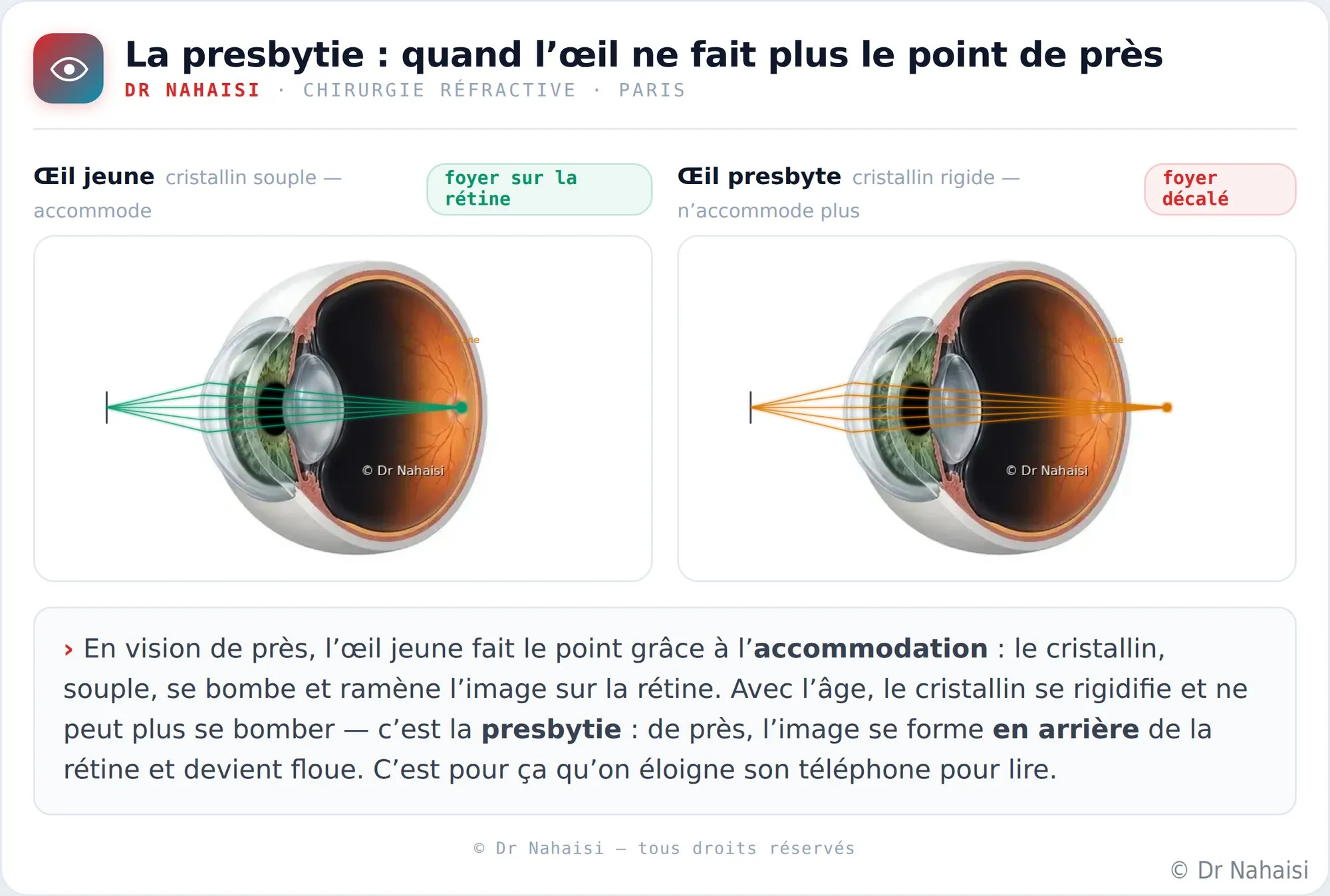
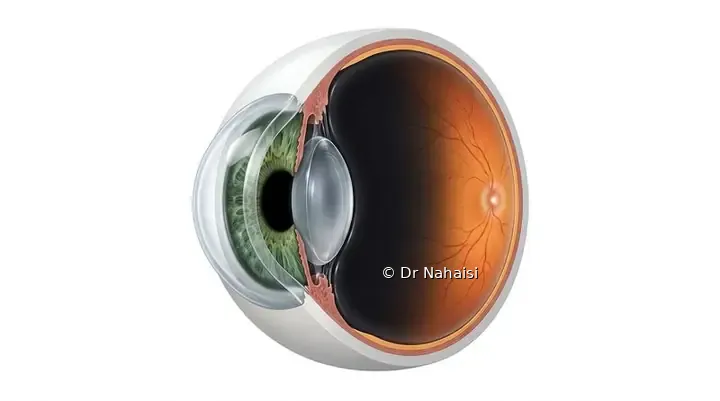
Accommodation is the eye's natural ability to focus up close. The mechanism relies on the crystalline lens, the small flexible lens located inside the eye, just behind the iris. This lens is surrounded by a ring-shaped muscle, the ciliary muscle. When you look at a nearby object, this muscle contracts and makes the lens bulge. Its optical power increases, and the image becomes sharp up close again. It is a bit like a camera's autofocus, except that it is automatic and instantaneous. A teenager has an enormous reserve of accommodation, on the order of 10 to 12 diopters, which allows them to read a text a few centimeters away without the slightest effort.
Presbyopia is the gradual loss of this ability. With age, the lens stiffens and the ciliary muscle loses its ability to contract. The eye can no longer make the lens bulge, and so can no longer accommodate. In near vision, the image then forms behind the retina and becomes blurry. That is why people start holding their phone farther away to read. They also look for more light, and their eyes tire more quickly in the evening. The first symptoms appear around age 40-45, then presbyopia increases until it stabilizes around 55-60. It affects everyone, without exception, whether you are nearsighted, farsighted, astigmatic or emmetropic.
In near vision, the young eye focuses through accommodation: the flexible lens bulges and brings the image back onto the retina. With age, the lens stiffens and can no longer bulge. Up close, the image then forms behind the retina and becomes blurry. This is presbyopia, and it is why people hold their phone farther away to read.
The principle of PresbyLASIK: transferring focusing to the cornea
PresbyLASIK does not give the lens back its flexibility; no surgery can do that to date. It replaces the lost function by transferring it to the cornea, the transparent lens at the front of the eye.
The laser sculpts several zones of different power on the corneal surface:
- a central zone, slightly more curved and therefore slightly myopic, dedicated to near vision;
- a peripheral zone, set for distance vision.
The cornea thus becomes multifocal. Instead of a single focal point, it creates several and distributes the light between them. Depending on the distance of the object you are looking at, one zone or the other provides the sharp image. The brain learns very quickly to select the right zone without thinking about it, a bit like it learns to ignore the frame of your glasses. The trade-off is that vision is never 100% perfect at every distance. That is the compromise, which I come back to further on. It remains functional in everyday life, without glasses.
PresbyLASIK, PresbyMAX, blended vision: not to be confused
The word PresbyLASIK refers to a LASIK whose sculpting profile is multifocal, that is, designed to correct presbyopia. The profile itself is calculated by the PresbyMAX module, software built into the Schwind Amaris 750S laser. So it is the same surgical procedure as a standard LASIK, with a different, more complex ablation profile.
It should not be confused with blended vision (monovision), the other major strategy for correcting presbyopia, which is for nearsighted patients. Blended vision is a monofocal LASIK: one curvature per eye, with no multifocality and no PresbyMAX. All of the myopia is corrected in one eye, for distance vision, and a little myopia is deliberately left in the other, for near vision. I describe blended vision in detail in the "Who is it for?" section below, so that you can clearly see the difference.
Understanding presbyopia in detail (accommodation, profiles, strategies)
SEEING THE PRINCIPLE
A simulator to visualize it, alongside the explanations
The explanations above lay the groundwork. To make them more concrete, I had a small simulator developed that lets you see, with your own eyes, what happens in a presbyopic eye depending on distance and correction. You can compare an uncorrected presbyopic eye, the same eye with glasses, then after a multifocal laser treatment, for both near and distance vision.
THE PRESBYMAX MODULE AND THE THREE PROFILES
PresbyMAX: corneal multifocality, calculated to measure
The PresbyMAX module of the Schwind Amaris 750S laser is the software that calculates the multifocal ablation profile. Based on the tests from your pre-operative assessment (refraction, aberrometry, corneal topography, determination of the dominant eye), it determines how to distribute the light rays over several focal points: one for distance vision, one for intermediate vision, one for near vision.
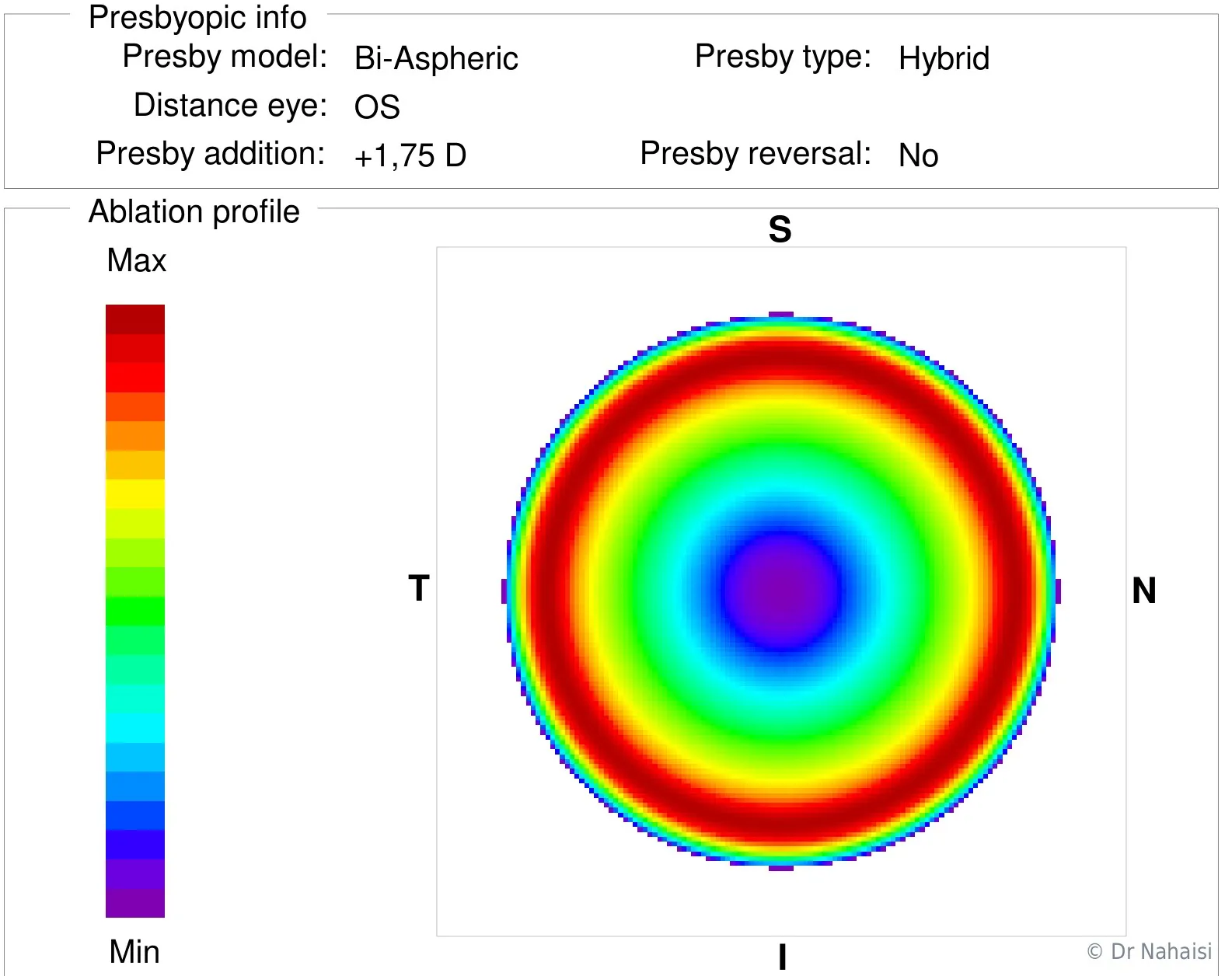
The treatment plan calculated by PresbyMAX, as I see it on the Schwind laser console before starting. At the top, the parameters chosen for this patient: a hybrid profile, an addition of +1.75 diopters, and the left eye designated as the distance-vision eye. At the bottom, the map of the ablation profile, which shows where and how much tissue the laser will remove. The center stays purple, where the laser removes the least. The cornea keeps a steeper curvature there; this is the zone that will provide near vision. The red ring at the periphery is the zone where the laser removes the most, which flattens the cornea for distance vision. This is what a multifocal cornea looks like, even before it is sculpted.
The pre-operative assessment: the tests and how the strategy is chosen
The concept of the dominant eye: the key to the strategy
Before getting into the profiles, a word about ocular dominance. Just as people are right-handed or left-handed, we have a dominant eye and a non-dominant eye. The dominant eye is the one the brain spontaneously favors for aiming, for distance vision and for precision. The non-dominant eye plays a more secondary role and tolerates slight distance blur better. It is always determined during the pre-operative assessment, with a very quick test. It shapes the whole strategy. As a general rule, distance vision is preserved in the dominant eye and near vision is entrusted more to the non-dominant eye.
The three PresbyMAX profiles
PresbyMAX does not apply a single setting to everyone. It offers three modes, and I choose with you the one that matches your eyes and what you need from them in daily life.
PresbyMAX monovision profile. The dominant eye receives a monofocal treatment, entirely dedicated to distance vision. It sees sharply at a distance, as after a standard LASIK. The non-dominant eye receives a multifocal profile geared toward intermediate and near vision. This is the profile indicated when distance vision must remain excellent, for example if you drive a lot or work outdoors. Tennis and golf players also find it suits them.
PresbyMAX hybrid profile. This time both eyes receive a multifocal treatment, but with a different distribution. The dominant eye is mainly geared toward distance vision (about 80%), with some intermediate vision added. The non-dominant eye is geared toward intermediate and near vision. The compromise is gentler than pure monovision. The difference between the two eyes is less marked and the distance/near transition more natural. Intermediate vision, the one used for a computer screen, is often better. This is the profile I favor for patients who work a lot on screens and read regularly.
PresbyMAX micro-monovision profile. This is the one most geared toward near vision. The dominant eye is set mainly for intermediate vision, with only 20 to 30% of focus for distance vision. This profile compromises distance vision too much for most people, and I almost never use it. It could suit a very particular case, for example a seamstress who sews very close up for hours. That is rare.
The choice of profile is made together in consultation, based on your starting prescription and your visual habits, with test results to support it. Nothing is standardized.
WHO IS PRESBYLASIK FOR?
PresbyLASIK, blended vision: a strategy for each profile
Not all presbyopia is treated the same way. The strategy depends first on your starting prescription, and that is what determines whether PresbyLASIK or blended vision is right for you.
The presbyopic emmetrope: toward PresbyLASIK. This is the typical indication. Emmetropic people have always seen well at a distance and discover reading glasses for the first time around age 42-45, often with frustration. Since they have no pre-existing optical defect to "recycle", blended vision is not possible. Multifocality is created directly on the cornea with PresbyMAX.
The presbyopic farsighted patient: toward PresbyLASIK. For farsighted patients, PresbyLASIK often feels like a release, because presbyopia adds to a problem that already existed. Farsighted people used their accommodation to compensate for their defect, including at a distance. When the accommodation reserve decreases, they become bothered up close around age 40, then at a distance around 50. The multifocal profile steepens the cornea: it corrects the hyperopia and compensates for the presbyopia in the same procedure. They are often among my most satisfied patients.
The presbyopic nearsighted patient: toward blended vision, not PresbyLASIK. Nearsighted people are in a particular, often advantageous, situation. There is one simple idea to remember: to see up close without having to accommodate, you need to be a little nearsighted. That is why presbyopic nearsighted people take off their glasses to read, their uncorrected myopia serving as built-in near vision. We make use of this natural advantage with blended vision: all of the myopia is corrected in the dominant eye, which then sees sharply at a distance, and a little myopia, about -1.50 diopters, is deliberately left in the non-dominant eye, which keeps its near vision. It is a standard, monofocal LASIK, simply with a different target for each eye.
Why not use multifocality for nearsighted patients? Because they adapt to it less well. Blended vision, which is simpler, gives better results. And it can be tested with contact lenses before the operation, so that you experience the effect for real before committing.
Presbyopia and astigmatism: corrected at the same time
The vast majority of presbyopic patients also have astigmatism, even if mild. Good news: the laser corrects both at once. The PresbyMAX ablation profile automatically integrates the astigmatism correction with the presbyopia correction, with no extra step or extra cost.
Candidacy criteria
As with any corneal laser treatment, candidacy for PresbyLASIK depends on the characteristics of your cornea, assessed during the pre-operative assessment: its thickness (pachymetry, with a usual safety threshold of around 500 microns), its regularity and curvature, the thickness of tissue that will remain after sculpting (the residual stromal bed), as well as the condition of the crystalline lens and the retina. The multifocal profile uses corneal tissue just like a standard LASIK. If your cornea is a little borderline, I lean toward TransPRK, which better preserves the structure (see the next section).
One point specific to multifocal treatment: in case of confirmed glaucoma, multifocal profiles should be avoided, because they slightly reduce optical quality while the visual field is already weakened. A monofocal treatment may then still be considered, case by case. Simple treated eye pressure, without confirmed glaucoma, is not an obstacle, however.
The pre-operative assessment: everything you need to know
Age and early cataract
PresbyLASIK can be performed up to age 60, or even 65, as long as the eyes are suitable. Age is not a contraindication in itself. What matters is notably the transparency of the crystalline lens. Beyond 55-60, if a significant early cataract is detected, corneal laser surgery is no longer the best option: it is better to consider lens surgery with an implant, performed by specialized colleagues, which then treats presbyopia at the same time.
PRESBYLASIK OR TRANSPRK
Is a flap needed? PresbyLASIK and presbyopic TransPRK
The PresbyMAX multifocal profile can be applied in two ways, depending on how the cornea is accessed. The excimer laser and the profile are exactly the same; only the access route changes.
PresbyLASIK creates a thin corneal flap with the femtosecond laser, which is lifted to sculpt the deep layer of the cornea and then put back in place. It is the most comfortable route, with a very fast recovery.
Presbyopic TransPRK is an "all-laser, no-contact" technique: the laser directly removes the thin surface layer of the cornea, the epithelium, then sculpts the multifocal profile, without creating a flap. It is less comfortable in the first days, with about 48 hours of stinging and watery eyes, and visual recovery takes 7 to 10 days. On the other hand, it hardly weakens the architecture of the cornea at all. I prefer it when the cornea is a little thin or slightly irregular.
In both cases, the multifocal result at 3 months is equivalent. The choice is made at the assessment, based on your cornea and your profile.
HOW THE PROCEDURE GOES
How PresbyLASIK goes at the Institut Voltaire
The procedure is performed as an outpatient at the Institut Voltaire, during the Friday morning surgery session. All the practical details (the appointment notice, the anti-anxiety tablet, removing contact lenses, arrival, changing into surgical attire, going home) are covered on a dedicated page. Here I describe the procedure itself, step by step.
Surgery day: preparation and practical details
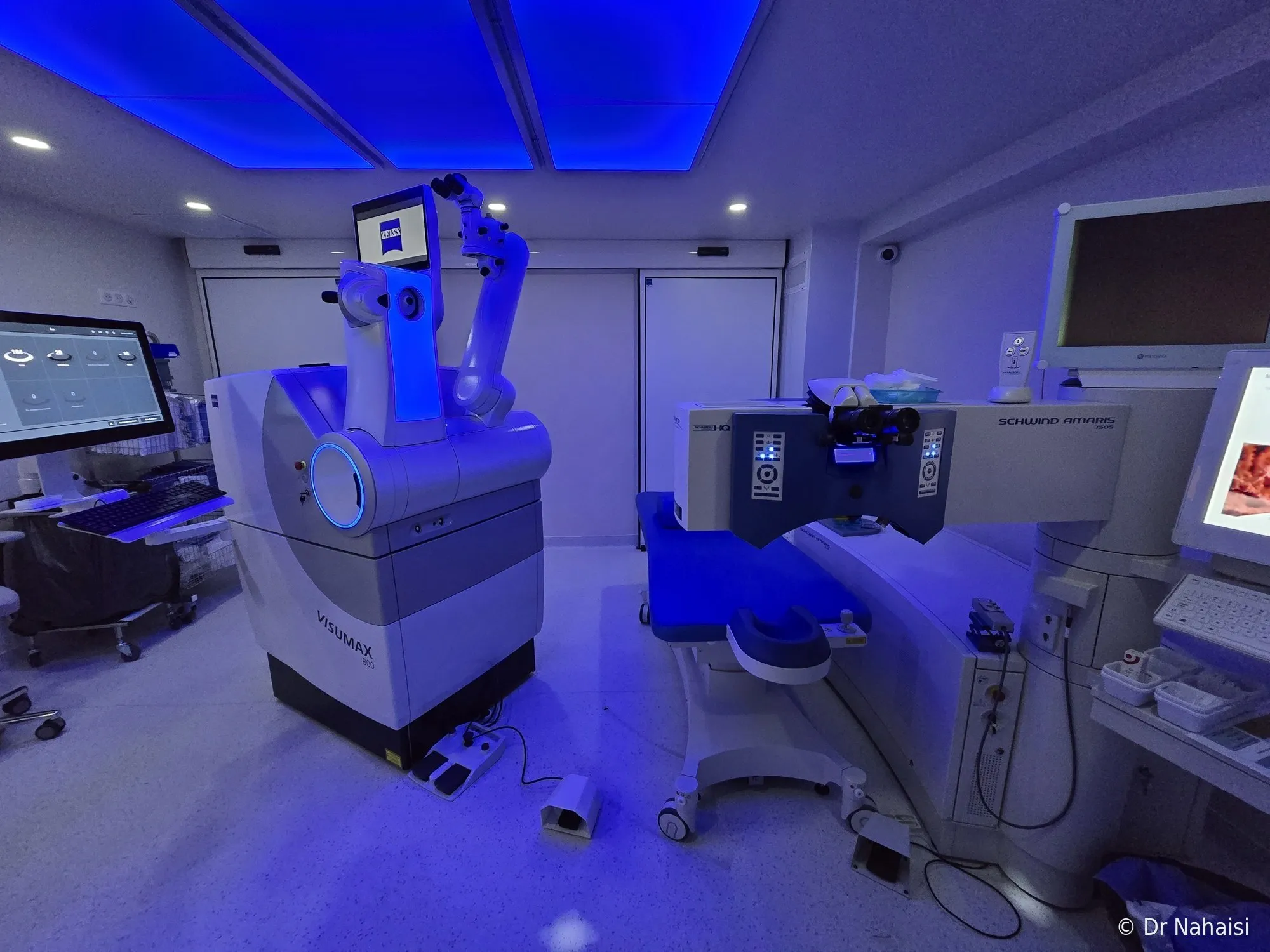
The operating room at the Institut Laser Ophtalmologique Voltaire. On the left, the Zeiss Visumax 800 femtosecond laser, which cuts the flap. On the right, the Schwind Amaris 750S excimer laser with its PresbyMAX module, which sculpts the multifocal profile. The bed swivels from one to the other without you having to get up. This is where PresbyLASIK takes place, as an outpatient procedure, under anesthetic eye drops.
Before the procedure. You take an anti-anxiety tablet about an hour beforehand, to help you relax. No fasting is needed; you can eat normally. When you arrive, after the administrative paperwork and the last check-up eye scans, you put on sterile attire and are taken into the room. You lie down comfortably. I put in anesthetic eye drops: the whole surgery is done under this local anesthesia, with no injection and no general anesthesia. A small device gently holds the eyelid open, so that you do not have to fight against blinking.
The laser pass, eye by eye. The sequence is as follows for each eye:
- Cutting the flap with the Visumax 800 (8 to 10 seconds). You look at a green light, gentle suction is applied to stabilize the eye, and your vision dims for a few seconds during the cut. You feel slight pressure, much gentler than with older lasers, and never painful.
- Lifting the flap. The bed swivels to place you under the excimer laser, then I gently lift the flap, like turning the page of a book. At this point you may feel slight tugging and see shadows passing through your field of vision. It is brief and painless.
- Sculpting the PresbyMAX profile with the Schwind Amaris 750S (about twenty seconds). The laser applies the multifocal profile calculated specifically for your eye. You simply look at a light during this time, and you feel nothing. A particular smell may be given off, sometimes described as a burning smell: it comes from the interaction of the laser with the surrounding air, not from the cornea, which is neither heated nor burned.
- Repositioning the flap (about thirty seconds). I rinse the surface and put the flap back exactly in place. It adheres immediately by natural suction, without any stitches.
We then move on to the second eye, with the same sequence. Between positioning, the explanations I give you at each step (I describe in advance what you are going to feel) and the music in the operating room, your time in the room remains short: about ten minutes for both eyes.
Safety throughout the procedure. Two systems keep watch continuously. Eye-tracking follows your eye at all times: even if your gaze moves slightly, which happens naturally, the correction stays applied exactly where it should be, as if the eye were perfectly still. Iris recognition, for its part, identifies the unique patterns of your iris to confirm the right eye and the right profile. It also automatically compensates for cyclotorsion, the slight rotation of the eye between the sitting and lying positions, a detail that is particularly important when astigmatism is also present.
Right afterward. You go to the recovery room while the first sensations settle. I give you UV-protective glasses and clear eye shields to wear at night for the first three nights, and I go over the instructions for the first days again before you leave. You go home accompanied, which is what I recommend, or alone by taxi or ride-hailing service. You will not be fit to drive in the hours that follow.
RECOVERY AFTER PRESBYLASIK
Recovery: why distance vision is what bothers you at first
The first hours. A gritty feeling in the eyes, sensitivity to light, watery eyes, wanting to keep your eyes closed: this is normal and temporary, and it lasts a few hours. Usually, you go home and take a nap thanks to the anti-anxiety tablet, and when you wake up it is already much better. The dark glasses provided are enough for comfort in the light.
The specific feature of PresbyLASIK, to keep in mind. Contrary to what you might imagine, in the first days it is often near vision that is already fairly good, and distance vision that is bothersome. This is perfectly normal. After a multifocal treatment, distance vision is the one that takes the longest to settle, because it corresponds to the peripheral part of the cornea, whose curvature stabilizes over a few weeks. The distance/near balance gradually evens out over about a month. Above all, you should not judge the result in the first days. That is what I tell my patients when they worry, at two weeks, that they are still bothered at a distance: it is expected, there is nothing to do but stay calm, it corrects itself. And I remain reachable to reassure you throughout this period.
Returning to activities. Screen work and driving are possible from the next day for most patients. Non-contact sports can resume from the next day, sports with a risk of a blow to the eye after three weeks. No swimming pool, steam room or sauna for two weeks. I can prescribe a sick note (time off work) case by case if you wish.
A tip for screen work. During the first weeks, eye strain on screens is common. A simple trick that really helps: every 20 minutes, take a 20- to 30-second micro-break by looking up at a distant point, more than 5 meters away. It rests the eyes and clearly reduces the discomfort.
Eye drops. You use eye drops for about a month, on a tapering schedule: antibiotic and anti-inflammatory eye drops, and preservative-free artificial tears for dryness. The details are given to you in writing and explained again before you leave the operating suite.
The first check-up. I see you again in consultation on the Monday afternoon following the procedure. It is a short check-up. I check that the flap is well attached and that there is no inflammation, then I measure the acuity achieved. Further check-ups are then scheduled at one month, then depending on your situation.
Temporary effects in the first weeks. Several normal phenomena may appear. Dry eye is almost systematic, and artificial tears relieve it. Vision also fluctuates from one day to the next, or during the day: better in the morning, a little less sharp in the evening. Finally, there are halos around lights, which are the subject of the next section. All of this gradually settles over 1 to 3 months.
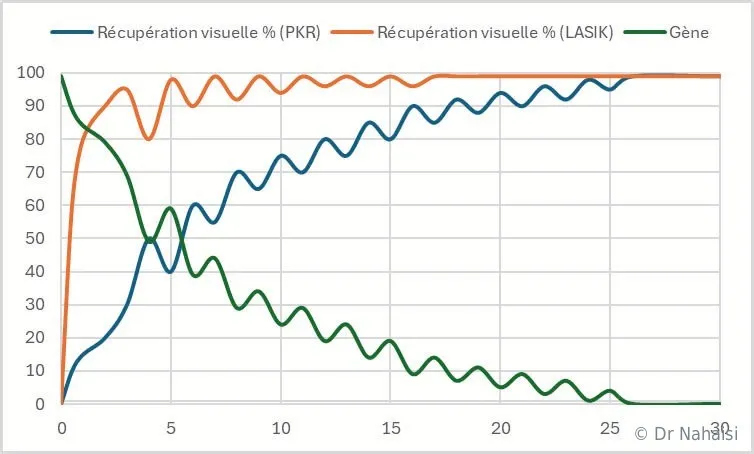
Visual recovery over 30 days (curve from the booklet). After PresbyLASIK (LASIK curve, in orange), recovery is fast: most of it happens in the first days. After presbyopic TransPRK (PRK curve, in blue), the improvement is more gradual while the epithelium heals; allow 7 to 10 days for independence. Discomfort, in green, decreases in parallel. The curve fluctuates before settling, and the result at 3 months is equivalent between the two techniques.
HALOS AND THE DISTANCE/NEAR COMPROMISE
Halos and the compromise: what you need to accept before going ahead
The compromise. Every presbyopia treatment rests on a compromise. Distance vision quality is slightly reduced to regain near vision. The goal is to eliminate dependence on glasses for about 90% of everyday activities: reading your phone, working on a screen, driving, shopping. Nobody gets back the eyesight they had at 20. Most often, the small loss in distance vision is imperceptible in daily life. Some patients still keep a pair of glasses on hand for specific situations, prolonged reading in low light in the evening or very small print, but you can absolutely live your life without them. You go from constant dependence to almost complete freedom.
Halos around lights. This is the most typical effect of multifocal treatments. Since the cornea now distributes light rays over several focal points, at night, when the pupil dilates in the dark, these focal points generate stray images around point light sources. Headlights and streetlights appear surrounded by a halo or a light streak. It is a direct and expected consequence of multifocality, not a defect.
These halos are more pronounced in the first month or two, generally peaking around the second month, then they gradually regress. The brain learns to filter them out, and most patients no longer notice them after a few months. For the rare patients who do not adapt, the reversibility of the treatment, explained in the next section, makes it possible to reduce or cancel the multifocal effect.
A LASTING AND REVERSIBLE TREATMENT
Lasting, and reversible in case of discomfort
This is one of the great advantages of the Schwind PresbyMAX platform, and a point I want to explain clearly: PresbyLASIK is lasting and, in case of discomfort, it is reversible.
The corneal flap created during the procedure can be lifted again, even months or years later. An "inverse" laser treatment is then performed, giving the cornea back its previous curvature and reducing or canceling the multifocal effect. The Schwind platform keeps all the data from the initial treatment: the laser "knows" exactly what it did, and can precisely calculate the profile needed to adjust or cancel it.
This reversal is very rarely performed. It concerns patients who, despite the adaptation period, cannot get used to the compromise, because they remain too bothered in distance vision or by persistent halos. But it is an important safety net: if the compromise does not suit you, there are always options. At the Institut Voltaire, we are fortunate to be equipped with this technology.
Enhancement
We wait at least 6 months after the operation to let the cornea heal and the result stabilize. If an enhancement proves useful, to adjust the profile or slightly strengthen near or distance vision, it is generally simple: the existing flap is lifted and another laser pass is performed. The enhancement is included in the first year. After that, a preferential rate applies for up to 5 years after surgery.
RISKS AND COMPLICATIONS
PresbyLASIK: the risks explained
PresbyLASIK is a well-established surgery, with a high satisfaction rate. Like any procedure, it nevertheless carries possible side effects and complications, rare but worth knowing about so you can decide with full awareness.
Poor tolerance of the compromise. This is the real particularity of presbyopia treatment. The main risk is not adapting to multifocality, with distance discomfort or halos, rather than a serious medical complication. Hence the importance of fully understanding and accepting the compromise before going ahead, and the reassurance that reversibility provides.
Dry eye. It is common in the first weeks, and artificial tears relieve it. It disappears in almost all cases. The corneal nerves cut when the flap is created regenerate in 6 months on average. Lasting dryness is exceptional, and I have a whole range of treatments to manage it in the rare pronounced cases.
Halos and night vision. They are common with multifocal treatments, peaking around the second month, then they regress. In almost all patients they are temporary, and reversible if they persist.
Imperfect result. Undercorrection, overcorrection or asymmetrical healing between the two eyes are possible. In that case, an enhancement can be considered after stabilization.
Flap displacement. A very rare risk, limited to the first days, in case of a direct blow or hard rubbing. This is the reason for the precautionary instructions and for wearing eye shields at night. After 48 hours, the flap no longer moves in the course of normal life.
Serious complications. Infection is extremely rare and is treated with antibiotics: you do not lose an eye with this surgery. Corneal ectasia is also exceptional. PresbyLASIK does not touch the optic nerve, the retina or the internal structures of the eye. It is precisely to minimize these risks that the pre-operative assessment is thorough and that I am selective about candidacy criteria.
DURABILITY AND FOLLOW-UP
The result over time
The laser treatment is lasting. Corneal remodeling can sometimes slightly reduce its effectiveness over several years, but this regression is not systematic: you can absolutely keep the same result for life. And if a slight regression does occur, you never go back to what you had before the operation.
An important point about the timing of the procedure: presbyopia is a progressive condition that only stabilizes around age 55-60. At 45, we are operating on a condition that will continue to evolve. At 55, it is almost stable. If you have surgery before complete stabilization, an enhancement may be considered a few years later to keep up with the progression. This is planned for and normal.
Post-operative follow-up is included, with no limit on consultations. You can contact me at any time by message and come in for a consultation as often as needed. The relationship I build with each patient does not end on surgery day.
FEES AND COVERAGE
How much does PresbyLASIK cost in Paris
PresbyLASIK fee: €1,800 per eye, €3,600 for both eyes. The slight extra cost compared with standard LASIK corresponds to the multifocal profile calculated by the Schwind PresbyMAX laser.
For presbyopic nearsighted patients treated with blended vision (standard LASIK with a difference between the eyes, without a multifocal profile), the fee is that of LASIK: €3,200 for both eyes.
What is included: the procedure with the Visumax 800 and Schwind Amaris 750S lasers, clinic fees, complete post-operative follow-up with no limit on consultations, any enhancement in the first year (then a preferential rate for up to 5 years), and post-operative prescriptions.
Pre-operative consultation: at the standard rate set by French national health insurance. At the Paris 10th and 19th offices, there is no fee supplement and nothing to pay upfront (direct billing). At the Institut Voltaire (Paris 11th), you pay €50 upfront, including a €30 fee supplement (above the standard rate), of which at least €20 is reimbursed by your complementary health insurance.
Payment is made on surgery day, before the procedure. Payment in 4 installments is possible, by check or direct debit. Refractive surgery is not reimbursed by French national health insurance, but many complementary health insurance plans cover part of the costs: I give you a personalized quote to send them.
Detailed fees, quotes and complementary insurance reimbursements
Frequently asked questions
Your questions about PresbyLASIK
What is the difference between PresbyLASIK and standard LASIK?
The surgical procedure is the same: cutting a flap with the femtosecond laser, sculpting with the excimer laser, putting the flap back. The difference lies in the sculpting profile. A standard LASIK gives the cornea a single curvature, a monofocal profile, to correct distance vision. A PresbyLASIK applies a multifocal profile, calculated by the PresbyMAX module, which creates several focal zones on the cornea to correct both distance vision and near vision.
PresbyLASIK or blended vision: what is the difference?
These are the two major strategies for correcting presbyopia, and they are not for the same patients. Blended vision is for nearsighted patients: it is a monofocal LASIK in which a little myopia is deliberately left in the non-dominant eye so that it keeps its near vision. PresbyLASIK is for emmetropic and farsighted patients. Multifocality is created directly on the cornea with PresbyMAX, since there is no myopia to recycle. The choice follows from your starting prescription, and we make it together at the assessment.
Is PresbyLASIK painful?
No. The eye is numbed with eye drops. During the procedure, there may be some discomfort or a passing feeling of pressure, but no pain. Afterward, you feel a gritty sensation, watery eyes and sensitivity to light for a few hours. By the evening or the next day, most patients resume their activities.
Why is my distance vision blurry in the first days after PresbyLASIK?
This is normal and expected. After a multifocal treatment, near vision is often good quickly, but distance vision takes longer to settle. The distance/near balance gradually evens out over about a month. At two weeks, still being a little bothered at a distance is nothing to worry about: there is nothing to do but stay calm, it corrects itself. You should not judge the result in the first days.
Are halos common after PresbyLASIK?
Yes, they are common and expected after any multifocal treatment. They appear mainly at night, around headlights and streetlights, because the cornea now distributes light rays over several focal points. They are more pronounced in the first month or two, peaking around the second month, then they regress. The brain learns to filter them out. In the very rare cases where they remain bothersome, the treatment can be reversed on the Schwind PresbyMAX platform.
Is PresbyLASIK reversible?
Yes, and this is a particular feature of the Schwind PresbyMAX platform. The flap can be lifted again, even months or years later, to perform an inverse treatment that gives the cornea back its previous curvature and reduces or cancels the multifocal effect. The platform keeps all the data from the initial treatment and precisely calculates the profile needed. This reversal is very rare, but it exists: if the compromise does not suit you, there are always options.
What is the dominant eye in presbyopia surgery? How is it determined?
Just as people are right-handed or left-handed, we have a dominant eye and a non-dominant eye. The dominant eye is the one the brain favors for distance vision and precision; the non-dominant eye tolerates slight distance blur better. It is determined with a very simple, quick test during the pre-operative assessment. This information guides the whole strategy for treating presbyopia.
Do both eyes need surgery, or is one enough for presbyopia?
It depends on the profile chosen and on your needs. With the monovision profile, both eyes receive treatment, one monofocal and the other multifocal. In some situations, operating on just one eye may be enough to achieve the desired balance. This is decided together in consultation, based on the test results.
Is it normal to see differently with each eye after PresbyLASIK?
Yes, that is how the correction works: each eye receives a slightly different setting, one more for distance, the other more for near. Above all, do not cover one eye to compare. Live normally with both eyes open; the brain sorts things out on its own and adapts within a few days to a few weeks.
Can PresbyLASIK be done with TransPRK rather than LASIK?
Yes. The PresbyMAX multifocal profile can be applied without a flap, using TransPRK, a no-contact surface technique. This is the route I prefer when the cornea is a little thin or slightly irregular. Recovery is more gradual, 7 to 10 days, but the multifocal result at 3 months is equivalent.
Up to what age can you have PresbyLASIK?
Up to age 60, or even 65, as long as the eyes are suitable. Age is not a contraindication in itself: what matters is the transparency of the crystalline lens and the health of the cornea and retina. Beyond 55-60, if a significant early cataract is detected, lens surgery with an implant is generally preferred, which then treats presbyopia at the same time.
When can I go back to work and drive after PresbyLASIK?
Screen work and driving are possible from the next day in the vast majority of cases. Some eye strain at the end of the day is normal in the first weeks. Night driving may take a little longer, because of halos. A sick note (time off work) is possible case by case.
I have glaucoma. Can I have PresbyLASIK?
With confirmed glaucoma, multifocal treatments should be avoided, because they slightly reduce optical quality while the visual field is already weakened. A monofocal treatment may still be considered case by case. Simple treated eye pressure, without confirmed glaucoma, is not an obstacle to refractive surgery. You will simply need to continue the usual monitoring: eye pressure, visual field, OCT.
Do I need a referral or a letter from an ophthalmologist to book a PresbyLASIK consultation?
No. No referral letter or prescription is needed. You can book an appointment directly on Doctolib or by phone.
What if I am not happy with the result of my PresbyLASIK?
After the stabilization period, at least 6 months, if the result does not suit you (persistent distance discomfort, insufficient near vision, poor tolerance of the compromise), further surgery is possible. Options range from a simple enhancement, to adjust the profile, to a complete reversal, which gives the cornea back its previous curvature. Reversibility is one of the great strengths of the Schwind PresbyMAX platform.
BOOK AN APPOINTMENT
Ready to free yourself from your reading glasses?
The first step is simple: a consultation to review your eyes and the options available to you. No commitment, no pressure. We carry out a complete assessment and talk frankly about the compromise and the profile that would suit you.
I see patients at three locations in Paris:
- Institut Laser Ophtalmologique Voltaire, 5 rue La Vacquerie, 75011 Paris (Wednesday afternoons). Metro Voltaire (9), Philippe Auguste (2).
- Cabinet Ophtavie, 37 rue Archereau, 75019 Paris (Monday afternoons). Metro Crimée (7).
- Centre Santé Plus, 12 rue du Faubourg Saint-Martin, 75010 Paris (Thursday afternoons). Metro Strasbourg-Saint-Denis (4, 8, 9).
Surgery takes place on Friday mornings at the Institut Voltaire, sometimes on Wednesday afternoons.
Book an appointment on Doctolib
Phone and WhatsApp: 01 84 80 28 04. This number also receives WhatsApp messages; it is often the easiest way to reach me. By phone, a menu guides you: press 1 to book an appointment, 2 for a question about surgery, 3 for an emergency after a procedure. Options 2 and 3 go directly to my phone. By email: nahaisi@laservisionparis.com, or via Doctolib messaging.
Download the explanatory booklet (PDF)
"I don't operate on eyes, I operate on patients."
Dr Steven Nahaisi, ophthalmic surgeon in Paris, specialist in laser refractive surgery.
Author: Dr Steven Nahaisi, ophthalmic surgeon, specialist in laser refractive surgery, Institut Laser Ophtalmologique Voltaire, Paris 11th.
Your surgeon
Dr Steven Nahaisi
Ophthalmic surgeon dedicated exclusively to laser refractive surgery. He operates at the Institut Laser Ophtalmologique Voltaire and consults in three Paris offices. Consultations in English.