Full transparency
Surgery day, hour by hour
Your appointment is at the Institut Laser Ophtalmologique Voltaire (Voltaire Laser Eye Institute), 5 rue La Vacquerie, Paris 11th (11e arrondissement), at the time shown on your appointment notice. When you arrive, the secretaries go through the administrative formalities with you. You are then taken to an examination room for two or three eye measurements, then to the preparation room, where you are given a gown to wear over your clothes and a surgical cap. We go into the operating room, which takes about ten minutes. You then rest for a few minutes, I check your eyes, and you go home.
Dr Steven Nahaisi
Updated on 15 October 2026 · 19 min read
This page goes through each step in order, with answers to the questions I am most often asked before surgery.
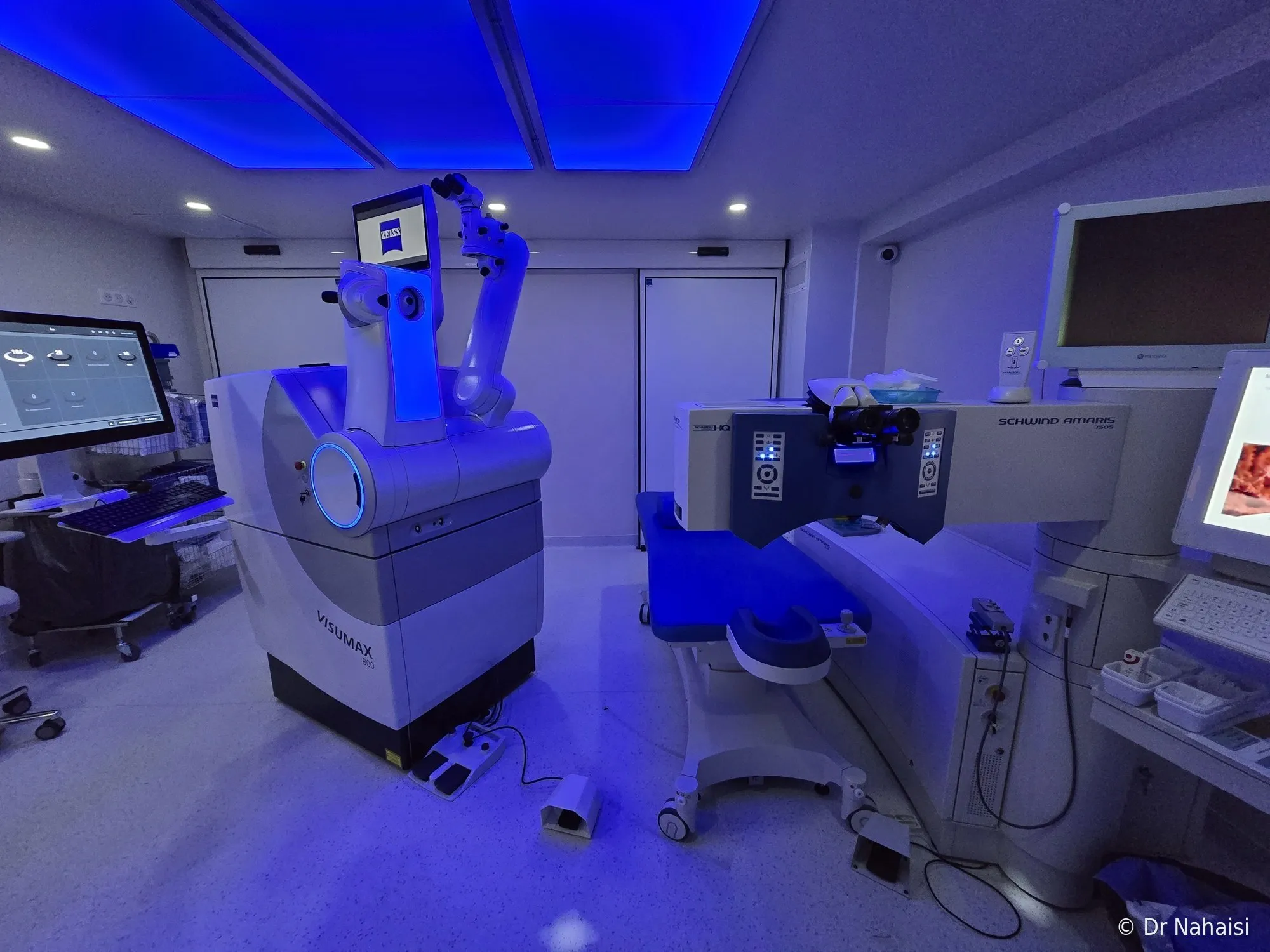
The operating room at the Institut Laser Ophtalmologique Voltaire, during a procedure. This is the room you will enter, and you will stay there for about ten minutes.
On this page12 sections
- 02WHAT TO PREPARE BEFOREHAND
- 03ARRIVING AT THE INSTITUT VOLTAIRE
- 04THE FINAL MEASUREMENTS
- 05PREPARATION AND ENTERING THE OPERATING ROOM
- 06THE PROCEDURE
- 07RIGHT AFTER THE PROCEDURE
- 08GOING HOME
- 09THE FIRST HOURS AT HOME
- 10COMING WITH SOMEONE
- 11THE FIRST CHECK-UP
- 12THE QUESTIONS I AM ASKED BEFORE SURGERY
- 13BOOK AN APPOINTMENT
WHAT TO PREPARE BEFOREHAND
Contact lenses
If you wear soft contact lenses, you remove them 48 hours before the procedure and go back to your glasses in the meantime. A contact lens slightly changes the surface of the cornea, and the measurements on surgery day must be taken on your cornea as it really is.
For rigid lenses, it is decided case by case. We generally check with repeated topographies to make sure the curvature of the cornea is no longer changing. I tell you the timeframe during the consultation; it depends on how long you have worn them.
The surgical file
You leave the consultation with your file: the appointment notice with the date, time and place, the pre-operative and post-operative prescription, the consent form to bring back signed on the day, and the quote to send to your complementary health insurance.
Two things to do before leaving home: sign the consent form, and pick up the eye drops at the pharmacy. We take care of the rest on site.
The day before
Do as you usually do. There are no particular restrictions, neither on food nor on drinks.
If you know that stress will keep you from sleeping, you can take an anti-anxiety tablet the evening before, in addition to the morning one. It is not mandatory. Set an alarm, as you may sleep heavily.
The morning
You eat and drink normally. Have a good breakfast. Anesthesia is done with drops; there is no injection and no general anesthesia, and therefore no fasting.
The anti-anxiety tablet is taken about one hour before your appointment time, so that it has time to work. Its purpose is for you to arrive relaxed and let things happen during surgery, without being tempted to move. You will feel a little slowed down, which is the intended effect, and it has no long-term consequences for your health. It will also help you take a good nap when you get home. It is not mandatory: if you are confident you can come in relaxed, you can do without it; just tell me when you arrive.
What to wear
Come as you are, in comfortable clothes. You keep them on throughout the procedure. We add a sterile gown over them, a surgical cap and shoe covers. There is no undressing and no hospital gown.
Before surgery, scrunchies, buns and ponytails come out. You will be lying on your back, with your head on a headrest, and the surgical cap needs to fit properly.
As for eye makeup: even with thorough makeup removal, it is best not to wear any the day before, because some may remain at the time of surgery.
What to bring
Your signed documents, your means of payment, your prescription glasses and a pair of sunglasses, which will keep the light from bothering you when you leave. Travel light; your belongings will be kept in a locked locker while you are in the operating room.
ARRIVING AT THE INSTITUT VOLTAIRE
Where and when
Procedures take place at the Institut Laser Ophtalmologique Voltaire, 5 rue La Vacquerie, in the 11th arrondissement of Paris. The nearest metro stations are Voltaire, line 9, and Philippe Auguste, line 2.
I operate on Friday mornings. It is my surgery day; I have no consultations at the same time. Come at the time shown on your appointment notice.
Checking in at the front desk
Your first step is the front desk. All the paperwork is done there.
We confirm your identity and the planned procedure, that is, the eye, the correction and the technique. This check is repeated several times during the morning, at several levels. Don’t be surprised if you are asked the same question again; it is intentional.
You hand in your signed surgical consent form. If you have forgotten it, the secretaries reprint it and you sign it on site.
You pay for the procedure before surgery, by bank card, check, bank transfer or direct debit. Payment in 4 installments is possible by check or direct debit. You are then given the invoice, which you will send to your complementary health insurance.
Fees, quotes and complementary health insurance reimbursement
Instructions and eye shields
We explain the post-operative course and the instructions for the first few days even before you go into the operating room. We explain them again after the procedure, they are written in the booklet, and you can write to me at any time over the weekend.
If you are having LASIK, you are given your protective eye shields. You will wear them for the first three nights, so that you don’t rub your eyes while sleeping. After SMILE or TransPRK, there are no eye shields.
THE FINAL MEASUREMENTS
What is measured on the day itself
You have already had a complete assessment in consultation. On the morning of the procedure, an orthoptist repeats two or three tests, which are used to program the laser.
Aberrometry. It measures how your eye processes light, beyond the simple correction in diopters.
Reference imaging of the iris. A photograph of your iris is taken while you are sitting up. It is used first for iris recognition: before each laser pass, the machine recognizes your iris and confirms that it is treating the right eye with the right profile. It is also used to correct cyclotorsion, the slight rotation of the eye that occurs when you go from sitting to lying down. This is what makes it possible to apply an astigmatism treatment on the right axis.
Pupillometry. The diameter of your pupil is measured in different lighting conditions. This value determines the size of the optical zone I will treat.
These tests are painless and take a few minutes. You rest your chin on a chin rest and look at a small light.
PREPARATION AND ENTERING THE OPERATING ROOM
Changing into surgical attire
You are then taken to the preparation room, which leads directly into the operating room. You are asked to put on a sterile gown over your clothes, a surgical cap and shoe covers. Your coat, bag and phone are placed in a locked locker.
The anesthetic drops
The anesthetic drops are put in. They sting for a second, then nothing. That is your entire anesthesia: no injection, no IV, no general anesthesia, and therefore no consultation with an anesthesiologist before the procedure. You remain conscious and talk to me throughout the surgery.
Your eye then no longer feels pain. You still feel touch and pressure, which travel through other pathways.
The room and the team
In the room, two lasers: the Visumax 800, the femtosecond laser, and the Schwind Amaris 750S, the excimer laser. One eye and then the other are treated in the same session, without you having to get up.
There are two of us with you, a surgical assistant and me. She stays with you from start to finish; she can talk to you and hold your hand if you need it. As for me, I talk a lot too: I explain what I am doing as I go, and we chat.
I operate with music; it is relaxing. And I sing, probably badly. If you would like a particular piece of music, just ask, we can do it.
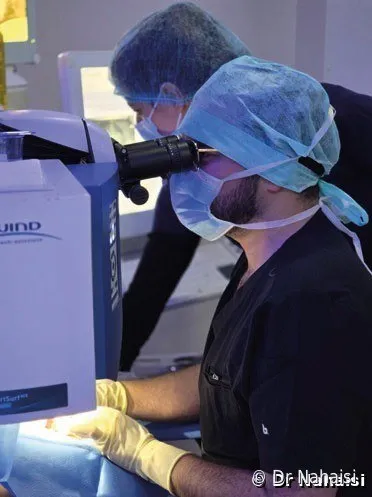
During the procedure. I am at the microscope, the surgical assistant is next to you, and I explain what I am doing as I go.
THE PROCEDURE
Getting into position
You lie on your back, with your head resting in a headrest. We adjust the position so that you are comfortable and well centered.
The skin around the eyes is cleaned with an antiseptic, then an adhesive sterile drape is applied that leaves the eye to be treated exposed and keeps the eyelashes out of the way. A small eyelid speculum is put in place to hold the eye open. It is what keeps you from blinking during the procedure. It does not injure the eyelids. The eye that is not being treated is protected.
What you feel
You feel my hands touching your face and your eyelids. That is the main sensation during the procedure.
At times you feel pressure on the eye, especially during the few seconds when the eye is docked to the femtosecond laser. Some describe it as a finger pressing on the closed eyelid.
You feel water running, because the surface of the eye is rinsed regularly. It is cool, and it is surprising the first time.
You see lights and blurry shapes. Your vision sometimes darkens to almost black for a few seconds at the moment of docking, then it comes back. I warn you just before. You will not see an instrument coming clearly toward your eye, rather shadows floating in your field of vision.
You hear a sharp, regular crackling while the excimer laser is working. And you notice a somewhat unusual smell, which comes from the reaction of the air to the laser.
What you don’t feel is pain. At most a tingling here and there.
Throughout all this, I talk to you. I tell you what I am doing, how much time is left, and what is going to happen.
With LASIK
The sequence is the same for each eye. The Visumax 800 cuts the corneal flap, which takes 8 to 10 seconds. This is the docking phase, with the pressure and the darkening of vision. I then lift the flap, like turning the page of a book, and you then see a diffuse light. The Schwind Amaris 750S sculpts the cornea for a few seconds, tracking your eye continuously. I reposition the flap, rinse, check that it is properly in place, and we move on to the second eye.
With SMILE
Everything is done on the Visumax 800, with no change of machine. The laser cuts a lenticule inside the thickness of the cornea, as well as a 2 to 3 millimeter micro-incision. The cutting takes about 14 seconds per eye. I then separate the lenticule and remove it through the micro-incision, then rinse.
With TransPRK
There is no flap and no docking. Everything is done with the Schwind Amaris 750S, without contact with the eye. The laser removes the epithelium, the surface layer of the cornea, then sculpts the stroma in the same pass. There is no strong pressure and no complete darkening of vision. At the end of the procedure, I place a bandage contact lens on each eye, which protects the healing area during the first few days.
How long it takes
About ten minutes in the room for both eyes, including setup, for a pure operating time of about one and a half minutes per eye. The rest is the time between each step, getting in and getting out.
RIGHT AFTER THE PROCEDURE
The moment you sit up
The speculum and the sterile drape are removed, you are helped to sit up, and you stay for a few moments on the edge of the table.
You see through a veil, like a cloudy fog. Behind this veil, many patients already feel they can see more sharply than before. With high corrections, the effect is striking from the very first minutes. I call it the WOW effect, and it is often the first thing my patients say when they sit up.
The recovery room
You then spend a few minutes in a recovery room, while the first sensations settle. Your eyes are closed most of the time.
I check your eyes before you leave. I make sure that the flap is properly in place in the case of LASIK, that the bandage contact lens is properly positioned in the case of TransPRK, and that the surface of the eye is clean. It is brief, at the slit lamp, as in a consultation.
We go over the instructions for the first few hours and for the first weekend together. The secretaries schedule your check-up appointment before you leave.
GOING HOME
How to get home
You will not be able to drive after the procedure. The morning tablet makes you drowsy, and your vision is not yet good enough.
You go home with someone accompanying you, or alone by taxi or ride-hailing car, which is what most of my patients do. On foot if you live in the neighborhood. Public transportation is not forbidden; it is simply less pleasant with the light and the watery eyes. When a car is possible, it is more comfortable.
After TransPRK, the first few hours are more uncomfortable, and it is preferable to have someone take you home.
If you are coming from far away
Some patients come from elsewhere in France or from abroad and go back to their hotel. That is entirely possible. Plan to be in town for the check-up that follows, and keep my number handy.
THE FIRST HOURS AT HOME
The nap
The morning tablet helps you fall asleep, and it is during this sleep that the surface of the eye calms down. When they wake up, most patients find that they already feel much better.
The discomfort
It starts when the anesthesia wears off. Your eyes sting, they water, they are sensitive to light, and all you want is to keep them closed.
After LASIK, SMILE or PresbyLASIK, this phase lasts 4 to 6 hours, and vision is often good by the same evening. After TransPRK, the uncomfortable phase extends over 48 to 72 hours, with a foreign body sensation and sensitivity to light. You have been prescribed painkillers; take them without hesitation.
Starting the eye drops
You start your drops about 6 hours after the procedure, when you wake up from your nap. If you are off by an hour or two, it makes no difference to the result. And if you really cannot open your eyes that same evening, don’t force it: drops were already put in during surgery, so it can wait until the next morning.
The eye drops and the treatment schedule
The evening
You can have dinner, take a shower, make phone calls, look at a screen if you feel like it. Just avoid aiming the shower head directly at your face for the first few days.
After LASIK, you sleep with the protective eye shields for the first three nights. You can sleep on your side; the eye shields are designed for that, they just need to be securely attached.
And you can write to me, weekends included.
COMING WITH SOMEONE
The person accompanying you stays with you during the waiting and preparation time. They go with you as far as the entrance to the preparation room, and do not enter the operating room, for reasons of asepsis. They then meet you at the exit.
There is some flexibility on this. If you have a particular need, a disability, a language barrier, talk to me about it beforehand; we adapt case by case.
Coming with someone is not mandatory. It is nicer to have someone with you, but many of my patients come and leave alone, by taxi or ride-hailing car. If you are having TransPRK, I advise you to arrange for someone to be with you.
Allow one hour to one and a half hours in total on site. If the person accompanying you cannot stay the whole time, arrange to meet them one hour after your appointment time.
THE FIRST CHECK-UP
I operate on Friday mornings, and the first check-up takes place the following Monday afternoon, at my practice in the 19th arrondissement, rue Archereau. Depending on the technique and the situation, it may also be scheduled on Wednesday or Thursday, or later if your recovery allows. The appointment is set on surgery day, before you leave.
This is the appointment at which I remove the bandage contact lens after TransPRK, check the position of the flap after LASIK, and measure your visual acuity for the first time. The examination is short: vision check, examination of the cornea at the slit lamp, check of healing. We adjust the eye drop treatment if needed, and go over any questions from the weekend.
Further check-ups are then scheduled, typically at one month, then at three and six months depending on the situation. Post-operative follow-up is unlimited and included in the fee. I am the one who follows you, from start to finish.
The complete patient journey, from the first consultation to follow-up
Frequently asked questions
THE QUESTIONS I AM ASKED BEFORE SURGERY
Do I need to fast on the day of laser eye surgery?
No. You eat and drink normally, and I even recommend a good breakfast. Anesthesia is done with drops only; there is no injection and no general anesthesia.
How much time should I plan to spend on site on the day of laser eye surgery?
One hour to one and a half hours in total, between arrival, paperwork, measurements, changing into surgical attire, the operating room and the rest period afterwards. The procedure itself takes about ten minutes for both eyes.
Is the anti-anxiety tablet mandatory on the day of laser eye surgery?
No, but I recommend it. Its purpose is for you to arrive relaxed and let things happen, without being tempted to move. You will feel a little slowed down, which is the intended effect, and it has no long-term consequences. If you are confident you can come in relaxed, you can do without it. You can also take one the evening before if you know that stress will keep you from sleeping, setting an alarm, as you may sleep heavily. The morning dose remains the more useful of the two.
When should I remove my contact lenses before laser eye surgery?
48 hours before the procedure for soft contact lenses. For rigid lenses, it is decided case by case, with follow-up topographies to check that the curvature of the cornea is no longer changing. I tell you the timeframe during the consultation.
Does laser eye surgery hurt during the procedure?
No. Anesthesia with drops eliminates surface pain. You will feel my hands on your face, pressure on the eye at times, water running during rinsing, and at most an occasional tingling. The discomfort comes afterwards, when the anesthesia wears off.
Can I blink during laser eye surgery?
No. A small speculum holds your eyelids open throughout the procedure, and it is what keeps you from blinking. It does not injure the eyelids and does not cause the eyelid to droop afterwards.
What happens if I move my eye while the laser is working?
Your eyes move constantly, even when you are staring at a point, and the lasers are built with this in mind. The Schwind Amaris 750S tracks your eye continuously and adjusts the position of the laser pulses in real time according to the exact position of your iris. If the movement becomes too large, the laser stops on its own. We reposition, and start again.
Will I see the laser coming toward my eye?
No. You see a blurry light to focus on, and indistinct shapes. During docking with the femtosecond laser, your vision darkens for a few seconds, sometimes to almost black, then it comes back. I warn you just before.
What should I do if I need to sneeze, cough, or take a break during laser eye surgery?
Swallowing is no problem at all; do it freely. If you need to cough or sneeze, let me know, even with a single word: I move away, we wait, we start again. We sometimes take breaks for patients who need them, and the procedure then goes perfectly.
Can the person accompanying me stay with me on the day of laser eye surgery?
They go with you as far as the entrance to the preparation room and meet you at the exit. They do not enter the operating room, for reasons of asepsis. We can be flexible depending on the situation; talk to me about it beforehand.
Are both eyes operated on the same day in refractive surgery?
Yes, in the vast majority of cases. One eye and then the other are treated in the same session, without you having to get up. Operating on the two eyes separately is reserved for specific situations, which I explain to you in consultation if this applies to you.
When will I see you again after laser eye surgery?
On the Monday afternoon following Friday’s surgery, sometimes on Wednesday or Thursday depending on the case. And you can write to me in the meantime, including over the weekend.
BOOK AN APPOINTMENT
Before setting a surgery date
A pre-operative consultation is necessary. It lasts about one hour and is generally enough to do everything: the complete assessment, the discussion about your expectations, the choice of technique and the answers to your questions. You need neither a referral letter nor a prescription from another ophthalmologist to come and see me.
The pre-operative assessment: what we examine and why
Where I see patients
Institut Laser Ophtalmologique Voltaire: 5 rue La Vacquerie, 75011 Paris. Consultations on Wednesday afternoons, surgery on Friday mornings, sometimes on Wednesday afternoons. Metro Voltaire (9) and Philippe Auguste (2).
Paris 19th practice: 37 rue Archereau, 75019 Paris. Consultations on Monday afternoons, and post-operative check-ups. Metro Crimée (7).
Paris 10th practice: 12 rue du Faubourg Saint-Martin, 75010 Paris. Consultations on Thursday afternoons. Metro Strasbourg Saint-Denis (4, 8, 9).
The consultation is at the standard rate set by French national health insurance with no fee supplement in the 10th and 19th, with nothing to pay upfront (direct billing). At the Institut Voltaire, you pay €50 upfront, including a €30 fee supplement, reimbursed up to at least €20 by your complementary health insurance, and often in full.
Contact me
Phone and WhatsApp: 01 84 80 28 04 · Email: nahaisi@laservisionparis.com · Doctolib messaging
Book an appointment on Doctolib
Read my patients’ Google reviews
“I don’t operate on eyes, I operate on patients.”
Dr Steven Nahaisi, ophthalmic surgeon in Paris, specialist in laser refractive surgery.
Author: Dr Steven Nahaisi, ophthalmic surgeon, specialist in laser refractive surgery, Institut Laser Ophtalmologique Voltaire, Paris 11th.
Your surgeon
Dr Steven Nahaisi
Ophthalmic surgeon dedicated exclusively to laser refractive surgery. He operates at the Institut Laser Ophtalmologique Voltaire and consults in three Paris offices. Consultations in English.