Your journey
The Cost of Laser Eye Surgery in Paris
Laser refractive surgery is not reimbursed by French national health insurance. It is considered an elective procedure, meaning it is not mandatory and is each patient’s own choice. Your complementary health insurance may, however, cover part of the cost, sometimes a significant part.
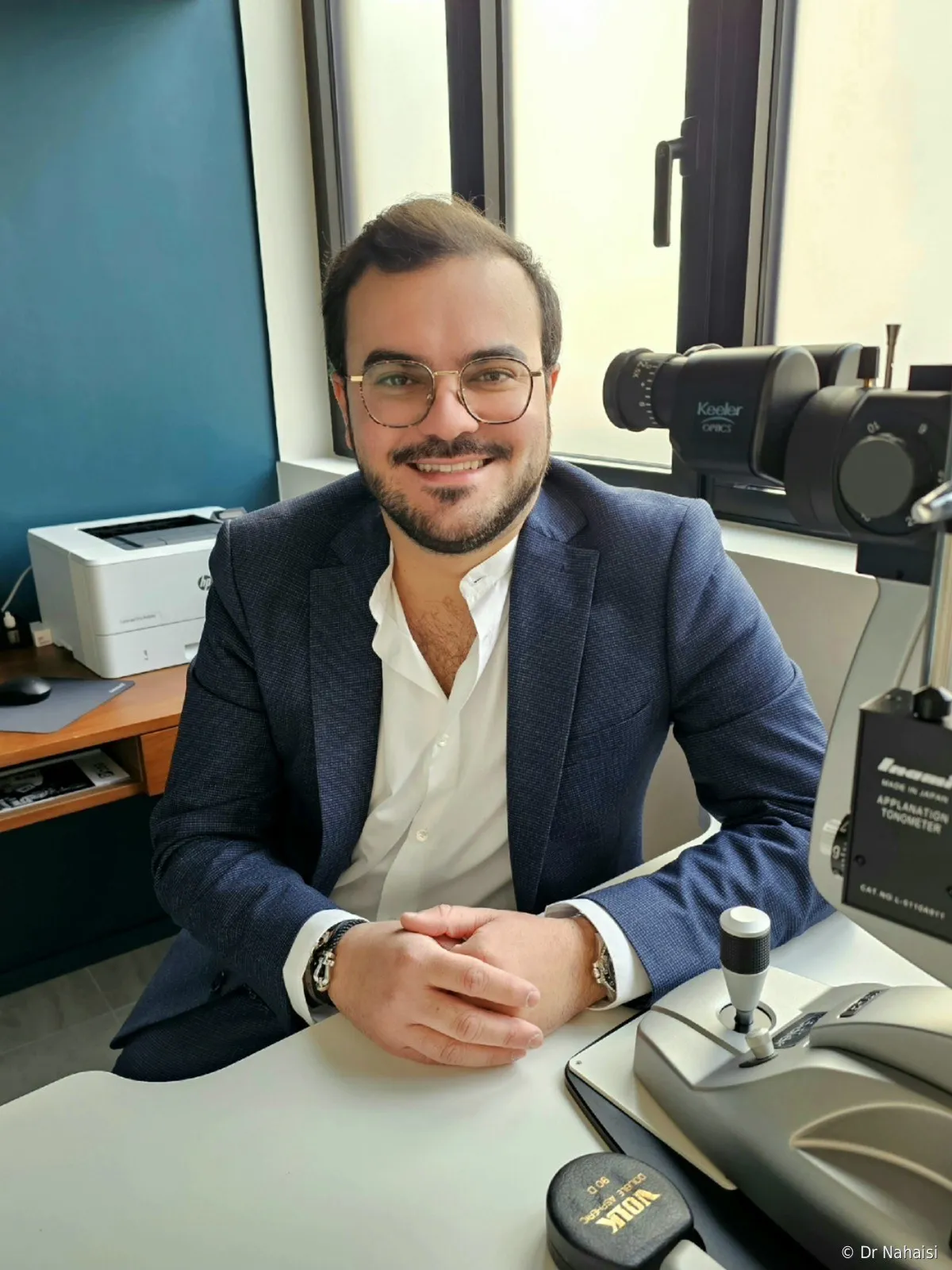
Dr Steven Nahaisi
Updated on 15 October 2026 · 17 min read
On this page, I detail the fees for each technique, what is included in the price, the payment and reimbursement terms, and how to plan ahead with your complementary health insurance.
On this page10 sections
- 02FEES BY TECHNIQUE
- 03WHAT IS INCLUDED IN THE FEE
- 04THE COST OF THE CONSULTATION
- 05PAYMENT AND PAYMENT OPTIONS
- 06COMPLEMENTARY HEALTH INSURANCE AND REIMBURSEMENTS
- 07REQUESTING A QUOTE IN ADVANCE
- 08A FEW WORDS ABOUT OUR FEES
- 09FREQUENTLY ASKED QUESTIONS ABOUT FEES
- 10BOOK AN APPOINTMENT
- 11CHEAP REFRACTIVE SURGERY: WHAT CAN IT HIDE?
FEES BY TECHNIQUE
How much does laser eye surgery cost?
The following table shows the fees per eye or for both eyes. They include the surgeon’s fees, the clinic fees at the Institut Voltaire, unlimited post-operative follow-up and a possible enhancement in the first year.
| Technique | Per eye | Both eyes | Recovery / Indications |
|---|---|---|---|
| TransPRK | €1,400 | €2,800 | 100% laser technique, with no cutting and no contact (Schwind Amaris 750S). Recovery: 7 to 10 days |
| LASIK | €1,600 | €3,200 | Femtosecond for the cut + excimer for the reshaping (Zeiss Visumax 800 + Schwind). Recovery: < 24h |
| SMILE | €1,900 | €3,800 | Femtosecond only (Zeiss Visumax 800). Recovery: comparable to LASIK |
| PresbyLASIK | €1,800 | €3,600 | Presbyopia in emmetropic and farsighted patients (presbyopic nearsighted patients: blended vision at the LASIK fee). Recovery: < 24h |
The technique is chosen during the pre-operative assessment, based on the anatomy of your cornea and your prescription. It is not an à la carte choice. But when several techniques are possible, the decision can be made together.
Details by technique:
TransPRK: €2,800
TransPRK is a 100% laser surgery, with no cutting and no contact with the eye. The Schwind Amaris 750S excimer laser treats the surface of the cornea directly. It is the technique I use when the cornea is too thin for LASIK, or when the corneal profile calls for it. It is also the most suitable for patients with pre-existing dry eye. It is also suitable for very anxious patients who are afraid of the cut involved in LASIK and its possible risks.
Visual recovery takes 7 to 10 days. The first 48 hours can be very uncomfortable (watery eyes, sensitivity to light, foreign body sensation). After 48 hours, the discomfort decreases sharply, but vision remains blurry for just under a week. People generally return to work after a week of recovery.
LASIK: €3,200
LASIK combines two lasers. The Zeiss Visumax 800 femtosecond laser cuts an ultra-thin corneal flap, about 100 microns (0.1 mm), then the Schwind excimer laser corrects vision by reshaping the cornea beneath the cut area. The flap is then put back in place at the end of the procedure. It is the most commonly performed technique. Its main advantage is a very fast recovery, generally less than 24 hours before returning to work.
LASIK is suitable for myopia (up to -10D, sometimes -12D depending on the cornea), hyperopia (up to +7/+8D), astigmatism (up to -6D) and presbyopia, provided that the corneal thickness is sufficient (safety threshold: about 500 µm) and that the cornea shows no signs of weakness or deformation.
SMILE: €3,800
SMILE is performed entirely with the latest-generation Zeiss Visumax 800 femtosecond laser. The laser cuts a small disc of corneal tissue (lenticule) inside the cornea, which is extracted through a micro-incision. No flap, no excimer laser.
The fee is higher because the cost of using the Visumax 800 per treatment is higher. Recovery is comparable to LASIK, sometimes with a slightly longer visual haze. Enhancement is less easy than with LASIK. This technique corrects mild to moderate astigmatism, but it is less suited to it than LASIK, and it does not correct hyperopia.
PresbyLASIK: €1,800 per eye (€3,600 for both eyes)
PresbyLASIK corrects presbyopia in emmetropic and farsighted patients, with or without astigmatism. In presbyopic nearsighted patients, I tend to use blended vision (monovision), at the LASIK fee (€3,200). It is based on the same principle as LASIK, with a treatment profile adapted to correcting near vision.
This multifocal correction profile on the Schwind laser is the one with the highest cost, hence its extra cost compared with standard LASIK.
The strategy varies depending on the profile: monovision, multifocal or hybrid treatment. It is a discussion we have in detail during the consultation.
See the Presbyopia / PresbyLASIK page
Important: the choice of technique is not yours alone. It is a medical choice, which depends on the anatomy of your cornea, your prescription and your needs. We make it together, during the pre-operative assessment. There is no technique that is better in absolute terms. There is the one that best suits your eye and your profile.
WHAT IS INCLUDED IN THE FEE
One all-inclusive fee
The surgery fee covers your entire care, apart from the first pre-operative assessment consultation. There is nothing to add.
The surgery
The procedure on both eyes, performed at the Institut Laser Ophtalmologique Voltaire (Voltaire Laser Eye Institute) on the Schwind Amaris 750S (excimer) and Zeiss Visumax 800 (femtosecond) platforms.
Post-operative follow-up
Unlimited. All check-up visits after surgery are included in the fee, with no limit on their number. A patient operated on three years ago receives the same attention as a patient operated on the day before. Follow-up is provided by me, from start to finish.
Follow-up visits are carried out by me only as part of the follow-up of the surgery. Beyond the stage where vision is balanced and satisfactory, routine follow-up (eye pressure, fundus exam, etc.) is done with your regular ophthalmologist.
A possible enhancement
If additional laser treatment is needed in the first year after the procedure, it is included in the initial fee, at no extra cost.
If it takes place later, within the first 5 years after surgery, a preferential rate applies.
Once the fee is paid, you have nothing more to pay. Follow-up, check-ups and any enhancement are included.
THE COST OF THE CONSULTATION
Pre-operative consultation, standard rate set by French national health insurance
The pre-operative consultation is billed at the standard rate set by French national health insurance. At the 10th and 19th arrondissement practices, there is no fee supplement and there is nothing to pay upfront (direct billing). At the Institut Voltaire (11th), a €30 fee supplement applies.
What changes depending on where you are seen is the amount you pay upfront:
| Location | Paid upfront | Details |
|---|---|---|
| Paris 10th, 12 rue du Fg St-Martin | €0 | Standard rate with no fee supplement. Nothing to pay upfront (direct billing): you pay nothing with your Carte Vitale (French health insurance card) and complementary health insurance. |
| Paris 19th, 37 rue Archereau | €0 | Standard rate with no fee supplement. Nothing to pay upfront (direct billing): you pay nothing with your Carte Vitale (French health insurance card) and complementary health insurance. |
| Paris 11th, Institut Voltaire, 5 rue La Vacquerie | €50, including a €30 fee supplement | Your complementary health insurance reimburses at least €20, and sometimes the full €50, depending on your plan. |
If you do not have complementary health insurance, there will be a contribution of about twenty euros at the 10th and 19th arrondissement centers.
The consultation is available to patients covered by CMU, now called Complémentaire santé solidaire (C2S) (French state health coverage), with nothing to pay upfront wherever you are seen.
No need for a letter from a doctor or another ophthalmologist to book an appointment. Simply book a slot on Doctolib.
PAYMENT AND PAYMENT OPTIONS
When and how do you pay for surgery?
On surgery day
Payment is made on the day of the procedure, directly with the clinic’s front desk, before going into the operating room.
Accepted payment methods
Credit card, check, bank transfer, direct debit.
If you would like to spread the payment over several installments, it is possible under the following terms.
By check (the most common)
On the day of the procedure, you hand over several checks. A cashing date is written on each one, and they are cashed month after month. You choose the frequency, up to a maximum of 4 monthly installments.
Example for LASIK at €3,200: 4 checks of €800, cashed on surgery day and then over the following 3 months.
If you do not have a checkbook, you have time to order one from your bank between the consultation and the procedure.
By direct debit
When paying by check is not possible, I use an app that divides the fee into 4 monthly installments by direct debit. You will receive a link by email to approve the direct debit mandate online.
Matching payment to your insurance reimbursement
On the day of the procedure, you receive a receipted invoice that you send to your complementary health insurance. It reimburses you directly, usually within a few days to a few weeks. If you would rather not pay the full amount upfront, we can work something out: you write a check for the amount of the expected reimbursement, and I will only cash it once you have confirmed that you have received the transfer.
Example for LASIK at €3,200 with €1,200 reimbursed by your complementary health insurance: your out-of-pocket cost is €2,000. You pay the €2,000 on surgery day (in one payment or in several checks), and you write a check for €1,200 that I will cash only once you have received your reimbursement.
COMPLEMENTARY HEALTH INSURANCE AND REIMBURSEMENTS
How does reimbursement by your complementary health insurance work?
French national health insurance does not reimburse refractive surgery. However, most complementary health insurers cover part of the cost. The amount varies depending on your plan: from a few hundred euros to sometimes more than €1,000 or even €2,000, particularly with employer-provided plans.
Finding out your reimbursement before surgery
You are the one who contacts your complementary health insurance. I send you a quote that you forward to them. They reply with the amount they cover. It is the only reliable way to know your reimbursement.
You can also check your benefits table, which includes a “chirurgie réfractive” (refractive surgery) line, often the last line of the optical section, after the reimbursements for lenses and frames.
On the day of the procedure
You receive a receipted invoice (that is, an invoice proving that you have paid the full amount). You send it to your complementary health insurance, which reimburses you directly into your account. This reimbursement usually takes a few days to a few weeks depending on the insurer.
Watch out for waiting periods
Some complementary health insurers impose a waiting period before covering refractive surgery. If you have just changed insurer or plan, check this before scheduling your procedure.
Two insurance plans?
If you have a personal plan and an employer plan (or your spouse’s), you can send the quote or the invoice to both. Reimbursements can be combined.
Insurers sometimes play with words
Some insurers reply in very administrative language and ask for unusual documents (statement of fees, AMC form, etc.). This is often a standard reply that does not apply to refractive surgery, since it is a procedure not reimbursed by French national health insurance. Do not be discouraged. We are used to handling these situations and will do the necessary paperwork so that you get the reimbursement you are entitled to.
Platforms such as Santéclair and care networks
Some insurers offer to refer you to “approved” partner centers through platforms such as Santéclair, which impose very low fees on affiliated practitioners.
This model may suit structures looking to attract volume, but it is very far from the way I work. I have always chosen to remain independent, to invest in the latest machines and to keep medical time for each patient. The Institut Voltaire is not part of these networks.
If your insurer refers you to a partner center at a reduced rate, I invite you to read the section “Cheap refractive surgery: what can it hide?” at the end of this page.
REQUESTING A QUOTE IN ADVANCE
Planning ahead with your complementary health insurance
Many patients want to know their insurance reimbursement even before coming for a consultation. That is entirely possible.
I can send you a preliminary quote from your first contact (email or Doctolib messaging), without you needing to come in. This quote allows you to ask your insurer and get an idea of your out-of-pocket cost.
What you need to know about this quote
The preliminary quote is based on the most likely technique (usually LASIK, unless otherwise indicated). It is not binding, since the chosen technique will be confirmed during the pre-operative assessment, based on the anatomy of your cornea.
If the technique chosen after the consultation differs from the one in the initial quote, I will issue a new, adjusted quote.
How do you request one?
Write to me by email or through Doctolib messaging, giving me your first and last name, your date of birth and your current prescription if you know it. I send the quote back within the following days.
A FEW WORDS ABOUT OUR FEES
Our prices are not the cheapest, and that is a choice
Our fees are not the cheapest in Paris.
The price of refractive surgery reflects three things: how modern the machines are, the surgeon’s expertise, and the quality of the support and follow-up. At the Institut Voltaire, we have chosen not to compromise on any of the three.
The machines. The Institut Voltaire is equipped with the Schwind Amaris 750S excimer platform and the Zeiss Visumax 800 femtosecond laser, one of the most recent on the market. Acquiring these machines led to an increase in the cost per treatment, and therefore in fees. It is an investment we stand by, because it makes a concrete difference to the precision of the treatment and to comfort during the procedure. For your information, this equipment represents an annual cost of about €800,000 for the Institut Voltaire.
Expertise. I specialize exclusively in refractive surgery, with more than 3,500 procedures performed. It is my full-time job, and nothing else. My fees are aligned with those of my two colleagues at the Institut Voltaire, Dr Rambaud and Dr Nicolau, both also specialized in refractive surgery. Three surgeons in the same facility, with the same standards and the same fees, is also a guarantee for you.
Follow-up. When you write to me, I am the one who answers. Follow-up is unlimited, at no extra cost, and provided by your surgeon. It is a real commitment, one you will not find in low-cost centers.
You will find cheaper options in Paris or abroad. In this field, it is always one of these three pillars that is lacking when the price drops significantly.
My advice: make your choice based on how you feel with the surgeon you have met, and not on price alone. A relationship of trust matters a great deal in this process.
CHEAP REFRACTIVE SURGERY: WHAT CAN IT HIDE?
Cheap refractive surgery, what you need to know before choosing
Refractive surgery offers at prices far below average are out there, whether through low-cost centers, platforms such as Santéclair, or clinics abroad. These prices are sometimes half the usual prices.
In itself, a low price does not necessarily mean a bad result. Some surgeons who operate at high volume do perfectly sound work from a technical standpoint. The problem is not always the quality of the procedure.
What is often lacking is everything around it:
Human support. In high-volume structures, the surgeon is not necessarily the one who saw you in consultation. Sometimes you only meet them on surgery day. Follow-up is provided by other practitioners, or delegated to your regular ophthalmologist.
Medical time. When a center has to treat 15 or 20 patients per morning to be profitable at that price, the time spent with each patient inevitably decreases. Less time to explain, to answer questions, to detect an at-risk profile.
How modern the machines are. The operating costs of latest-generation lasers are high. A very low price may mean that the center uses older or fully depreciated machines, which do not offer the same level of precision.
Follow-up if there is a problem. Complications are rare, but when they occur, it is the relationship with your surgeon and their availability that make the difference. A surgeon you can reach directly does not have the same impact as a switchboard.
The vast majority of patients who come to see me are referred by a relative, a colleague or a patient who has already had surgery. It is my greatest reward, and it is also what motivates me to maintain this level of standards. They come because of the trust they have in me and my team, not for the prices. This relationship of trust is what makes the quality of the journey.
My advice remains the same: meet your surgeon, ask them your questions, and make your choice based on how you felt. It is the best criterion.
Author: Dr Steven Nahaisi, ophthalmic surgeon, specialist in laser refractive surgery, Institut Laser Ophtalmologique Voltaire, Paris 11th (11e arrondissement).
Frequently asked questions
Your questions about fees and reimbursements
How much does LASIK cost with Dr Nahaisi?
LASIK costs €3,200 for both eyes, all inclusive: surgery, unlimited post-operative follow-up and a possible enhancement in the first year.
How much does TransPRK cost?
TransPRK costs €2,800 for both eyes, all inclusive.
How much does SMILE laser eye surgery cost?
SMILE costs €3,800 for both eyes, all inclusive. The higher fee is due to the higher cost of using the Zeiss Visumax 800 laser.
How much does laser correction of presbyopia cost?
PresbyLASIK costs €1,800 per eye, i.e. €3,600 for both eyes.
Is post-operative follow-up included in the fee for laser eye surgery?
Yes. Follow-up is unlimited, included in the fee, at no extra cost. Dr Nahaisi personally provides every check-up visit.
Can I pay for laser eye surgery in installments?
Yes. Dr Nahaisi accepts payment in 4 installments at no extra cost, by check or by direct debit.
Are there any additional costs on top of the listed fee for laser eye surgery?
No, apart from the first consultation, which is itself fully reimbursed most of the time. The fee covers everything: surgery, follow-up, a possible enhancement and unlimited availability of your surgeon. No hidden costs.
Can I choose my laser eye surgery technique?
The technique is chosen during the pre-operative assessment. When several techniques are possible, it is my role to guide you toward the one I find best suited to your profile. It is a medical choice that we make together.
Does French national health insurance reimburse refractive surgery?
No. Refractive surgery is a procedure not reimbursed by national health insurance. However, your complementary health insurance may cover part of it. I send you a quote to forward to your insurer to find out your exact reimbursement.
My insurer says it needs a statement of fees or an AMC form for my refractive surgery. What is that?
It is a standard reply that many insurers send. Refractive surgery is not a procedure reimbursed by French national health insurance, so the AMC amount on the quote is €0. We are used to handling these situations and will provide you with all the necessary documents.
Can I get a quote for laser eye surgery even before the consultation?
Yes. Write to me by email or through Doctolib, and I will send you a preliminary quote within the following days. This allows you to ask your insurer ahead of time.
I do not have a checkbook. How can I pay for laser eye surgery in installments?
You have time to order one between the consultation and the procedure. Otherwise, payment in 4 installments is also possible by direct debit: a link will be sent to you on the day of the procedure.
I am a student: are there any special arrangements for laser eye surgery?
Improving my patients’ lives matters a great deal to me. For particular financial situations, do not hesitate to write to me directly. We will always try to find a solution, including a payment plan spread beyond 4 installments if necessary.
Do you have to pay for the pre-operative refractive surgery consultation?
The consultation is at the standard rate set by French national health insurance. At the 10th and 19th arrondissement practices, there is no fee supplement and there is nothing to pay upfront (direct billing). At the Institut Voltaire (11th), you pay €50 upfront, including a €30 fee supplement. Your complementary health insurance reimburses at least €20, and often the full amount depending on your plan.
BOOK AN APPOINTMENT
Questions? Just one step to get started.
Come and see me for a consultation. We do the assessment, we talk, and you leave with all the answers. No commitment, no pressure.
For a preliminary quote or any question about fees or surgery, write to me directly.
Book an appointment on Doctolib
Or by phone and on WhatsApp: 01 84 80 28 04. A menu guides you: 1 to book an appointment with the assistant, 2 for a question about surgery, 3 for an emergency after a procedure. Options 2 and 3 go directly to my phone, and the number also receives WhatsApp messages. By email: nahaisi@laservisionparis.com, or through Doctolib messaging.
Your surgeon
Dr Steven Nahaisi
Ophthalmic surgeon dedicated exclusively to laser refractive surgery. He operates at the Institut Laser Ophtalmologique Voltaire and consults in three Paris offices. Consultations in English.