Full transparency
Recovery After Laser Refractive Surgery
The procedure lasts about ten minutes. What follows lasts a few weeks, and that is what my patients talk to me about most: the evening of the surgery, the first weekend, vision that is not the same on Tuesday as it was on Monday.
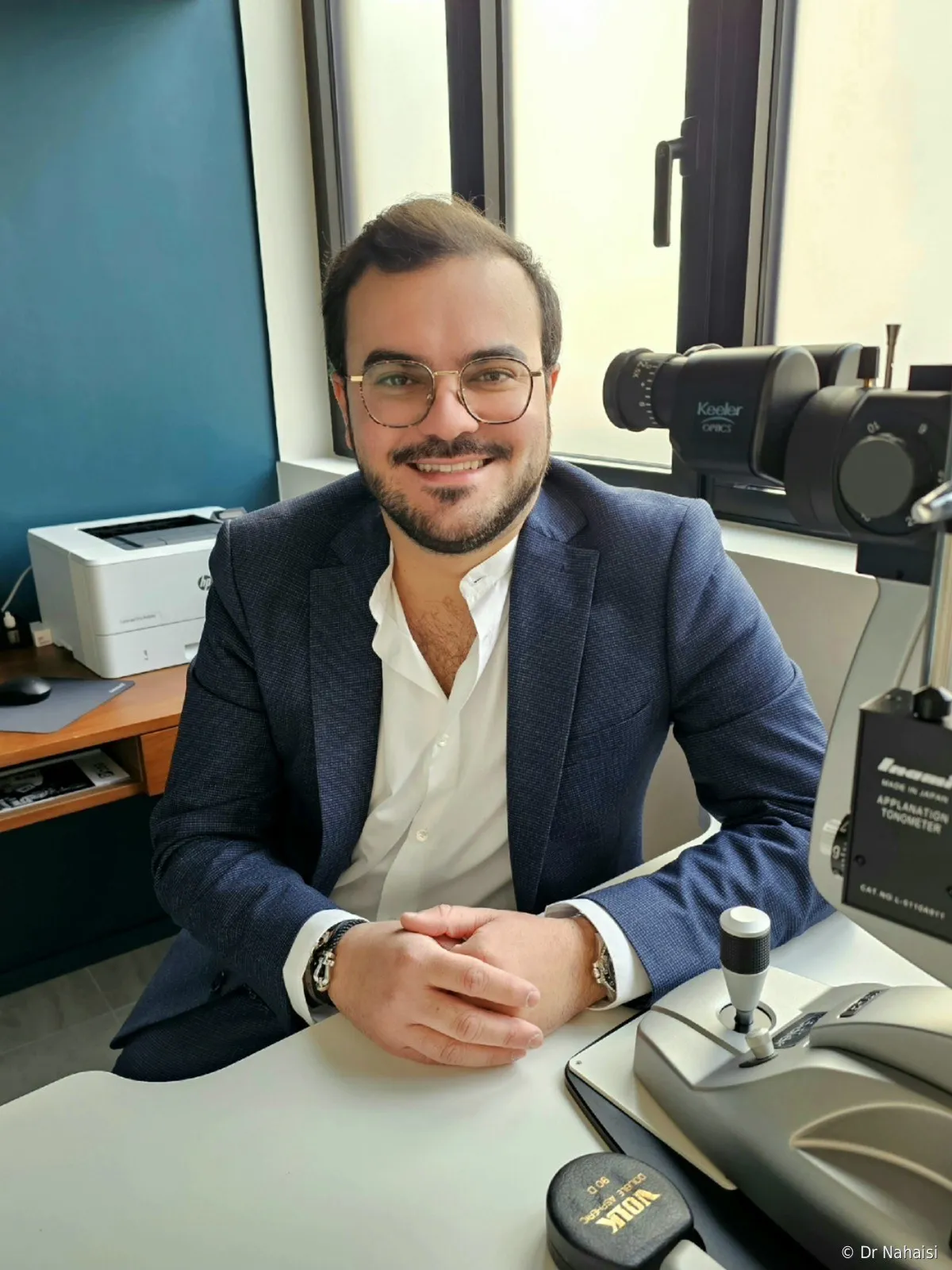
Dr Steven Nahaisi
Updated on 15 October 2026 · 31 min read
This page goes through recovery in order, day by day and then week by week. It applies to the four techniques I perform at the Institut Laser Ophtalmologique Voltaire (Voltaire Laser Eye Institute): LASIK, TransPRK, SMILE and PresbyLASIK. When recovery differs from one technique to another, I point it out.
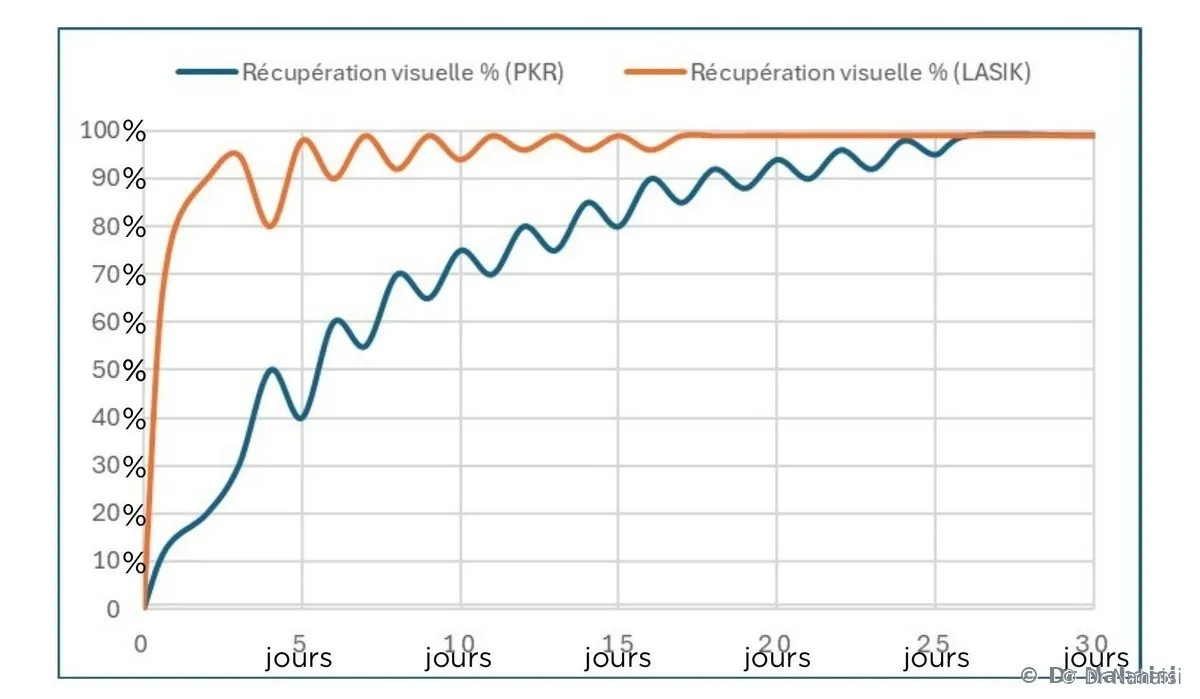
One point to remember before anything else. A normal recovery is not linear. Vision improves, dips a little, improves again. One eye can be better than the other for ten days, then the reverse.
Visual recovery over 30 days, taken from my booklet. In orange, LASIK, which improves from the very next day. In blue, TransPRK, which is more gradual. The green curve shows the discomfort felt, which fades in the first few days.
On this page13 sections
- 02THE FIRST HOURS
- 03THE EVENING AND THE FIRST NIGHT
- 04THE NEXT DAY
- 05THE FIRST WEEK
- 06THE FIRST MONTH, THEN STABILIZATION
- 07WHAT CHANGES DEPENDING ON THE TECHNIQUE
- 08WHAT IS NORMAL, AND WHAT SHOULD ALERT ME
- 09TREATMENT AFTER THE PROCEDURE
- 10GETTING BACK TO YOUR LIFE
- 11DRYNESS AND HALOS
- 12FOLLOW-UP AND HOW TO REACH ME
- 13RECOVERY FAQ
- 14BOOK AN APPOINTMENT
THE FIRST HOURS
When you leave the operating room
You see through a veil, like a cloudy fog. Behind this veil, many patients already feel they see more sharply than before, and with high corrections the effect is striking within the first few minutes.
I check your eyes before you leave, we go over the instructions for the first hours together, and you are given your protective glasses for the trip home.
The full course of surgery day
What you will feel
Your eyes sting, they water, they are sensitive to light, and all you want is to keep them closed. They sting because you have just had surgery. It is not related to the drops or to a problem with the treatment.
This phase lasts 4 to 6 hours after LASIK, SMILE or PresbyLASIK. After TransPRK, it is longer and more pronounced, for about 48 to 72 hours; I come back to this below.
Going home
You do not drive that day. The tablet taken before the procedure makes you drowsy, and your vision is not yet good enough.
You go home with someone accompanying you, or alone by taxi or ride-hailing service, or on foot if you live in the neighborhood. Public transportation is not forbidden, it is simply less pleasant with the light and the watering. Patients who come from outside Paris can take the train, preferably accompanied.
The nap
The morning tablet helps you fall asleep, and it is during this sleep that the surface of the eye settles down. When you wake up, the discomfort has clearly decreased.
You start your eye drops at that point, about 6 hours after the procedure. If you are an hour or two late, it makes no difference. And if you cannot open your eyes at all that evening, don't force it: drops were already put in at surgery, and it can wait until the next morning. Rest comes first.
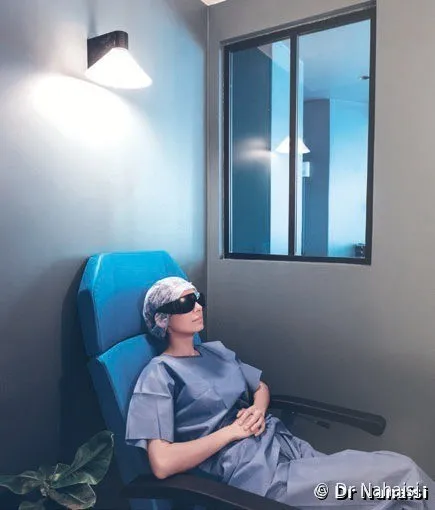
The recovery room at the Institut Voltaire, just after the procedure. You stay there until the first sensations settle down, wearing your protective glasses.
THE EVENING AND THE FIRST NIGHT
When you wake up from your nap
After LASIK or SMILE, you already feel much better, and vision is often good by that same evening, through a slight veil.
After TransPRK, it works the other way around. Vision is fairly good in the hours following the procedure, then it becomes blurry in the evening, as healing of the surface begins.
The night
After LASIK, you sleep with the clear protective eye shields for the first three nights. They prevent accidental rubbing during sleep. You can sleep on your side, they are designed for that; they simply need to be well secured. There are no eye shields to wear after SMILE or after TransPRK.
What you can do from the first evening
You can shower that same evening. Avoid aiming the shower head directly at your face for the first few days, and instead wash your face with wet hands, going around the eyes.
You can have dinner, make phone calls, look at a screen if you feel like it. None of this harms healing.
THE NEXT DAY
After LASIK, SMILE or PresbyLASIK
The next day, you can see. Not perfectly, but you can see. A slight veil often remains, like a window that is not quite clean, and it clears over a few days.
You can go back to work the next day, screens included. The first day is tiring. You will probably need to increase the font size on your screen, move your chair back a little and take breaks. Accommodation is readjusting, and you can feel that your eyes have trouble focusing up close, a bit like a digital camera. This is normal.
Driving is generally possible again the next day, once the veil has lifted. You are the only judge: if you are not comfortable, you wait one more day.
An evening out or a dinner the following weekend is no problem at all. Just be careful about knocks and rubbing in the first few days, and keep your protective glasses with you if there are lots of people around.
After TransPRK
The day after TransPRK is the most uncomfortable day of the whole process. A sometimes intense foreign-body sensation, watering, strong sensitivity to light, and sometimes real pain. The bandage contact lens placed on each eye at the end of the procedure protects the healing area and reduces these sensations without eliminating them.
You stay at home, with the prescribed painkillers and rest with your eyes closed. Your phone is generally unusable for these first three days, because your vision cannot keep up.
This phase lasts two to three days, then things improve. It is the only truly difficult moment of the process, and I tell every patient so before the procedure.
TransPRK: principle, indications and recovery
Redness of the white of the eye
A red eye the next day, looking like small burst blood vessels, is common. It is due to the pressure applied during the procedure and to a few superficial vessels that have bled. It has no consequences, apart from appearance.
This redness often increases over the first two or three days, then clears over about two weeks. If bleeding of this kind appears spontaneously months after the surgery, it is generally not related to the surgery, and I then advise having your blood pressure checked by your primary care physician. I do mean the blood pressure in your arm, not the pressure in your eye.
THE FIRST WEEK
After LASIK, SMILE or PresbyLASIK
This is the week of eye strain. Vision is already good, but the eye is working with new optics. Headaches at the end of the day, a feeling of pressure on the temples, slightly slow focusing on text up close.
This difficulty accommodating is common in the first few days and fades quickly. A simple rule helps a lot when using a screen: every 20 minutes, look into the distance for 20 seconds.
The residual veil clears over the week. The second week is a completely different story.
After TransPRK
I prefer to give figures rather than impressions.
On Day 3, you recover 20 to 30% of your visual acuity. The pain is gone. You can get around and go out, but it is still too little to drive or work.
Between Day 7 and Day 10, you are at around 70%. The surface has closed and the unpleasant sensations have disappeared. The remaining blur is unusual, rather cottony.
The bandage contact lens is removed between the 3rd and the 5th day, at the first check-up. Removal takes a few seconds and is not painful. If you feel that it is wrinkling, moving or has fallen out before this appointment, write to me.
Most people go back to work after one week. There is then one more week of discomfort, comparable to the first week of a patient who had LASIK. I prescribe a sick note on a case-by-case basis; ask for it on surgery day.
THE FIRST MONTH, THEN STABILIZATION
Vision fluctuates
This is what people write to me about most in the weeks that follow. You see very well in the morning, less well at 6 p.m., and you wonder whether something has gone wrong. It hasn't. Three mechanisms overlap during the first month.
Surface dryness. The tear film that covers the cornea is the eye's first lens. When it is unstable, so is the image. Vision that becomes sharp again just after a drop of artificial tears is the signature of this mechanism.
Eye strain. The eye is relearning its focusing reflex with new optics.
Tapering of the treatment. The anti-inflammatory eye drop is reduced in steps, and the cornea follows this change.
So you may see excellently one day, less well the next, better the day after, with clear differences from one eye to the other. All of this evens out. There is nothing special to do, and if it worries you, come in for a check-up.
Where you stand at one month
After LASIK, SMILE or PresbyLASIK, vision is close to the final result. Screen fatigue has disappeared or almost. Dryness is still there, often at the end of the day.
After TransPRK, you are at around 90% of your final acuity on Day 30. High corrections sometimes take longer.
After PresbyLASIK, you also need to allow time for the brain to adapt to the new distribution of images between the two eyes.
PresbyLASIK and presbyopia correction
Between 1 and 3 months
This is the window in which the result is assessed. After TransPRK, full recovery occurs between the 2nd and the 3rd month. After LASIK or SMILE, most of the result is achieved earlier, but the cornea continues to stabilize over the same period.
A difference between the two eyes at two months is nothing abnormal. These asymmetries are most often explained by dryness, eye strain or ongoing healing, and they fade on their own.
In fact, I prefer a result that improves gradually to a result that is perfect from the first day, which would rather suggest a risk of change in the other direction later. After TransPRK, a feeling of reaching a plateau around the 6th or 8th week is not unusual and does not predict the result.
Enhancement
If at three months the result is not the one we were aiming for, an enhancement (touch-up) is possible. It is discussed after stabilization, not before six months. It is included during the first year, then offered at a preferential rate up to 5 years after the procedure.
After LASIK, it is done by lifting the existing flap. After SMILE, it is done with TransPRK or by secondarily creating a LASIK flap, depending on the case.
WHAT CHANGES DEPENDING ON THE TECHNIQUE
Two healing patterns
All the techniques I perform reshape the same deep layer of the cornea, the stroma. What changes is the access route, and that is what determines the recovery.
LASIK and SMILE work beneath the surface. The superficial layer, the epithelium, remains intact. It does not need to heal, so it does not hurt, and vision returns quickly.
TransPRK works on the surface. The laser removes the epithelium to reach the stroma, and this epithelium must then grow back. This regrowth explains the discomfort of the first two days and the slower recovery.
LASIK, SMILE and PresbyLASIK
| What applies to you | Guideline |
|---|---|
| Duration of initial discomfort | 4 to 6 hours |
| Usable vision | The same evening, through a veil |
| Night eye shields | LASIK only, for the first 3 nights. None after SMILE |
| Rubbing | To be avoided for the first 3 days after LASIK |
| Return to work | From the next day, screens included; tiring first week |
| Driving | Generally from the next day |
| Shower | From the same evening, without aiming the shower head at your face for 3 days |
| First check-up | The Monday afternoon following the Friday surgery |
| Visual veil | Clears over a few days, sometimes a little longer after SMILE |
After LASIK, the main instruction comes down to three words: do not rub. The flap adheres on its own, without stitches, and it needs a few days to bond firmly to the cornea. After the first 48 to 72 hours, contact during normal everyday life can no longer displace it.
After SMILE, there is no flap, and the 2 to 3 millimeter micro-incision closes on its own. Some patients do, however, describe slightly milky or less contrasted vision for a few days longer than after LASIK. It clears.
LASIK in detailSMILE in detail
TransPRK
| What applies to you | Guideline |
|---|---|
| Duration of initial discomfort | 48 to 72 hours, with possible real pain during the first two days |
| Bandage contact lens | Placed on each eye, removed between the 3rd and the 5th day |
| Night eye shields | None, the bandage contact lens provides protection |
| Acuity on Day 3 | 20 to 30% |
| Acuity between Day 7 and Day 10 | 70% |
| Acuity on Day 30 | 90% |
| Full recovery | 100% between the 2nd and the 3rd month |
| Return to work | About one week, followed by a week of discomfort |
| Driving | Generally at the end of the first week |
| Sun | Enhanced sun protection for the following 6 months |
The bandage contact lens is not a corrective lens. It is a soft dressing placed on the healing surface, which protects it, reduces the sensations and speeds up closure. You do not feel it, or barely.
As for rubbing, there is no strict prohibition after TransPRK, since there is no flap. It is simply better not to irritate a healing surface.
WHAT IS NORMAL, AND WHAT SHOULD ALERT ME
Where the line is drawn
Write to me as soon as something concerns you; I prefer one question too many. That said, the left-hand column is by far the fuller one in real life: the vast majority of what you will feel is listed there.
| Normal | Write to me or call me |
|---|---|
| Eyes that sting, burn and water in the first hours | Pain that increases instead of decreasing, or that comes back after having disappeared |
| Visual veil or fog in the first few days | A clear drop in vision after a phase of improvement |
| Red white of the eye, red patches that spread for 2 to 3 days and then clear over 15 days | Red and painful eye, with thick, yellow or greenish discharge |
| Gritty, sand-like sensation under the eyelid | A foreign-body sensation that nothing relieves, with vision that is getting worse |
| Vision that fluctuates from one day to the next and from one eye to the other during the first month | An eye that takes a knock or is rubbed hard in the days following LASIK |
| Halos and spread-out lights in the evening, headaches at the end of the day, screen fatigue | Severe pain beyond the first 3 days after TransPRK |
| Drops that sting or make your eyes water, eyelids stuck together in the morning with discharge | Pain or a drop in vision beyond the first 24 hours after LASIK or SMILE |
| Discomfort and sensitivity to light around the 10th day, a bandage contact lens that wrinkles, moves or falls out after TransPRK | Simply a doubt about something you cannot find the answer to here |
Two situations you should know about
Discomfort with sensitivity to light around the 10th day. In some patients, the corticosteroid treatment raises the pressure inside the eye, which causes dull pain, a veil and marked sensitivity to light. It is not serious and it is easily resolved. When people write to me at this stage, I ask three questions: do you have pain, is the veil in one eye or both, are you very sensitive to light? If so, we stop the corticosteroid, because ten days after the surgery the risk of infection and inflammation is already virtually nonexistent, and we keep only the artificial tears.
A knock to the eye after LASIK. Displacement of the flap in the first few days is rare, and it is treated by going back to the operating room to reposition it. It is a simple procedure, with a slightly slower recovery and no consequence for the final result. What matters is to let me know quickly.
Situations that require a prompt consultation
This instruction is written out in full on your prescription. Pain during the first two days is normal, particularly after TransPRK, and it is treated with the prescribed painkillers.
However,a sudden drop in visual acuity, or severe eye pain beyond the first 3 days after TransPRK or beyond the first 24 hours after LASIK or SMILE, requires a prompt consultation to assess the situation.
You can reach me by phone or WhatsApp at 01 84 80 28 04. On WhatsApp, you can attach a photo of your eye, and that is often the fastest way. Outside the practice's opening hours, go to the ophthalmic emergency department of Cochin Hospital, 27 rue du Faubourg Saint-Jacques, 01 58 42 23 00, and let me know at the same time. By email:nahaisi@laservisionparis.com, or through Doctolib messaging.
TREATMENT AFTER THE PROCEDURE
Your prescription is the reference
Your prescription is given to you with your surgical file, before surgery day, so that you have time to go to the pharmacy. It is personal, adapted to your technique and your cornea, and it is the reference. If you have any doubt about what you have in hand, write to me.
Treatment starts about 6 hours after the procedure, when you wake up from your nap.
The four types of treatment
The morning eye wash. A single-dose vial and a clean gauze pad, to clean the eyelids and eyelashes when you wake up, when secretions have built up overnight. It takes thirty seconds and makes a difference to your comfort at the start of the day. After TransPRK, the single-dose vials are kept in the refrigerator; the cold clearly soothes a healing surface. It is used for cleaning, not for moisturizing: tears are more effective for that.
The antibiotic and corticosteroid eye drop. A single bottle for both actions: preventing infection and calming the inflammatory reaction of the cornea. It is taken on a tapering schedule, in three steps, from the highest number of drops to the lowest. This tapering follows the reaction of your cornea, which is strongest in the first few days and then less and less noticeable. You complete all the steps, even if everything is fine before the end, and you do not continue beyond them: a corticosteroid continued for too long can raise the pressure inside the eye. If you want to change anything, write to me first.
Artificial tears. They do not treat, they soothe, and they are your best allies for several months. Overdosing is not possible: you can use as many as you need. A thicker gel version is used at bedtime for those who wake up with sticky or dry eyes. This is the only treatment you manage yourself, over several weeks to several months depending on the patient.
Painkillers. They are mainly useful after TransPRK, to get through the first 48 hours. Take them without waiting for the pain to set in; that is when they are most effective. After LASIK or SMILE, they are rarely necessary.
My two standard prescriptions
Here are the two prescriptions I write. They are given for information only: the one you receive on surgery day is adapted to your case, and it is the reference.
After LASIK, SMILE or PresbyLASIK
| Product | What it is for | When and for how long |
|---|---|---|
| Seresta 10 mg | Anti-anxiety medication, so you arrive relaxed | 2 tablets 1 hour before the procedure, then 2 when you get home if the discomfort is intense |
| Dacudose | Morning eye wash, with gauze pads | In the morning if needed, for 5 days |
| Tobradex (or Chibrocadron, or Maxidrol if unavailable) | Antibiotic and corticosteroid, prevents infection and calms inflammation | 1 drop 4 times a day for 5 days, then morning, noon and evening for 5 days, then morning and evening for 5 days |
| Vismed Multi 0,18 | Artificial tears | 1 drop at least 2 to 3 times a day, for at least one month, as often as needed in case of discomfort |
| Vismed Multi 0,3 gel | Thicker tears, for the night | 1 drop at bedtime, for at least one month |
| Doliprane 1000 mg | Painkiller | 1 tablet after the surgery if needed |
| Hypoallergenic Micropore tape | To secure the eye shields | 3 nights. The eye shields and protective glasses are provided on surgery day |
After TransPRK
| Product | What it is for | When and for how long |
|---|---|---|
| Seresta 10 mg | Anti-anxiety medication, which also helps you sleep through the 48 uncomfortable hours | 2 tablets 1 hour before, then 2 tablets up to 3 times a day for 48 hours |
| Dacudose | Morning eye wash, with gauze pads. Keep in the refrigerator; the cold is soothing | In the morning, for 7 days |
| Tobradex (or Chibrocadron, or Maxidrol if unavailable) | Antibiotic and corticosteroid | Same schedule as for LASIK: 4 times a day for 5 days, then 3 times for 5 days, then 2 times for 5 days |
| Vismed Multi 0,18 and Vismed Multi 0,3 gel | Artificial tears, day and night | Same schedules as for LASIK |
| Doliprane 1000 mg | Painkiller | 1 tablet every 6 hours in case of pain, for 2 days |
| Acupan 30 mg | Stronger painkiller, if the pain is intense | 1 tablet, up to a maximum of 3 a day, for 2 days |
No eye shields or Micropore tape after TransPRK: the bandage contact lens protects the surface.
How do you put in your post-operative eye drops?
In front of a mirror, with clean hands. Pull your cheek down with one finger, never the upper eyelid: this opens the small fold between the lower eyelid and the eye, called the lower conjunctival sac. That is where the drop should land, not on the cornea. Hold the bottle a few centimeters above and squeeze just enough for a drop to form at the tip. Once it has formed, stop squeezing: it will come off on its own and fall into the fold. You can also bring the bottle closer until the drop itself touches the surface of the eye and settles there. It is the bottle that must never touch the eye or the eyelashes. One drop is enough; the rest overflows.
If you put in several eye drops in a row, space them about one minute apart, otherwise the second washes out the first.
Many eye drops sting or make your eyes water when you put them in, especially slightly oily preparations. This is common, it is not a sign of allergy or of a mistake, and shaking the bottle before use improves comfort.
A single missed dose or a dose taken late does not compromise anything. What matters is the total duration and following the steps.
If the pharmacy gives you a product that is similar but not identical, write to me: I will tell you whether it is equivalent or whether it needs to be exchanged.
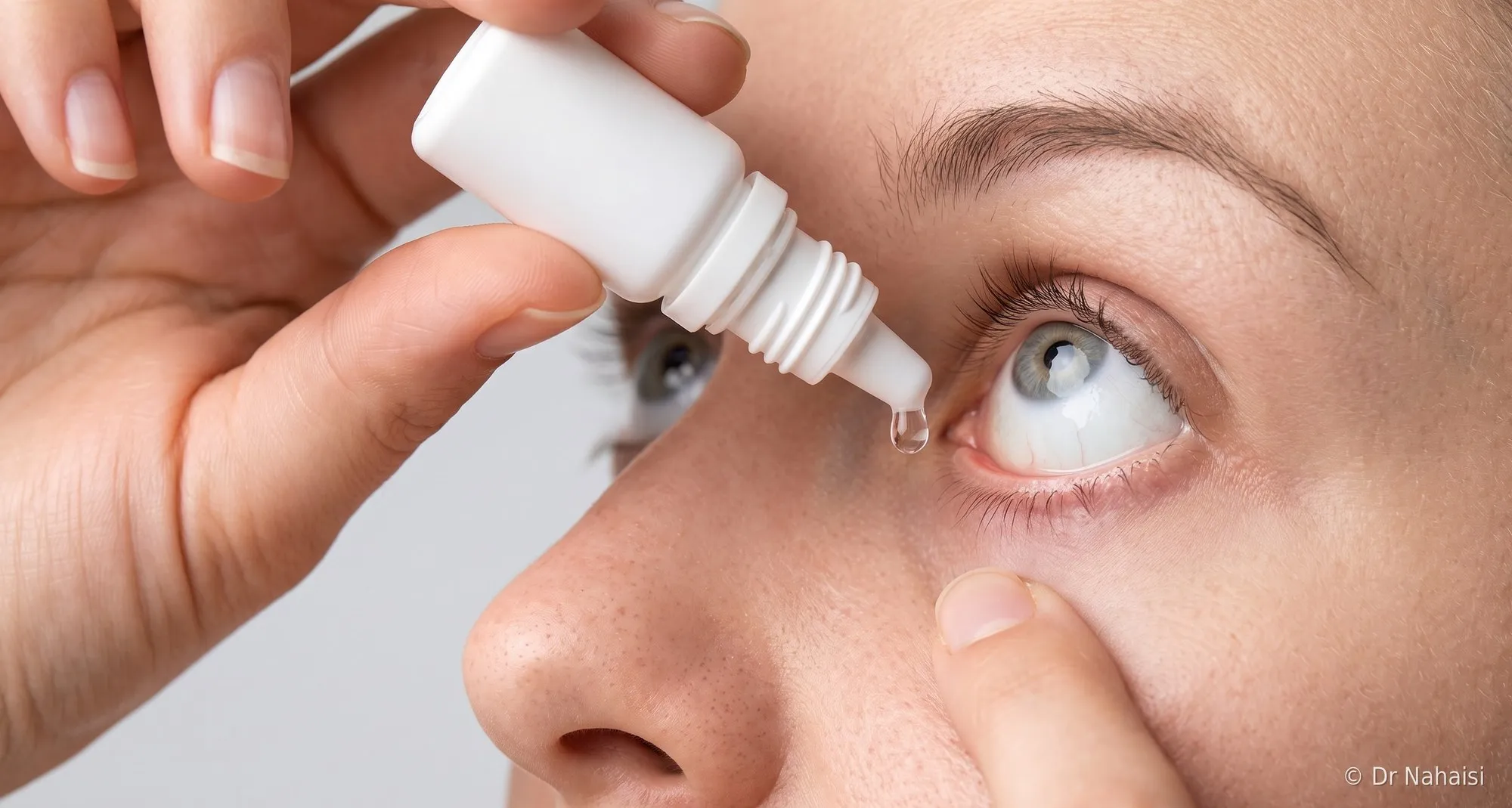
How to put in the drops. The finger pulls the lower eyelid down and opens the conjunctival sac, the drop forms at the tip of the bottle before falling, and the bottle touches neither the eye nor the eyelashes.
GETTING BACK TO YOUR LIFE
Timeline for resuming activities
| Activity | LASIK, SMILE, PresbyLASIK | TransPRK |
|---|---|---|
| Screens | Immediately | Immediately; your vision limits use for the first 3 days |
| Shower | The same evening, without aiming the shower head at your face for 3 days | The same evening, without water directly on your face for 3 days, or as long as the bandage contact lens is in place |
| Work | From the next day | About one week |
| Driving | Generally from the next day | End of the first week |
| Sports with no risk of trauma | From the next day | When your vision allows |
| Swimming with your head above water | After about 3 days | After about 3 days, once the bandage contact lens has been removed |
| Opening your eyes underwater | To be avoided for 2 weeks | To be avoided for 2 weeks |
| Swimming pool | 2 weeks | 2 weeks |
| Combat sports, ball sports | 3 weeks | 3 weeks |
| Swimming goggles | Not before 3 to 4 weeks; they press on the eye | Not before 3 to 4 weeks |
| Eyelid and eyelash makeup | Not before one week, and not the day before the procedure either | Not before one week, and not the day before the procedure either |
| Steam room, sauna | Not before 2 weeks | Not before 2 weeks |
| Sun | Sunglasses for comfort | Enhanced protection for 6 months |
| Flying | Possible from the next day | Possible, more comfortable after 3 to 4 days |
Sports
After LASIK, from the next day you can resume any sport with no risk of eye trauma: gym, weights, cycling, running, Pilates. What I call a high-risk sport is combat sports and sports where a ball or an elbow can hit you in the eye.
After TransPRK, your visual recovery sets the pace. As soon as your vision allows, sports with no risk of trauma are permitted.
For running outdoors in the first few days, a simple pair of sunglasses is enough, the idea being to keep dust or an insect from getting into the eye.
The swimming pool waits 2 weeks. Combat sports and ball sports require 3 weeks, because the risk is a blow, not the water.
On the flap and contact sports: the risk of displacement after LASIK exists, but it is exceptional. The reported cases involve very targeted trauma, a scratch from a fingernail, a blunt object, an accident. Diving is not a problem. In boxing, with gloves, the risk is in my view nonexistent. When a patient practices a contact sport intensively and prefers to avoid the flap variable, I offer TransPRK.
Water
Do not put water directly on your face for the first 3 days. After TransPRK, this is because of the bandage contact lens in place. After LASIK, it is mainly so you won't feel like rubbing your eyes.
You can wash your hair from the next day, with your head tilted slightly back. A calm swim, with your head above water, is possible again after about 3 days. Avoid opening your eyes underwater for 2 weeks. And if water gets into your eyes, it is nothing serious.
Screens and work
Screens are never forbidden, at any point. Looking at a screen is tiring, but it does not harm healing.
After LASIK or SMILE, you can go back to work the next day, with a tiring first week. Increase the font size, move your chair back, and look into the distance for 20 seconds every 20 minutes.
After TransPRK, it is your vision that limits you. Your phone is hard to use for the first 3 days, then it is blurry but manageable. When you go back to work after one week, there is still one week of discomfort.
In a dusty environment or one with exposure to chemicals, a pair of wide protective glasses generally allows you to go back to work the next day after LASIK.
Makeup
No eyelid or eyelash makeup for one week, whatever the technique, and not the day before the procedure either. This instruction is on your prescription. Eyelash extensions and false eyelashes wait for the same length of time. Makeup on the rest of the face is possible from the next day, and a moisturizing cream on the eyelids is no problem.
DRYNESS AND HALOS
Dry eye
This is the most common side effect. A gritty, sand-like sensation, stinging, eyes that feel tight at the end of the day or in front of a screen. It gradually resolves over a few weeks to a few months.
After LASIK, cutting the flap temporarily severs nerve fibers in the cornea. These nerves help control tear production, and they regenerate in 6 months on average. Comfort improves at the same pace. For a hyperopia correction, the flap is by definition wider, and dryness is often a little more pronounced.
After SMILE, the micro-incision severs fewer fibers, but in practice the sensation is the same. After TransPRK, there is no flap and therefore not this mechanism, but surface healing can cause moderate, temporary dryness. In the end, the discomfort is relatively similar with all three techniques.
Preservative-free artificial tears are the basis of treatment, in unlimited amounts. When the discomfort is more pronounced, I have other options: enhanced tears, gels, more specific surface treatments, punctal plugs that retain tears, and sometimes oral treatment in certain patients. I personally see every patient concerned again and adjust.
Dryness lasting several months is rare, and it eventually settles down. If you already had dry eye, blepharitis or a tendency to rosacea before surgery, we discuss it at the pre-operative consultation and treat it beforehand. It is one of the points I look at most carefully before recommending surgery.
The pre-operative assessment: what I am really looking for
Halos and night vision
Point light sources that look spread out or surrounded by a ring: headlights, streetlights, taillights. This is more pronounced at the end of the day, when the pupil dilates and a larger area of the cornea contributes to vision. It is also more pronounced after a high astigmatism, hyperopia or presbyopia correction.
Halos increase temporarily, peaking around the 2nd month, then gradually decrease. With large treatments, this decrease can take 4 to 6 months.
At 6 months and at one year, night vision is generally better than before the procedure. This makes sense for nearsighted or astigmatic patients: their refractive error already produced halos, often larger than the ones they describe after surgery. A clear difference between the two eyes generally corresponds to the eye that had the higher correction.
What helps: keeping the surface well moisturized, because an unstable tear film increases the spreading of lights. If halos still clearly bother you well after the procedure, we look at what is causing them at a consultation: a residual correction, dryness or incompletely treated astigmatism. There is almost always something that can be done.
FOLLOW-UP AND HOW TO REACH ME
Check-ups
I operate on Friday mornings at the Institut Voltaire, and I see you againthe following Monday afternoon, at my practice in the 19th arrondissement, rue Archereau. Sometimes on Wednesday at the Institut Voltaire or on Thursday in the 10th, or later depending on the technique and your constraints. The appointment is set on surgery day.
This check-up is short. I check the position of the flap after LASIK, the healing of the surface after TransPRK, the absence of inflammation, and I measure the acuity achieved. After TransPRK, this is also when the bandage contact lens is removed.
A check-up is then scheduled around the first month, then at 3 months and sometimes at 6 months. It is generally at one or two months that I prescribe, when useful, a small pair of resting glasses for screen work, once the residual error has stabilized. None of this is set in stone: if you need to see me between two appointments, you come in.
Unlimited follow-up, included
Post-operative follow-up is included in the fee for the procedure, with no limit on the number of consultations, including years later. Any enhancement is included in the first year, then offered at a preferential rate up to 5 years.
Fees, quotes and reimbursement
Reaching me
Phone and WhatsApp:01 84 80 28 04 · Email:nahaisi@laservisionparis.com · Doctolib messaging
WhatsApp is often the easiest. You write, you attach a photo of your eye if needed, and I answer you myself, including in the evening and on weekends.
Outside the practice's opening hours, the address on your prescription is that of the ophthalmic emergency department of Cochin Hospital, 27 rue du Faubourg Saint-Jacques, 01 58 42 23 00.
Frequently asked questions
RECOVERY FAQ
Does it hurt after laser refractive surgery?
Pain after laser refractive surgery depends on the technique. After LASIK, SMILE or PresbyLASIK, there is no pain strictly speaking: the eyes sting, water and are sensitive to light for 4 to 6 hours, then everything settles down after a nap. After TransPRK, surface healing is genuinely uncomfortable for 48 to 72 hours, sometimes with real pain during the first two days. I systematically prescribe painkillers for this period, and the bandage contact lens placed at the end of the procedure reduces the sensations.
My eyes sting in the hours after laser eye surgery. Is that normal?
Yes, stinging in the hours following laser refractive surgery is normal. Your eyes sting because you have just had surgery, not because of the drops or a problem with the treatment. This discomfort settles within 4 to 5 hours, and it passes during the afternoon nap. Rest with your eyes closed: by the end of the day, you will feel much better.
When will I see clearly after LASIK, SMILE or TransPRK?
How long visual recovery takes after refractive surgery depends on the technique. After LASIK, SMILE or PresbyLASIK, vision is often already good the same evening, through a slight veil that clears over a few days. After TransPRK, expect 20 to 30% of your acuity on Day 3, about 70% between Day 7 and Day 10, 90% at one month, and 100% between the 2nd and the 3rd month. In all cases, the final result is assessed between 1 and 3 months after the procedure.
My vision has been fluctuating from one day to the next since my eye surgery. Is that normal?
Yes, fluctuating vision is the rule during the first month following laser refractive surgery. It improves, dips a little, improves again, sometimes with clear differences from one eye to the other. Three causes add up: surface dryness, eye strain due to the new optics, and the step-by-step tapering of the anti-inflammatory eye drop. There is nothing special to do, and if it worries you, come in for a check-up.
My eye is red with burst blood vessels after laser surgery. Is it serious?
No. A red white of the eye with red patches in the days following refractive surgery corresponds to small superficial blood vessels that have bled due to the pressure applied during the procedure. It has no consequences, apart from appearance. The redness often increases over the first 2 to 3 days, then clears over about two weeks. If bleeding of this kind appears spontaneously months after the surgery, it is generally not related to the surgery, and I advise having your blood pressure checked by your primary care physician.
When can I go back to work after laser refractive surgery?
You can go back to work the day after LASIK, SMILE or PresbyLASIK, screens included, with a tiring first week. After TransPRK, expect rather 7 to 10 days, and plan for another week of discomfort after returning. I prescribe a sick note on a case-by-case basis; ask for it on surgery day.
Are screens forbidden after laser eye surgery?
No, screens are not forbidden at any point after laser refractive surgery. Looking at them tires the eyes, but it does not harm healing. After LASIK or SMILE, increase the font size and take breaks during the first week: 20 seconds of looking into the distance every 20 minutes. After TransPRK, it is your vision that will limit you for the first 3 days, not an instruction.
When can I drive again after LASIK, SMILE or TransPRK?
You do not drive on the day of the procedure, because the tablet taken before surgery makes you drowsy and your vision is not yet good enough. After that, driving is generally possible again from the next day after LASIK, SMILE or PresbyLASIK, and at the end of the first week after TransPRK. You are the final judge: if you are not comfortable behind the wheel, you wait one more day. When driving at night, slight discomfort due to halos is possible in the first few weeks.
When can I get back to sports after refractive surgery?
Getting back to sports after refractive surgery depends on the sport and the technique. After LASIK, SMILE or PresbyLASIK, from the next day you can resume any sport with no risk of eye trauma: gym, weights, cycling, running, Pilates. After TransPRK, your visual recovery sets the pace. The swimming pool waits 2 weeks whatever the technique, combat sports and ball sports 3 weeks. If you run outdoors in the first few days, wear a pair of sunglasses to keep dust or an insect from getting into the eye.
I box. Could I displace my LASIK flap?
The risk of flap displacement exists after LASIK, but it is exceptional. The reported cases involve very targeted trauma: a scratch from a fingernail, a blunt object, an accident. In boxing, with gloves, the risk is in my view nonexistent, and diving is not a problem. If you practice a contact sport intensively and would prefer to have no flap at all, I offer you TransPRK, which does not create one. We discuss it at the consultation.
Can I shower and wash my hair after laser eye surgery?
You can shower from the evening of the procedure, whatever the technique. Simply avoid aiming the shower head directly at your face for the first 3 days, and instead wash your face with wet hands, going around the eyes. After TransPRK, this precaution applies as long as the bandage contact lens is in place. You can wash your hair from the next day, with your head tilted slightly back. And if a little water gets into the eye, it is nothing serious.
When can I go swimming or go back to the pool after laser eye surgery?
After laser refractive surgery, a calm swim, with your head above water, is possible again after about 3 days, and after the bandage contact lens has been removed in the case of TransPRK. The swimming pool waits 2 weeks; this is the timeframe written on your prescription, and it also applies to the sea with your head underwater. Avoid opening your eyes underwater for the same length of time. Swimming goggles should not be worn again before 3 to 4 weeks, because they press on the eyes. Steam room and sauna: not before 2 weeks.
When can I wear eye makeup again after refractive surgery?
No eyelid or eyelash makeup during the week following the procedure, whatever the technique, including eyelash extensions and false eyelashes. You should also avoid it the day before surgery. This instruction is on your prescription. Makeup on the rest of the face is possible from the day after the procedure, and a moisturizing cream on the eyelids is no problem.
How long do I need to wear the protective eye shields at night after LASIK?
The protective eye shields are worn for the first 3 nights, and only after LASIK. They prevent accidental rubbing during sleep, and they are secured with the Micropore tape provided on surgery day. You can sleep on your side, they are designed for that; they just need to be well secured. There are no eye shields to wear after SMILE or after TransPRK. After these three nights, simply avoid sleeping with your hand or elbow under your eye.
I forgot a drop of my eye drops after surgery, or I would like to stop the treatment early: is that possible?
A single missed dose or a delay of an hour or two in the post-operative treatment does not compromise anything: you resume the schedule at the next dose, without doubling it. However, you complete all the steps of the antibiotic and corticosteroid eye drop, even if everything is fine before the end, and you do not continue it beyond them either, because a corticosteroid continued for too long can raise the pressure inside the eye. Artificial tears, on the other hand, can be continued freely, for as long as you need them. If in doubt, write to me before changing anything.
How long does dry eye last after LASIK, SMILE or TransPRK?
Dry eye after refractive surgery lasts a few weeks to a few months depending on the patient. After LASIK, the nerve fibers severed when the flap is cut regenerate in 6 months on average, and comfort improves at the same pace. After SMILE or TransPRK, the mechanism is different, but the sensation felt is ultimately quite similar. Cases lasting beyond several months are rare and eventually settle down. Preservative-free artificial tears are the basis of treatment, in unlimited amounts, and when the discomfort is pronounced I have several other options to offer.
Will halos go away after laser refractive surgery?
Halos after refractive surgery first increase, peaking around the 2nd month, then gradually decrease, sometimes over 4 to 6 months for large treatments. At 6 months and at one year, night vision is generally better than before the procedure. Patients who had high myopia or high astigmatism see more pronounced halos at first, because their refractive error already produced a lot of them. Keeping the surface well moisturized helps, because an unstable tear film increases the spreading of lights.
When should I seek urgent care after laser eye surgery?
Two situations require a prompt consultation after refractive surgery, and they are written on your prescription: a sudden drop in visual acuity, and severe eye pain beyond the first 3 days after TransPRK or beyond the first 24 hours after LASIK or SMILE. Pain during the first two days after TransPRK, on the other hand, is normal and is treated with the prescribed painkillers. To reach me: phone and WhatsApp at 01 84 80 28 04, including in the evening and on weekends. Outside the practice's opening hours, go to the ophthalmic emergency department of Cochin Hospital, 27 rue du Faubourg Saint-Jacques, 01 58 42 23 00, and let me know at the same time.
BOOK AN APPOINTMENT
You do not need a referral letter, a prescription, or a prior visit to another ophthalmologist to come and see me. The consultation is at the standard rate set by French national health insurance with no fee supplement at my practices in the 10th and 19th, with nothing to pay upfront (direct billing). At the Institut Voltaire, in the 11th, you pay €50 upfront, including a €30 fee supplement that your complementary health insurance reimburses at least €20 of, and often in full.
- Institut Laser Ophtalmologique Voltaire : 5 rue La Vacquerie, 75011 Paris. Consultations on Wednesday afternoons, surgery on Friday mornings, sometimes on Wednesday afternoons. Metro Voltaire (line 9) and Philippe Auguste (line 2).
- 19th arrondissement practice : 37 rue Archereau, 75019 Paris. Consultations on Monday afternoons, and post-operative check-ups. Metro Crimée (line 7).
- 10th arrondissement practice : 12 rue du Faubourg Saint-Martin, 75010 Paris. Consultations on Thursday afternoons. Metro Strasbourg Saint-Denis (lines 4, 8, 9).
Phone and WhatsApp:01 84 80 28 04 · Email:nahaisi@laservisionparis.com · Doctolib messaging
Book an appointment on Doctolib
Download the information booklet (PDF)
“I don’t operate on eyes, I operate on patients.”
Dr Steven Nahaisi, ophthalmic surgeon in Paris, specialist in laser refractive surgery.
Author: Dr Steven Nahaisi, ophthalmic surgeon, specialist in laser refractive surgery, Institut Laser Ophtalmologique Voltaire, Paris 11th.
Your surgeon
Dr Steven Nahaisi
Ophthalmic surgeon dedicated exclusively to laser refractive surgery. He operates at the Institut Laser Ophtalmologique Voltaire and consults in three Paris offices. Consultations in English.